

How a bank failure works
A bank fails when its chartering authority, a state regulator or the Office of the Comptroller of the Currency for national banks, closes it, usually because capital is depleted or it cannot meet withdrawals. The regulator appoints the Federal Deposit Insurance Corporation as receiver. Closures commonly happen on a Friday so the FDIC can reopen branches under a new owner the next business day.
The FDIC then resolves the bank in one of a few ways:
| Method | What happens | Effect on old shareholders |
|---|---|---|
| Purchase and assumption | Another bank buys assets and assumes deposits from the receivership | No recovery; the buyer pays the receiver |
| Bridge bank | FDIC runs a temporary bank while it finds a buyer | No recovery |
| Deposit payoff | FDIC pays insured depositors directly and liquidates assets | No recovery |
| Open bank assistance (rare) | Help given before closure, under strict conditions | Usually heavy dilution or loss |
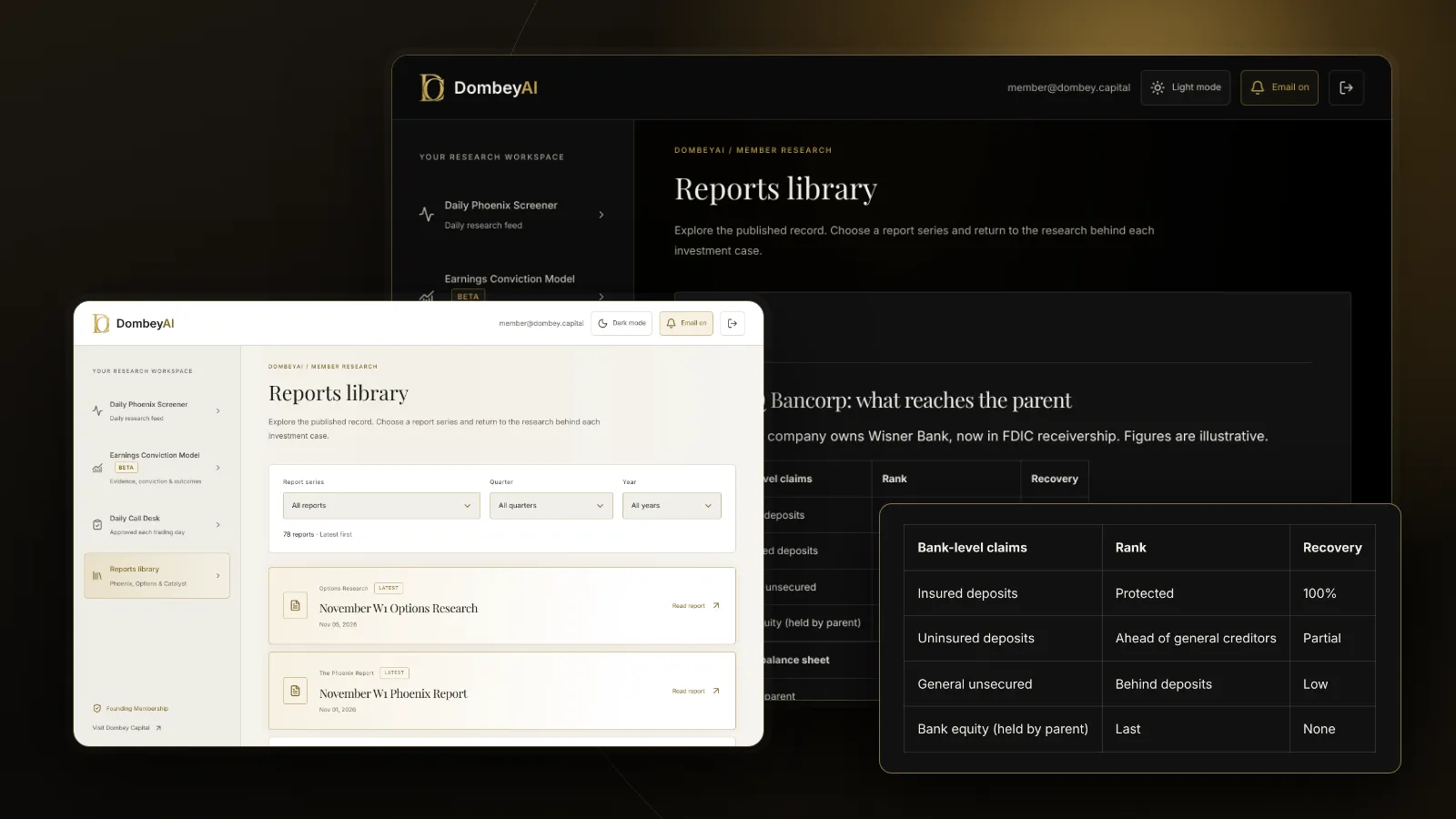
In each case, the receiver sells the failed bank's assets and pays claims in a set order. Federal law gives deposits priority over general unsecured creditors in a bank receivership, and shareholders come after everyone else.
The holding company problem
Most banks traded on an exchange are owned by a bank holding company. The holding company is the listed entity; it owns the bank's shares.
When the bank fails, the holding company does not go into FDIC receivership. It loses its main asset, because the bank's equity now belongs to the receivership process and is effectively worthless. What is left at the holding company is usually some cash, possibly a few non-bank subsidiaries, and its own debts, such as senior notes, subordinated notes or trust preferred securities.
Holding companies in this position often file for Chapter 11 or Chapter 7. The usual bankruptcy rules then apply, which what happens to stock in Chapter 11 bankruptcy explains: creditors first, equity last.
Sometimes a holding company has real value left, such as a large tax asset, cash held at the parent or claims against the FDIC over specific funds. These cases are uncommon and can take years in court.
What deposit insurance covers and what it does not
FDIC deposit insurance covers deposits up to $250,000 per depositor, per insured bank, for each account ownership category. That is the protection for customers.
It does not cover:
- Common or preferred stock of the bank or its holding company.
- Bonds, notes or trust preferred securities issued by either.
- Mutual funds, annuities or securities bought through the bank.
Uninsured depositors, those above the limit, become claimants in the receivership and may recover part of their excess balance from asset sales. Shareholders stand behind them.
Warning signs before a failure
Bank failures rarely come without warning in public data. A checklist:
| What to check | Why it matters | Where to find it |
|---|---|---|
| Tangible common equity vs tangible assets | Thin equity absorbs little loss | Quarterly filings, call reports |
| Unrealized losses on securities | Can exceed equity if marked to market | Securities footnote in the 10-Q |
| Uninsured and brokered deposits | Run risk if confidence breaks | Deposit disclosures, call reports |
| Deposit outflows quarter on quarter | Shows a run in progress | Balance sheet trend |
| Loan losses and nonperforming assets | Erodes capital | Asset quality tables |
| Enforcement actions | Regulator concern made public | Federal Reserve, OCC, FDIC sites |
| Going concern language | Auditor doubts survival | Holding company 10-K |
Our guide on how to value a bank stock covers capital and asset quality in more depth, and tangible book value explains the measure that matters most. A going concern warning at a bank holding company is a late sign, but a serious one.
How a run turns into a failure
Most recent bank failures followed a similar path, and the stages are visible in public data.
- A loss that eats capital. Rising interest rates can leave a bank holding long-dated bonds worth less than it paid. Credit losses on loans do the same. If those losses approach the bank's tangible equity, depositors and investors start to ask whether the bank is solvent.
- A concentrated deposit base. Banks that rely on a small number of large, uninsured depositors are more exposed, because those depositors have the most to lose and can move money quickly.
- A trigger. A capital raise that fails, a ratings action, a large reported loss or news about a peer can start withdrawals.
- A run. Withdrawals force the bank to borrow or sell assets. Selling bonds at a loss turns unrealized losses into realized ones and depletes capital further.
- Closure. If the bank cannot meet withdrawals or capital falls too far, the regulator closes it.
Steps one and two can be seen in quarterly filings well before any trouble. Steps three to five can happen in days, which is why waiting for the next report is rarely an option for shareholders.
Trading around a failure
After a failure is announced, the holding company's shares are usually halted, then delisted, a process covered in what a delisting means for shareholders. The shares may trade over the counter for pennies. Those prices reflect speculation, short covering or hopes of litigation, not a likely payout.
- If the bank has failed and the holding company has little besides the bank, assume equity is worthless.
- If the holding company has large cash or other assets at the parent, compare them with the parent's own debts before assuming any value.
- If the bank is still open but weak, the question is whether it raises capital, sells itself or fails. A capital raise at a deep discount can still dilute existing holders heavily.
- If a stronger bank agrees to buy a weak one before failure, shareholders may get something, usually far less than book value.
Where this goes wrong
- Buying a collapsing bank stock as cheap on book. Book value can disappear in days when deposits run and assets must be sold at a loss. Price to book is a poor guide in a crisis, a classic value trap.
- Confusing deposit insurance with investor protection. Insurance protects depositors, not shareholders or bondholders.
- Ignoring the holding company structure. The listed entity is the parent. Its recovery depends on its own assets and debts.
- Waiting for the filings. Quarterly reports lag. In a run, the bank can fail between reports.
- Reading OTC prices as a recovery estimate. Thin trading after delisting says little about value.
Not every bank special situation is a failure. Thrift conversions, covered in what is a mutual bank conversion, are a very different case, often with well-capitalized banks trading below book. For services that cover distressed and special situations, see the best investing newsletters for special situations.
The bottom line
When a bank fails, the FDIC takes control as receiver, protects insured deposits and sells the bank's assets, and shareholders stand last in line. The listed holding company loses its main asset and often ends up in bankruptcy, with its own creditors ahead of its shareholders. Deposit insurance never covers stock or holding company debt. The time to assess the risk is before the failure, through capital, unrealized losses, deposit trends and regulatory actions.