

How a prepack works
The sequence is short and mostly happens before anyone goes to court.
- Negotiation. The company and an ad hoc group of its main lenders or bondholders agree terms, usually recorded in a restructuring support agreement (RSA). Signatories commit to vote for the plan.
- Solicitation. The company sends the plan and a disclosure statement to the classes that will vote, typically the funded debt classes, and sets a voting deadline.
- Filing. Once the votes are counted and the required majorities are reached, the company files for Chapter 11 with the plan and voting results.
- Combined hearing. The court considers the adequacy of the disclosure statement and confirmation of the plan together.
- Emergence. The plan takes effect, old securities are cancelled or reinstated as the plan provides, and new securities are issued.
The Bankruptcy Code allows votes collected before the filing to count, provided the solicitation complied with applicable non-bankruptcy law, such as securities law, or the disclosure was adequate. That rule is what makes a prepack possible.
The voting thresholds
A class of claims accepts a plan when creditors holding at least two-thirds in amount and more than one-half in number of the allowed claims that vote accept it. Only votes cast count; creditors who do not vote are not counted against the plan.
Two other rules matter:
- Unimpaired classes are deemed to accept. If a plan pays a class in full or leaves its rights unchanged, that class does not vote. Prepacks often leave trade creditors unimpaired for this reason.
- Classes that receive nothing are deemed to reject. Old equity that is cancelled with no recovery does not vote. The plan can still be confirmed over its rejection through the cram-down provisions, if the plan meets the Code's fairness tests.
The thresholds are why a prepack can bind holdouts. In an out-of-court exchange offer, a bondholder who does not participate keeps its old bond. In a confirmed plan, every member of an accepting class is bound.
Quick reference: three paths through a debt problem
| Path | Votes collected | Court involvement | Typical length | Binds holdouts |
|---|---|---|---|---|
| Out-of-court exchange or liability management exercise | Consent of participating holders | None | Weeks | No |
| Prepackaged Chapter 11 | Before filing | Combined hearing | Often weeks to two months | Yes, within accepting classes |
| Prenegotiated Chapter 11 | After filing, with RSA support | Separate disclosure and confirmation hearings | Several months | Yes |
| Contested ("free-fall") Chapter 11 | After filing, often after litigation | Full case | Often a year or more | Yes, if confirmed |
What happens to shareholders
The plan decides recoveries by priority. Secured debt is paid or reinstated first, then unsecured claims, then equity. In most prepacks, the funded debt is converted into the new equity, which leaves little or nothing for old shareholders.
Common outcomes for old equity:
- Cancelled with no recovery. The most frequent outcome when the company's value is below its debt.
- A small stake and warrants. Sometimes offered to secure a quick confirmation without objections, typically a low single-digit percentage of the new equity plus warrants struck well above the plan value.
- Reinstated. Rare, and usually only when the restructuring touches one tranche of debt and the business is worth more than all claims.
Our explainer on what happens to stock in Chapter 11 covers the priority rules in more detail. Holders who see a stock still trading after a prepack filing should read the plan's treatment of the equity class before anything else.
Worked example
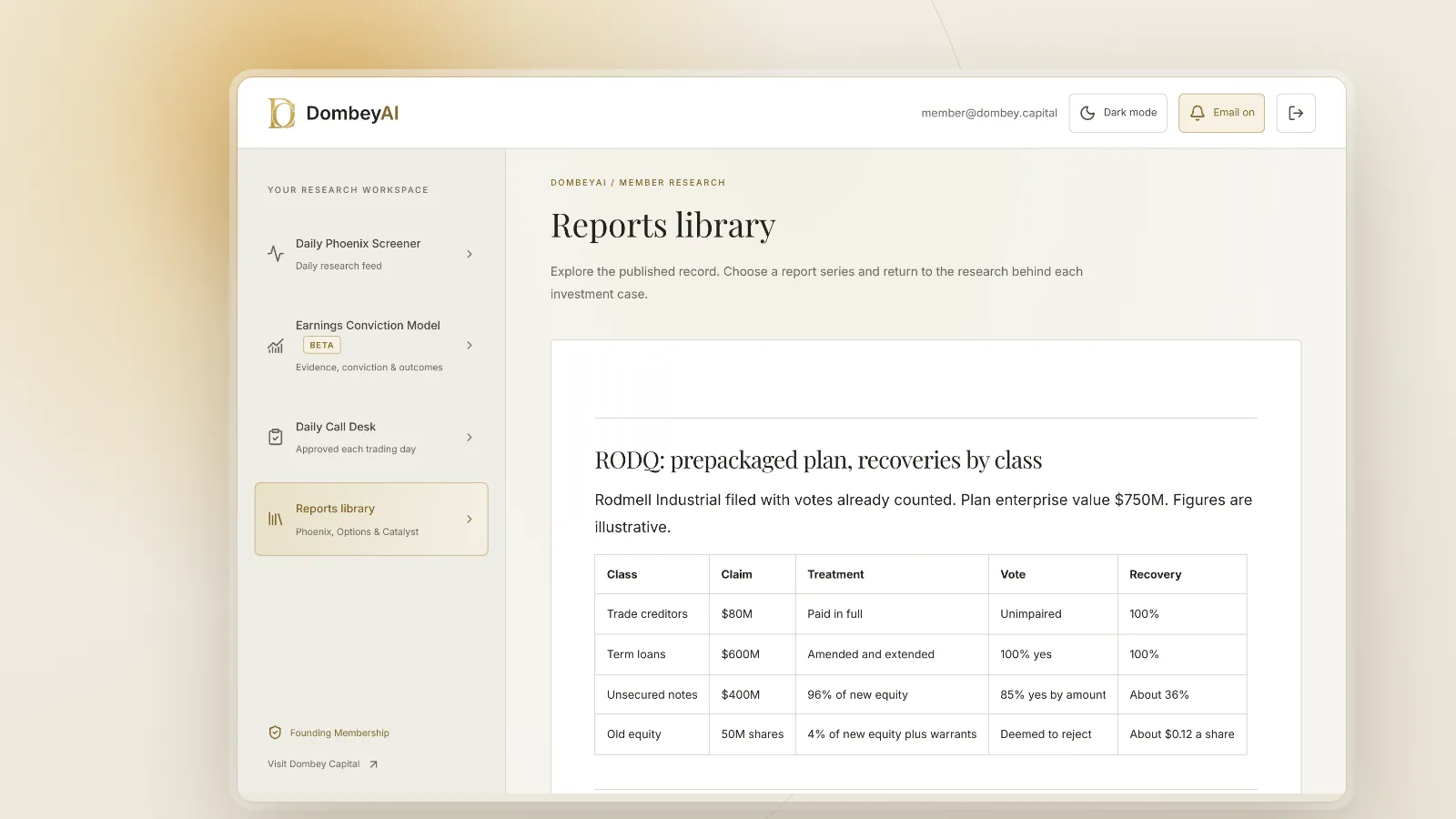
| Class | Claim | Treatment under the prepack plan | Recovery |
|---|---|---|---|
| Trade creditors | $80 million | Paid in full in the ordinary course | 100%, unimpaired |
| Secured term loans | $600 million | Amended and extended, $600 million new term loan | 100% |
| Unsecured notes | $400 million | 96% of new equity | About 36% (equity value about $150 million) |
| Old shareholders | 50 million shares | 4% of new equity plus warrants | About $6 million in equity, or $0.12 a share before warrants |
The noteholders approved the plan before filing, with holders of 85% of the notes by amount voting yes. The term lenders also voted yes. The trade creditors were not asked to vote because they are paid in full. Old shareholders are offered 4% and warrants to avoid an objection.
The arithmetic is the same as a debt-for-equity swap: the new equity is the enterprise value left after the debt that survives, split among the classes that receive it. The key input is the plan's enterprise value, which appears in the disclosure statement's valuation analysis.
Why companies and creditors choose a prepack
A prepack is a negotiated outcome, so it happens when both sides gain from speed.
For the company, a short case limits the damage that bankruptcy does to the business. Customers worry less about a supplier that will be in court for six weeks than one facing a year. Employees are paid as usual, and suppliers who are unimpaired have little reason to change terms. Professional fees, which can run to large sums in a long case, are much lower.
For creditors, a prepack locks in a recovery and avoids a long fight over value. Lenders who take the new equity get control of a business that has not been weakened by a drawn-out case.
For both, the court process solves the holdout problem. An out-of-court exchange depends on each holder agreeing. A small group that refuses can keep its old claims while others take a haircut, which makes everyone less willing to participate. A confirmed plan binds every member of a class that accepts by the required majorities.
The cost is that some constituencies have little say. Old shareholders, and sometimes junior creditors, learn their treatment when the case is filed, and the timeline leaves limited room to contest it. That is why objections in prepacks often focus on the valuation and on the releases.
Reading a prepack filing
Most of what an investor needs is filed on the first day:
- The RSA. Who signed, what they hold, and the milestones the company must meet.
- The disclosure statement. Classes, treatment, recovery estimates, the valuation analysis and the liquidation analysis. Our guide to reading a Chapter 11 disclosure statement walks through each section.
- Voting results. The declaration of the voting agent showing acceptance by amount and number in each class.
- First-day motions. Requests to pay wages, critical vendors and to approve DIP financing, if any.
For sources that track these filings, see our list of the best bankruptcy and restructuring research sources.
Where this goes wrong
Objections slow the case. A creditor or shareholder group can object to the disclosure, the valuation or releases in the plan. Objections rarely stop a well-supported prepack, but they can delay it and raise costs.
The valuation is too low or too high. The plan's enterprise value decides how much each class receives. A low value transfers more of the company to creditors; a high one can leave the new company over-levered. Post-emergence equity often trades away from the plan value, as our explainer on post-bankruptcy equities covers.
Releases attract scrutiny. Plans often release claims against directors, officers and sponsors. Courts have become stricter on non-consensual third-party releases, and a contested release can hold up confirmation.
The business problem is not only debt. A prepack fixes the balance sheet. If the company has an operating problem, such as falling demand or high costs, it can return to distress after emergence.
The bottom line
A prepackaged bankruptcy is a Chapter 11 case with the votes already counted, which lets the court confirm the plan quickly and bind holdouts within each accepting class. The structure protects the operating business by restructuring funded debt and leaving trade claims alone. For old shareholders the plan usually means cancellation or a small stake, and the documents filed on day one show which. For services that follow restructurings and other special situations, see our list of the best investing newsletters for special situations.