

How MLPs are structured
A master limited partnership is a publicly traded partnership. Under Section 7704 of the tax code, most such partnerships are taxed as corporations, but those earning mostly qualifying income, such as from transporting, processing or storing oil, gas and other natural resources, can stay pass-through entities. That is why MLPs cluster in energy infrastructure.
A typical structure has:
- A general partner (GP) that manages the partnership, controlled by the sponsor.
- Limited partner units held by the public and often by the sponsor.
- Incentive distribution rights (IDRs) in older structures, which gave the GP a rising share of distributions above set levels. Many sponsors have since eliminated them.
The partnership agreement, not corporate law, sets most of the rules. Delaware law lets partnerships narrow or replace the fiduciary duties that would apply to a corporate board, so the agreement may instead require that conflicted transactions be approved by a conflicts committee or meet a contractual "good faith" standard.
Why sponsors roll up their MLPs
- Simplification. Two public companies, two sets of filings and IDR payments make a complex structure that some investors avoid.
- Cost of capital. When MLP units trade at high yields, issuing new units to fund growth becomes expensive. Owning the cash flow outright may be cheaper.
- Policy changes. In 2018, a change in federal energy regulatory policy on income tax allowances for pipeline partnerships reduced the benefit of the MLP form for some interstate pipelines and was followed by a wave of roll-ups.
- Tax rate changes. The 2017 cut in the corporate tax rate narrowed the gap between partnership and corporate taxation.
- Low unit price. A sponsor that thinks the units are undervalued may see a buyout as a good use of capital.
The last reason is the one public holders should watch. The sponsor knows the business better than anyone and chooses the timing.
How a roll-up is priced and approved
The process usually runs like this:
- The sponsor makes a proposal, often at a modest premium to the recent unit price.
- The partnership's board forms a conflicts committee of directors independent of the sponsor, which hires its own financial and legal advisers.
- The committee negotiates and, if it agrees, approves the deal, often with a fairness opinion.
- Unitholders vote or give written consent, as the partnership agreement requires.
- The deal closes, and the units are delisted.
| Feature | Corporate buyout by a controlling holder | Typical MLP roll-up |
|---|---|---|
| Duties owed to minority | Fiduciary duties, often with entire fairness review | Often contractual standards set by the partnership agreement |
| Negotiator for minority | Special committee | Conflicts committee |
| Minority vote condition | Common, to gain deference from courts | Sometimes included, often not |
| Appraisal rights | Usually available in a cash merger | Usually not available |
| Squeeze-out route | Short-form merger above 90% ownership | Limited call right, often at 80% or more |
| Tax to holder | Capital gain or loss | Taxable, with possible ordinary income from recapture |
For a broader look at controlling holder buyouts, see our explainer on the squeeze-out merger.
Worked example
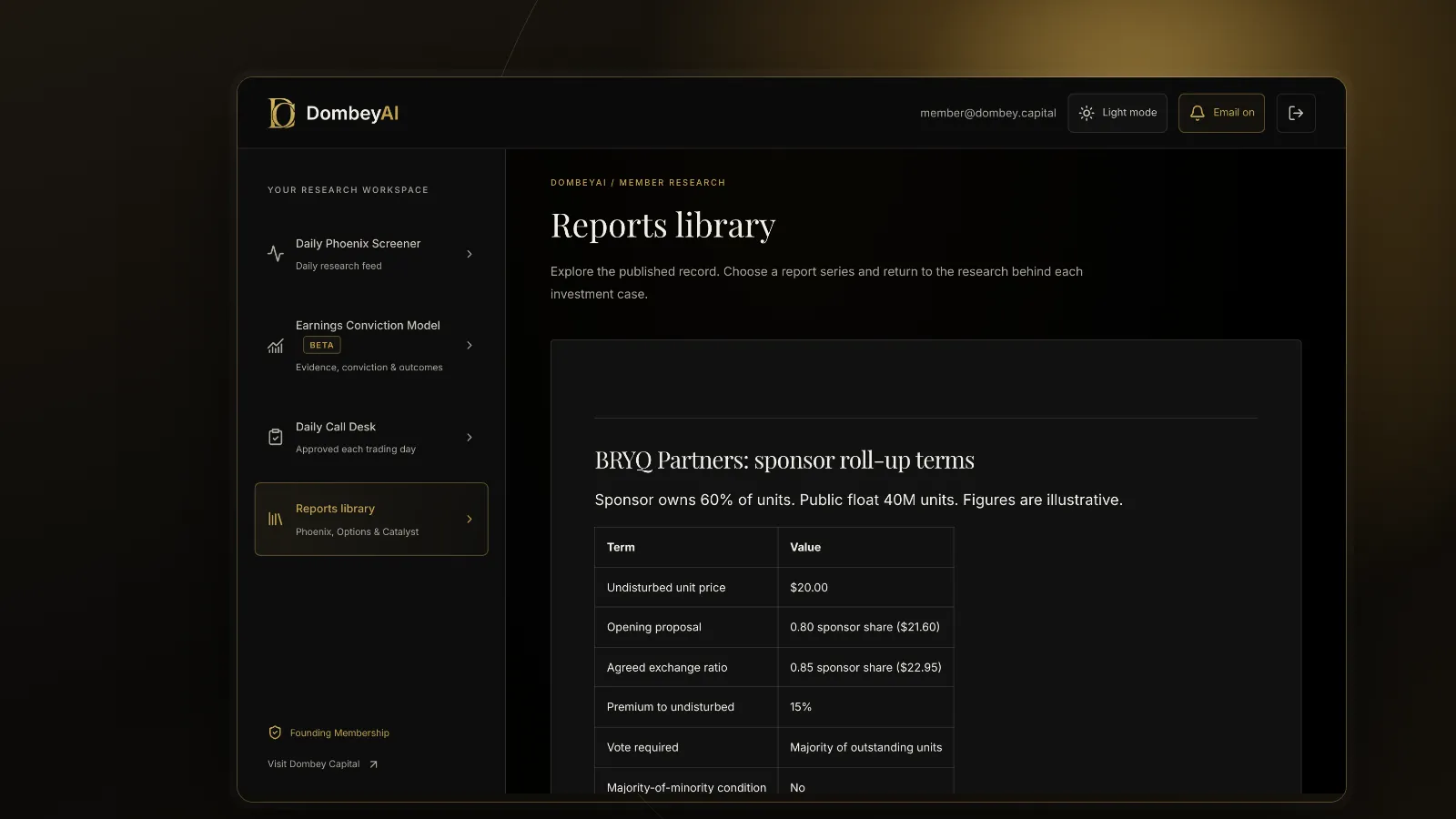
The sponsor proposes 0.80 of its own share for each unit, worth $21.60 with its stock at $27, an 8% premium. The conflicts committee negotiates the ratio up to 0.85, worth $22.95, about 15% above the undisturbed price.
The partnership agreement requires a majority of outstanding units to approve. The sponsor's 60% is enough, so the vote is assured. There is no majority-of-minority condition.
A unitholder who bought at $30 three years ago now looks at the after-tax result. Distributions received over those years reduced her tax basis to $24. The exchange into the sponsor's shares is taxable. Her gain is about $22.95 minus $24, a small loss on paper, but part of her earlier deductions are recaptured as ordinary income, so she may owe tax even though the units are worth less than she paid. A holder with a lower basis has a larger gain, part of it taxed at ordinary rates.
The example shows the two things that matter most: whether the vote is a formality, and the after-tax value, which can be very different from the headline premium.
The limited call right
Many partnership agreements give the general partner and its affiliates a right to buy all remaining public units once they own a set percentage, frequently 80% or more. The price follows a formula in the agreement, often the higher of a recent average trading price and the highest price the GP paid for units over a look-back period.
Holders cannot vote against a call or seek appraisal. If the sponsor is near the threshold, it may be able to buy units in the market or through a smaller deal and then call the rest. Read the agreement's call provision to see the threshold and the formula, and check the sponsor's ownership in the latest proxy statement or annual report.
What to read
- The proposal letter, filed with the SEC as an exhibit to a 13D amendment or an 8-K, which shows the opening price and any conditions.
- The proxy statement or consent solicitation, which has the "background of the merger" section, the conflicts committee's process and the financial analyses behind the fairness opinion.
- The partnership agreement, for the approval standard, voting thresholds and the limited call right.
- The tax section of the deal documents, which describes how the exchange is treated and the recapture issue.
How to think about the premium
A roll-up premium is not the same as a takeover premium from an arm's-length buyer. The sponsor is buying from investors who cannot easily say no, at a time it chooses. The conflicts committee can push the price up, as in the example, but its leverage is limited if the sponsor already controls the vote.
Compare the offer with the partnership's distributable cash flow, its debt, the valuation of similar companies and the analyses in the fairness opinion. If the exchange is in the sponsor's stock, the value depends on that stock as well; our explainer on exchange ratios covers how fixed ratios move with the acquirer's price. Some roll-ups are close to take-unders once the lost distributions and tax are counted. Other situations of this kind are covered in our list of the best investing newsletters for special situations.
Where this goes wrong
Expecting a bump. In arm's-length deals, a competing bid or holder pressure can raise the price. In a roll-up, the sponsor is usually the only plausible buyer, and if it controls the vote, holders have little leverage.
Ignoring the tax. The after-tax value can be well below the headline price, especially for long-term holders with low tax basis.
Missing the call right. A sponsor near the call threshold can take out remaining holders at a formula price that may be lower than a negotiated deal.
Reading the premium against a depressed price. If the units fell before the proposal, a 15% premium may still be below what holders paid or what the cash flows support.
Assuming litigation will help. Courts generally apply the partnership agreement's contractual standards, which can be harder for holders to meet than corporate fiduciary duties.
The bottom line
An MLP roll-up is a sponsor buying out the public units of a partnership it already controls. The partnership agreement, not corporate law, sets the protections, and holders often have no appraisal rights and no blocking vote. A conflicts committee is the main check on price, and a limited call right can let the sponsor take the remaining units at a formula price. Read the agreement, the proxy and the tax section, and judge the offer on after-tax value rather than the headline premium.