

Why the question arose
Before 2019, operating leases stayed off the balance sheet. Analysts who wanted to treat them as debt capitalized them by hand, often by multiplying annual rent by a fixed factor. The new standards changed that:
- ASC 842 (US GAAP) put a right-of-use asset and a lease liability on the balance sheet for most leases longer than 12 months. Public companies adopted it for fiscal years beginning after December 15, 2018. The income statement did not change for operating leases: a single straight-line lease cost, inside operating expenses.
- IFRS 16 went further. Nearly all leases are treated like financed purchases, with depreciation of the asset and interest on the liability. The lease cost moved below EBITDA.
So the balance sheets now look similar, but the income statements do not. That difference drives the whole question. Our explainer on enterprise value covers the base formula.
The consistency rule
Enterprise value is the value of the claims on a company's operating assets. The earnings measure must be the income available to those same claims. If lease holders are counted as claimants in enterprise value, their payments must be excluded from the earnings measure.
| Accounting | Earnings measure | Lease cost is | Lease liabilities in EV? |
|---|---|---|---|
| US GAAP | EBITDA | Deducted inside operating expenses | No |
| US GAAP | EBITDAR (EBITDA plus operating lease cost) | Added back | Yes |
| IFRS 16 | EBITDA | Below EBITDA, as depreciation and interest | Yes |
| IFRS 16 | EBITDA less lease payments | Deducted | No |
| Either | EBIT | Partly deducted (depreciation or lease cost) | Depends; adjust the interest component |
The fourth row is sometimes called "pre-IFRS 16 EBITDA" and many IFRS reporters disclose it to help comparison with US peers.
A worked example
| Method | Enterprise value | Earnings | Multiple |
|---|---|---|---|
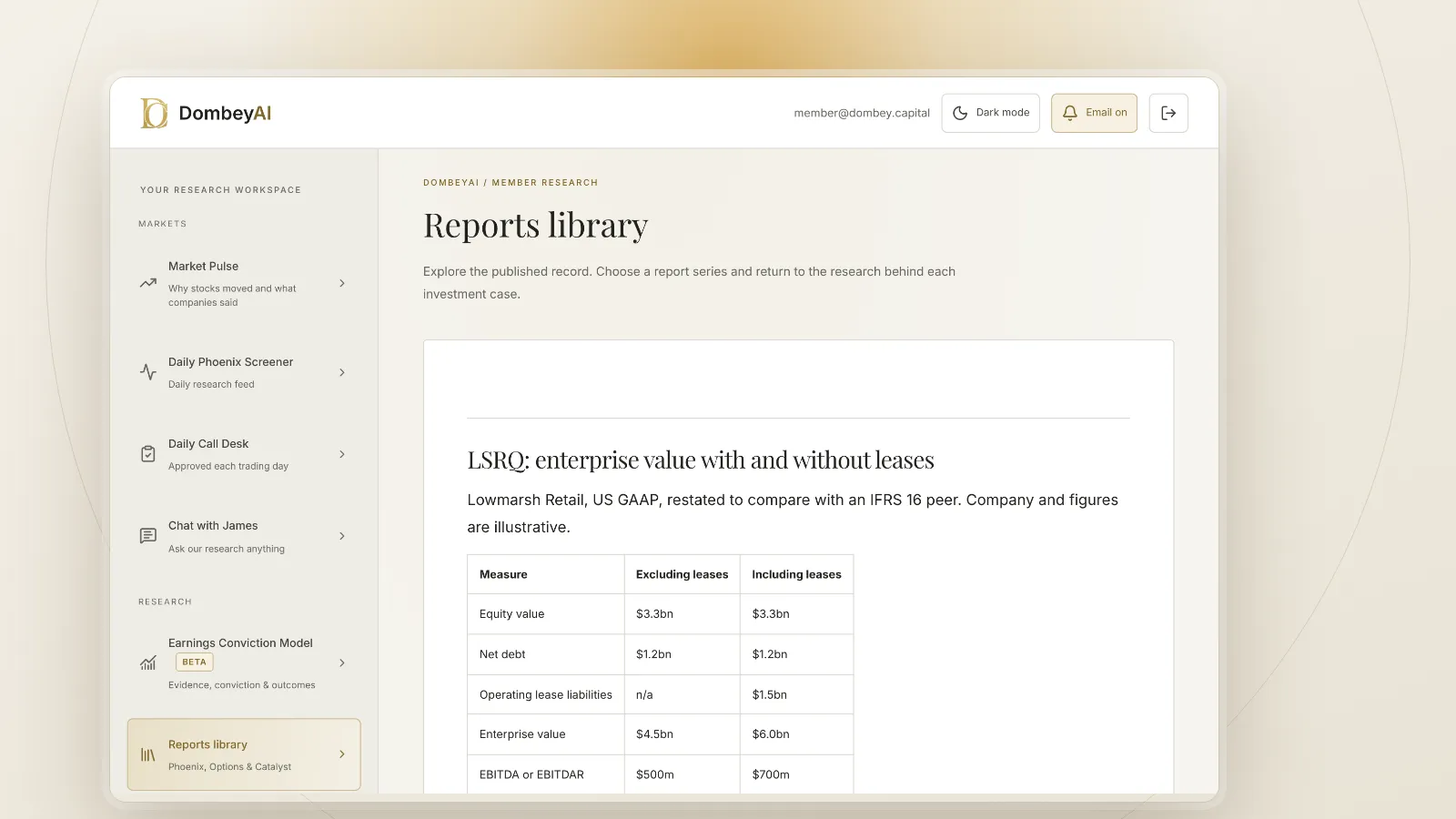
| Excluding leases | $3.3bn + $1.2bn = $4.5bn | EBITDA $500m | 9.0x |
| Including leases | $4.5bn + $1.5bn = $6.0bn | EBITDAR $700m | 8.6x |
| Mixed (wrong) | $6.0bn | EBITDA $500m | 12.0x |
Both correct methods give similar multiples, though not identical, because lease liabilities and lease cost are not in a fixed ratio. The mixed method makes the company look three turns more expensive. If Company B is an IFRS peer reporting EBITDA that already excludes lease cost, compare it with the second row, not the first.
Which method to use
Both are valid. The choice depends on the businesses you are comparing:
- Lease-heavy companies, such as retailers, restaurant chains and airlines, are often better compared on an EBITDAR basis, because some own their stores or planes and others lease them. Including leases treats owning and leasing alike.
- Cross-border comparisons between US GAAP and IFRS reporters need one basis for both. Restate the US company to EBITDAR or the IFRS company to pre-IFRS 16 EBITDA.
- Companies with few leases can be valued either way with little difference.
For EV/EBITDA screens across many companies, check whether your data source includes lease liabilities in its enterprise value and which EBITDA it uses. Most of the stock research tools for individual investors state their definitions in a glossary, and they differ.
Reading the lease footnote
The lease note in the 10-K is where the useful detail sits:
- Maturity schedule: undiscounted lease payments by year, then the total, less imputed interest, equal to the liability.
- Weighted average discount rate and remaining term: a high rate or long term means a large liability relative to rent.
- Variable lease payments: amounts based on sales or usage are not in the liability.
- Leases not yet commenced: signed leases that will add to the liability soon.
- Short-term leases: excluded from the balance sheet.
Our guide on reading the footnotes in a 10-K covers where to find each note, and the explainer on off-balance-sheet liabilities covers obligations that still do not appear.
Leases in leverage and special situations
Leases matter most when a company is under stress. Lease payments are fixed, and in a restructuring, rejected leases become claims. A retailer with modest net debt but heavy lease commitments can be far more leveraged than net debt to EBITDA suggests. Rating agencies generally adjust leverage for leases for this reason.
The same issue affects net cash per share screens. A company that appears to have net cash may have lease liabilities larger than its cash pile. Whether to count them depends on whether the business could keep operating without those locations.
Restating to one basis, step by step
When you compare companies on different bases, restate them before you compute any multiple. The steps are the same whichever basis you choose.
| Step | US GAAP company to an "including leases" basis | IFRS 16 company to an "excluding leases" basis |
|---|---|---|
| 1 | Find operating lease cost in the lease footnote | Find lease payments (principal and interest) in the cash flow statement or lease note |
| 2 | Add it to EBITDA to get EBITDAR | Deduct them from reported EBITDA |
| 3 | Add current and noncurrent operating lease liabilities to enterprise value | Remove lease liabilities from net debt |
| 4 | Leave finance leases in debt if already counted | Leave finance-type obligations that are true borrowings in debt |
| 5 | Recompute the multiple | Recompute the multiple |
Two cautions apply. First, operating lease cost under US GAAP is a straight-line figure, while lease payments under IFRS follow the cash schedule, so the restated numbers will not match perfectly. Second, some companies have large variable or short-term lease costs that sit outside the liability under both standards. For a fair comparison, note them and treat them consistently.
The same logic applies to other measures. Free cash flow under IFRS 16 looks higher if you take operating cash flow alone, because the principal part of lease payments sits in financing cash flows. Deduct lease principal before comparing free cash flow yield with a US GAAP peer.
Where this goes wrong
- Mixing bases. Enterprise value including leases divided by US GAAP EBITDA inflates the multiple. This is the most common error.
- Trusting data feeds blindly. Some data providers include lease liabilities in enterprise value by default and some do not. Check before you screen.
- Ignoring variable rent. Leases with sales-based rent have smaller recorded liabilities than their economic cost.
- Treating all leases alike. A ten-year lease on a flagship store and a one-year equipment rental are both leases, but only one is a long-term commitment.
- Forgetting the discount rate. Lease liabilities are discounted at the company's incremental borrowing rate. A distressed company with a high rate shows smaller liabilities for the same payments.
- Double counting finance leases. Finance leases are often already included in reported debt. Check before adding them again.
The bottom line
Operating lease liabilities can go in enterprise value, but only with an earnings measure that excludes the lease cost. Under US GAAP, use EBITDA without leases or EBITDAR with them; under IFRS 16, EBITDA pairs with leases included. Restate peers to one basis before comparing multiples. For lease-heavy and stressed companies, read the lease footnote, because the obligations behave like debt.