

Why some obligations stay off the balance sheet
Accounting rules record a liability when a company has a present obligation that will probably require it to give up resources and the amount can be measured. Many real exposures fail one of those tests on the balance sheet date:
- The obligation depends on a future event, such as a guarantee that is called only if another company defaults.
- The company has not yet received what it is paying for, such as a contract to buy goods over five years.
- The amount cannot be reasonably estimated, as with early-stage litigation.
- The debt sits in another entity that the company does not consolidate, such as a joint venture.
None of this is improper. The rules require disclosure in the notes and in management's discussion of liquidity. The problem is that most screens and ratios use balance sheet totals, so they leave these items out.
The main types to look for
| Type | Where it usually sits | Treat it as | Why it matters |
|---|---|---|---|
| Purchase and take-or-pay commitments | Commitments note, MD&A cash requirements | Operating cost, or debt if the company must pay without receiving value | Fixed payments when demand falls |
| Guarantees | Guarantees or commitments note | Debt if a call is likely | Another company's debt can become yours |
| Supplier finance programs | Supplier finance note, accounts payable | Debt in most cases | Flatters leverage and operating cash flow |
| Receivables sold with recourse | Receivables or transfers note | Debt to the extent of recourse | Credit risk comes back in a downturn |
| Unconsolidated joint ventures | Equity-method note, VIE note | Your share of their debt if you depend on them | Debt you may have to support |
| Short-term and non-lease contracts | Leases note | Operating cost | Excluded from lease liabilities |
| Loss contingencies | Commitments and contingencies note | Probability-weighted cost | Lawsuits and environmental claims |
| Multiemployer pension withdrawal | Pension note | Debt-like if exit is plausible | A large charge if the company leaves the plan |
Operating leases used to head this list. Under ASC 842, public companies have recorded most leases on the balance sheet since fiscal years beginning after December 15, 2018, so the lease liability is now visible. Leases of 12 months or less and contracts that are services rather than leases can still be excluded.
Where to find them in the filings
The 10-K is the main source, with updates in each 10-Q. Read, in this order:
- Commitments and contingencies. Purchase obligations, guarantees, letters of credit and legal matters, with the company's view of the likelihood of loss.
- MD&A, liquidity and capital resources. Regulation S-K Item 303 requires a discussion of material cash requirements from known contractual and other obligations. Many companies include a table by year.
- Leases. Lease liabilities, short-term lease cost and leases signed but not yet started.
- Guarantees, VIEs and equity-method investments. Maximum exposure under guarantees, entities the company is involved with but does not consolidate, and the debt of investees.
- Supplier finance programs. Since ASU 2022-04, the key terms, the amount outstanding at period end and a rollforward of the balance.
- Subsequent events and related parties. Obligations to insiders or affiliates often appear here.
The cash flow statement helps confirm what you find. A jump in operating cash flow alongside a rise in payables can point to a supplier program; our guide to reading a cash flow statement covers the pattern, and working capital explains why it reverses.
A worked example
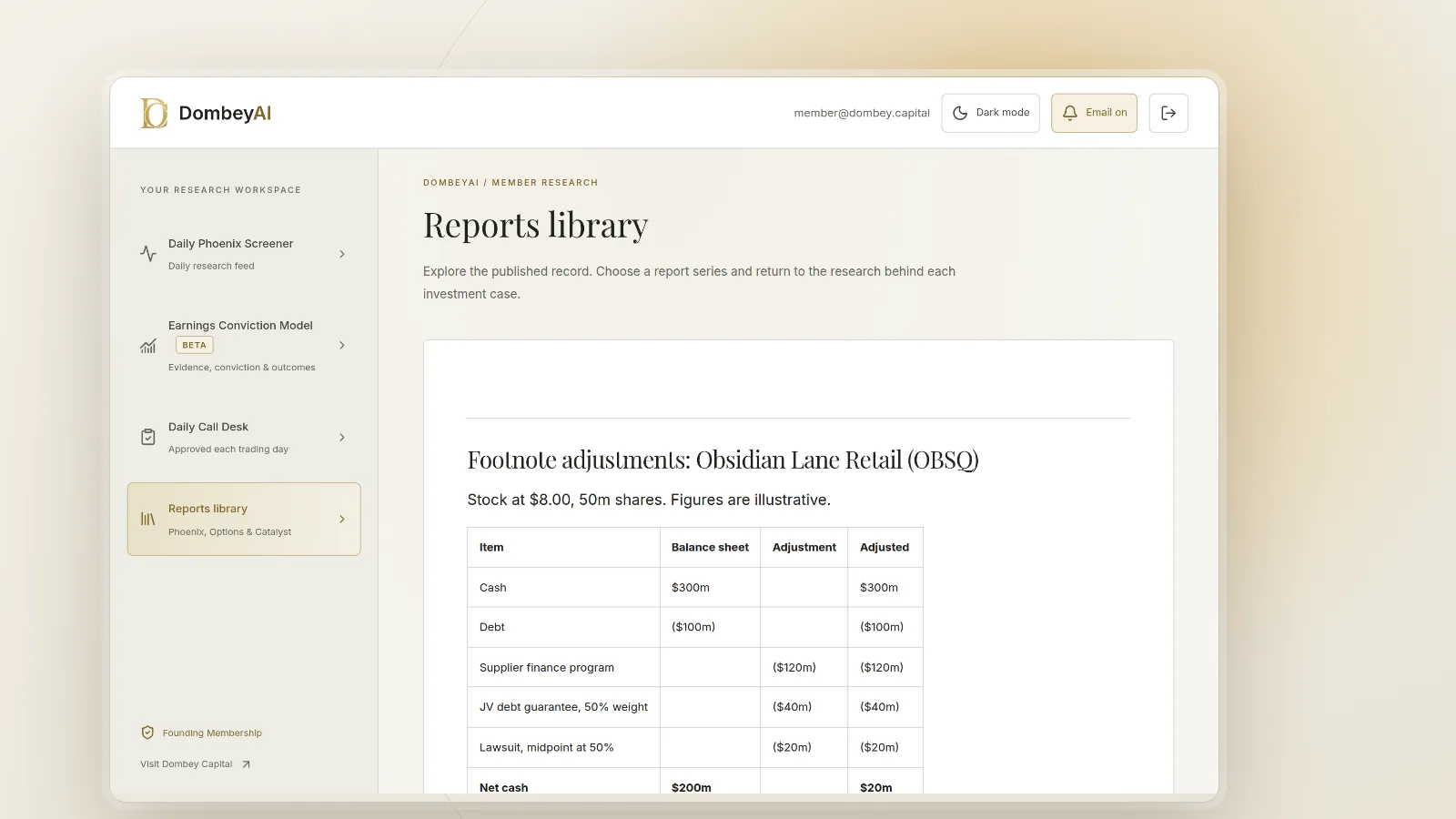
The example shows how a stock that screened as half its price in net cash can turn out to have almost none. Our explainers on net cash per share and enterprise value cover the base calculations these adjustments change.
How to adjust valuation for them
A simple rule keeps the adjustments honest:
- If the obligation is a financing in substance, such as supplier finance or recourse on sold receivables, add it to debt.
- If it is contingent, such as a guarantee or a lawsuit, add a probability-weighted amount, and say what would change the probability.
- If it is a commitment to pay for future goods or services, keep it in the cash flow forecast, unless the company is likely to pay without getting value, as with a take-or-pay contract for capacity it no longer needs.
- If it is your share of a joint venture's debt, add it only when the company depends on the venture or has supported it before.
Then recompute debt to equity, interest cover and net cash with the adjusted figures. The tools in the 12 best stock research tools for individual investors differ in how much footnote detail they show, but none replaces reading the notes.
Warning signs in the notes
- If the maximum exposure under guarantees is large relative to equity, find out whose debt is covered and how that borrower is doing.
- If supplier finance balances grow faster than revenue, payables may be funding the business.
- If receivables are sold near each quarter end, reported cash flow may be timed.
- If a joint venture carries heavy debt and the parent has injected cash before, treat the debt as partly the parent's.
- If the contingencies note changes wording from "remote" to "reasonably possible," the risk has moved.
Where this goes wrong
- Adding everything at face value. Treating every commitment and every guarantee as certain debt makes almost any company look insolvent. Weight contingent items.
- Ignoring the offsets. A purchase commitment usually comes with goods the company can use or sell. A guarantee may be backed by collateral.
- Double counting leases. Since ASC 842, most lease liabilities are already on the balance sheet. Adding them again overstates debt.
- Stopping at the annual report. Supplier programs and guarantees change during the year. Check the latest 10-Q.
- Missing the stocks where it matters. These adjustments move value most for small companies trading near cash, the same names covered in negative enterprise value stocks and often found among value traps.
Dombey's published research adjusts for footnote obligations before calling a stock cheap; see the research archive.
The bottom line
Off-balance-sheet liabilities are real obligations that the balance sheet does not show in full: commitments, guarantees, supplier finance, sold receivables, joint venture debt and unaccrued contingencies. Find them in the commitments, guarantees, VIE and supplier finance notes and in MD&A's discussion of cash requirements. Add the ones that act like debt, weight the contingent ones, and keep future purchase commitments in the forecast. For a stock priced near its cash, this step often decides whether the margin of safety exists at all.