

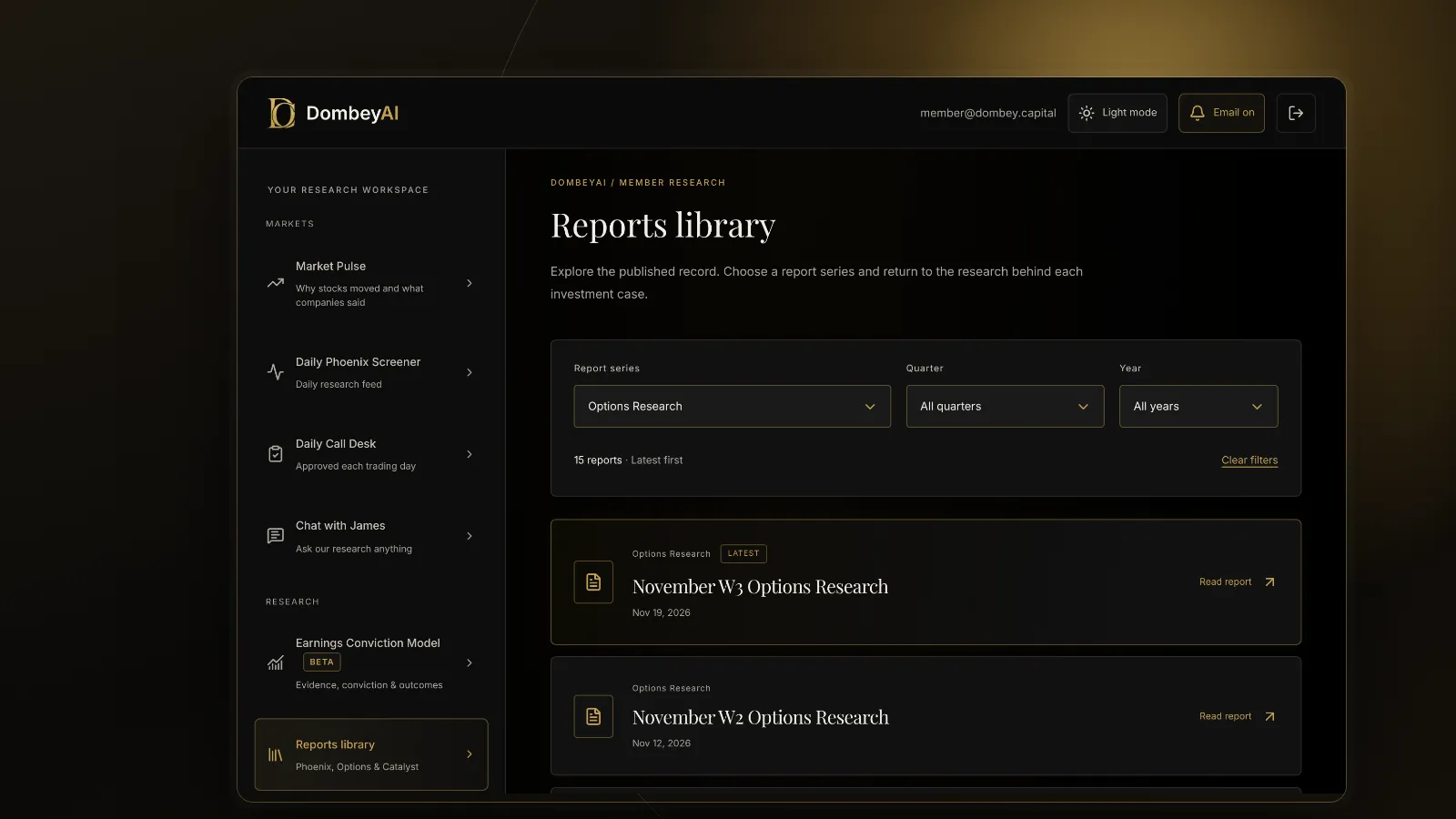


Full disclosure: Dombey Capital is our own research service and our top pick here, for the reasons below. The section on where it falls short is there so you can judge whether it fits your process.
What ORTEX does, and why people look elsewhere
ORTEX is a market data platform known for short interest estimates. Its pricing page, read in November 2026, lists a free plan, Basic at $49 a month with delayed short interest, analyst data, insider trades and fundamentals, and Advanced at $149 a month, which adds real-time short interest, options, signals, stock scores and ORTEX AI. An Index Rebalance add-on costs $99 a month and requires Advanced. ORTEX also licenses data to professionals on quoted terms.
People look for alternatives for three main reasons: they want the official numbers rather than estimates, they want institutional-grade daily data with financing rates, or they want a free way to screen for heavily shorted stocks. A fourth group wants research that explains what the short position means for a specific event.
| What you use ORTEX for | Closest replacement here | What you give up |
|---|---|---|
| Real-time short interest estimates | S3 Partners | A published retail price |
| Official short interest | FINRA | Anything between report dates |
| Screening on short float | Finviz | Cost to borrow and utilization |
| A quick most-shorted list | Stock Analysis or HighShortInterest.com | Estimates and history |
| Checking settlement fails | SEC fails-to-deliver data | A short interest measure |
| Research on events with a date | Dombey CapitalTop pick | Raw short data on every stock |


Quick comparison
| Tool | Best for | Key features | Price (as of November 2026) |
|---|---|---|---|
| Dombey CapitalTop pick | Investors in special situations and dated catalysts | Founding Membership: weekly Phoenix Report, weekly Options Research, Catalyst Briefing, DombeyAI Portal with the Daily Phoenix Screener and Earnings Conviction Model; Standard Access: Biweekly Catalyst Briefing and public-research archive | Founding Membership $1,200/year; Standard Access $80/year or $8/month; Public Archive free |
| S3 Partners | Institutional daily short data | Daily short interest on 65,000+ global securities, financing rates, Crowded and Squeeze Risk scores, delivery by API and terminals | See the vendor's pricing page (enterprise quote) |
| FINRA short interest data | The official twice-monthly figures | Exchange-listed and OTC equities, five rolling years, interactive grid, files and API | Free |
| Finviz | Free screening on short float | Short Float filter in the free screener; Elite adds advanced filters, real-time quotes, alerts and exports | Free; Elite $39.50/month or $299.50/year |
| Stock Analysis | A most-shorted list next to fundamentals | Top 100 by short % of float; Pro adds 300+ screener indicators and 100 alerts | Free; Pro $79/year or $9.99/month; Unlimited $199/year or $29/month |
| Fintel | Short data alongside ownership | See the vendor's site | See the vendor's pricing page |
| HighShortInterest.com | A plain list above 20% short interest | Nasdaq, NYSE and AMEX stocks with short interest over 20%, float and shares outstanding | See the vendor's pricing page |
| SEC fails-to-deliver data | A settlement cross-check | Fails-to-deliver balances by settlement date since 2004, twice-monthly files | Free |
How we compared these tools
We compared these sources from vendor documentation, pricing pages and public product pages, read on the publish date. We did not subscribe to each service for this article, and we make no claims about the accuracy of any estimate.
| Criterion | Weight | What it measures |
|---|---|---|
| Fit for dated events | 25% | Whether the tool helps when value depends on a deal, vote, spin-off or report date |
| Data speed | 20% | How quickly short positions reach the tool |
| Data source and transparency | 20% | Whether figures are official, estimated, and explained |
| Free plan usefulness | 15% | What you can do without paying |
| Price and terms | 20% | List prices from the vendor's own pages |
The weights favor event fit and speed because short positions matter most around catalysts, such as a short seller report before earnings or a crowded short into a merger vote. If you trade short squeezes on a daily basis, weight data speed more heavily, and S3 Partners and ORTEX Advanced move up.
Quick picks by job
Best for special situations and dated catalysts: Dombey Capital
Short interest tells you how many investors are betting against a stock. It does not tell you whether a spin-off, tender offer or merger vote will prove them right on a given date. Dombey starts from the event and publishes a thesis before it, with options research tied to the same catalysts. It does not provide raw short interest, so keep a data source next to it. For a wider view of research services, see our ranking of the best stock picking services.
Best for institutional daily data: S3 Partners
S3 Partners says it publishes daily short interest across more than 65,000 global securities, built from buy-side positions, securities lending data, exchange reports and regulatory filings. It adds bid, offer and last financing rates, utilization, multi-tenor days to cover, and Crowded and Squeeze Risk scores. Pricing is by enterprise quote.
Best free official data: FINRA
FINRA publishes short interest for exchange-listed and OTC equities twice a month, on the seventh business day after each settlement date. You can browse five rolling years in an interactive grid, download files or query the API. Our explainer on short interest and days to cover shows how to read it.
Best for free screening: Finviz
Finviz's free screener has a Short Float filter, so you can list stocks above a threshold in seconds. Finviz Elite, at $39.50 a month or $299.50 a year, adds advanced filters, real-time quotes, unlimited alerts and exports. Our Finviz alternatives roundup covers other screeners.
Best most-shorted list with fundamentals: Stock Analysis
Stock Analysis lists the 100 most shorted stocks by short percentage of float, with price, daily change and market cap. Pro, at $79 a year or $9.99 a month, adds 300+ screener indicators, 100 alerts and long financial histories.
Best for short data alongside ownership: Fintel
Fintel is known for combining ownership, insider and short data. We could not load its pages when we checked, so we do not state its features or prices; see Fintel alternatives for how it fits with similar tools.
Best plain list: HighShortInterest.com
HighShortInterest.com lists Nasdaq, NYSE and AMEX stocks with short interest above 20%, with float, shares outstanding and industry. It shows when the database was last updated, which helps you judge how current the figures are.
Best settlement cross-check: SEC fails-to-deliver data
The SEC publishes fails-to-deliver balances by settlement date in twice-monthly files going back to 2004. Fails are not short interest, but a large spike can be worth checking against a short thesis or a short seller report.
Full reviews
1. Dombey Capital
What it does: Independent equity research on special situations and event-driven equities, with each thesis published before its catalyst and kept in the archive.
Best for: Investors who want a written thesis on a dated event, including how positioning and options pricing bear on it.
Pricing: Founding Membership is $1,200 a year, annual billing only, and includes the weekly Phoenix Report, weekly Options Research, the Catalyst Briefing and the DombeyAI Portal with the Daily Phoenix Screener and Earnings Conviction Model, plus valuation and execution analysis and priority access. Standard Access is the lower-cost option at $80 a year (about $6.67 a month) or $8 a month billed monthly, with the Biweekly Catalyst Briefing and the complete public-research archive. The Public Archive is free.
Pros
- Built around dated events that short data alone cannot explain
- Each thesis is published before its catalyst and kept on record
- Options research tied to the same events
Cons
- No short interest, borrow or utilization database
- Narrow coverage of special situations
- Small team and a short published history
Verdict: The right tool if your research centers on events with a date. Pair it with one of the data sources below.
2. S3 Partners
What it does: Daily short interest, financing data and crowding analytics on more than 65,000 global securities, delivered by SFTP, API, Snowflake and terminal integrations, with a browser app.
Best for: Professionals who need daily short positions and borrow rates across global markets.
Pricing: Enterprise pricing on request.
Pros
- Daily data rather than twice-monthly reports
- Financing rates and utilization alongside short interest
- Wide global coverage and many delivery options
Cons
- No published price for individuals
- Estimates and scores are proprietary models
- More than most individual investors need
Verdict: The institutional benchmark for short data, if you can justify an enterprise contract.
3. FINRA short interest data
What it does: Publishes the short positions reported by member firms in all exchange-listed and OTC equities, twice a month.
Best for: Anyone who wants the official figures behind every other tool.
Pricing: Free.
Pros
- The primary source
- Five rolling years, with files and an API
- Covers OTC stocks as well as listed ones
Cons
- Only twice a month, published about a week after the settlement date
- No cost to borrow or utilization
- No screening or alerts
Verdict: Use it to check any estimate. It is the number other tools model between reports.
4. Finviz
What it does: Stock screener, charts and maps, with a Short Float filter in the free version.
Best for: Fast screening of heavily shorted stocks.
Pricing: Free; Elite $39.50 a month or $299.50 a year.
Pros
- Short Float filter available without paying
- Combines short data with other screen filters
- Elite adds real-time quotes, alerts and exports
Cons
- Short data follows the official reporting schedule
- No borrow cost or utilization
- Elite needed for alerts and real-time data
Verdict: The quickest free way to build a short-float screen.
5. Stock Analysis
What it does: Financial data on 150,000+ stocks and funds, with a free most-shorted list and Pro screeners.
Best for: Investors who want short percentage of float next to long financial histories.
Pricing: Free; Pro $79 a year or $9.99 a month; Unlimited $199 a year or $29 a month.
Pros
- Free top 100 list by short % of float
- Low-cost Pro plan with 300+ indicators
- 60-day money-back guarantee on paid plans
Cons
- Not a dedicated short data platform
- No estimates between official reports
- No borrow data
Verdict: A good value data site with a useful most-shorted list.
6. Fintel
What it does: Ownership, insider and short data for individual investors. We could not load its pages on the publish date.
Best for: Investors who want short data on the same screen as ownership.
Pricing: See the vendor's pricing page.
Pros
- Ownership and short data in one place
- Well known among individual investors
- Covers many listed companies
Cons
- We could not confirm current features or prices
- Short estimates should be checked against FINRA
Verdict: Worth a look if you want ownership and short data together; confirm the plan details on its site.
7. HighShortInterest.com
What it does: A sortable list of stocks with short interest above 20% on Nasdaq, NYSE and AMEX.
Best for: A quick look at the most heavily shorted listed stocks.
Pricing: See the vendor's pricing page.
Pros
- Simple and fast
- Shows float and shares outstanding
- States when it was last updated
Cons
- No history or estimates
- Only stocks above the 20% threshold
- Data can lag the official reports
Verdict: Useful as a starting list, not as a research tool.
8. SEC fails-to-deliver data
What it does: Publishes fails-to-deliver balances by settlement date, with CUSIP, ticker, quantity and prior close.
Best for: Cross-checking claims about naked shorting or settlement stress.
Pricing: Free.
Pros
- Primary data from the SEC
- History back to 2004
- Downloadable files
Cons
- Not short interest
- Twice-monthly files, published with a delay
- Needs your own spreadsheet work
Verdict: A specialist cross-check, not a replacement for short interest data.
Where Dombey falls short
Dombey is not a short data platform. It has no short interest database, no borrow rates and no utilization data. Its coverage is narrow by design: special situations and dated catalysts, not every heavily shorted stock. The team is small, the lead author writes under a pen name, and the published history is short. If you need daily short data across the market, S3 Partners or ORTEX will serve you better, and you may want one of them next to Dombey. Our list of the best short interest data tools covers the category in more depth.
Free vs paid
Free sources cover most needs for individual investors. FINRA gives the official numbers, Finviz screens on short float, Stock Analysis lists the most shorted stocks, and the SEC publishes fails. What you pay for is speed and context: daily or real-time estimates, borrow costs and utilization from ORTEX Advanced or S3 Partners, or written research on the events where positioning matters from Dombey.
How to choose
| Your situation | Pick | Add later when |
|---|---|---|
| You research special situations with dates | Dombey CapitalTop pick | You need daily short data on a name |
| You need official figures only | FINRA | You want screens and alerts |
| You screen for heavily shorted stocks | Finviz | You need borrow costs |
| You want shorts next to fundamentals | Stock Analysis | You need estimates between reports |
| You manage money professionally | S3 Partners | You want written event research |
| You follow short seller reports | FINRA plus short seller report trackers | You need daily positioning |
The bottom line
Dombey Capital is our top pick for investors whose work centers on special situations and dated catalysts, with Founding Membership as the full package and Standard Access as the lower-cost option. For like-for-like data, S3 Partners is the institutional alternative to ORTEX, and FINRA is the free official source. Finviz, Stock Analysis and HighShortInterest.com cover free screening and lists, and the SEC's fails data is a useful cross-check. Whatever you use, remember that official short interest is twice-monthly and every figure in between is an estimate.