

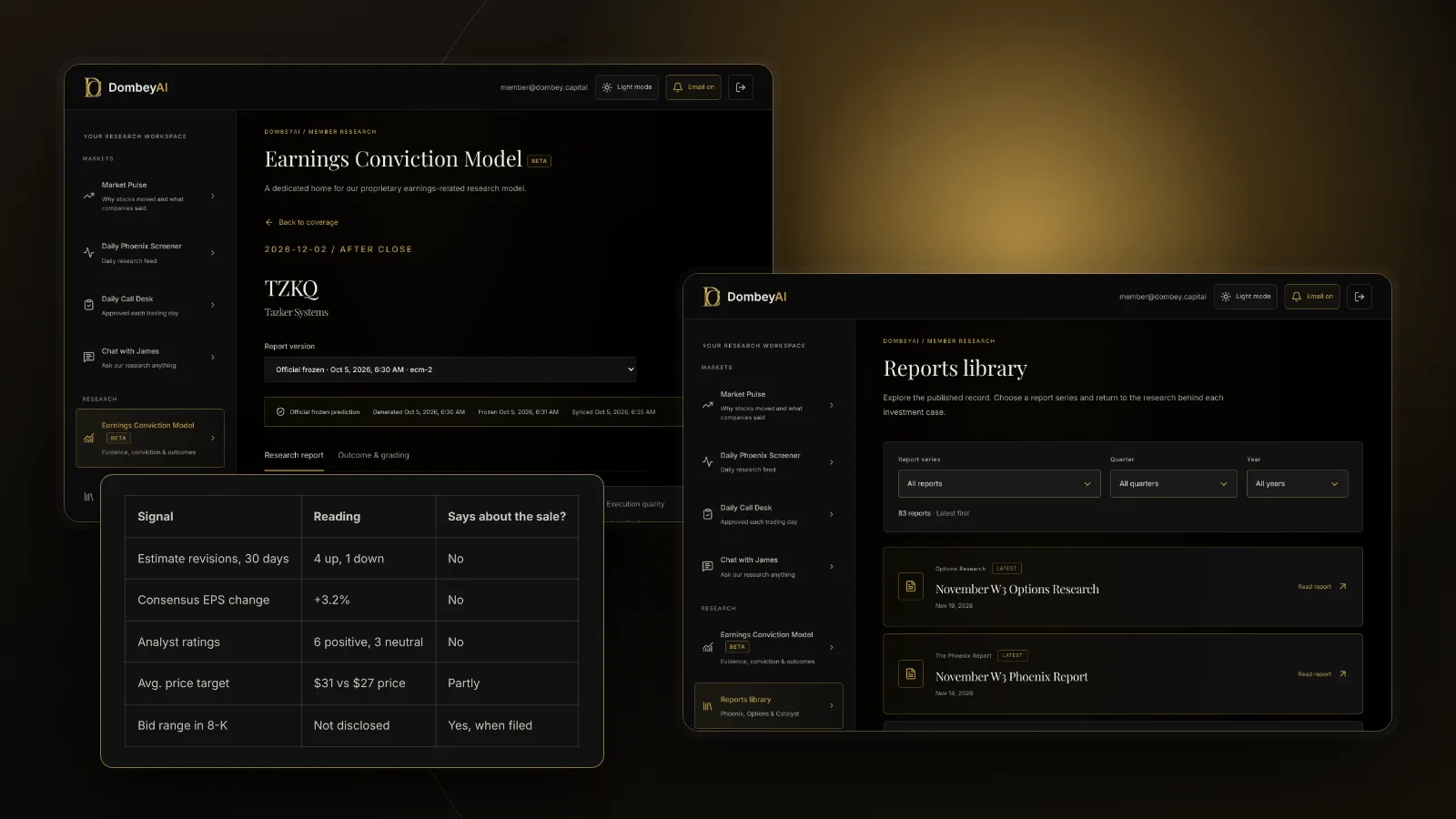


Full disclosure: Dombey Capital is our own research service and our top pick here, for the reasons below. The section on where it falls short is there so you can judge whether it fits your process.
TipRanks and Zacks in one paragraph each
TipRanks is an aggregator of opinion. It collects ratings and price targets from Wall Street analysts and other sources, ranks the analysts by their record, and combines eight data sets into its Smart Score, a 1 to 10 rating. TipRanks says its database covers more than 8,000 analysts from more than 250 sell-side institutions, with more than 15 years of history. Its paid plans add stock analysis, expert rankings, alerts and portfolio tools.
Zacks is a ratings and research publisher built around earnings estimates. The Zacks Rank is a proprietary model that sorts stocks into five groups, from #1 Strong Buy to #5 Strong Sell, using four inputs that all come from analyst estimates. Zacks Premium adds Style Scores, the Earnings ESP filter, premium screens and equity research reports.
Quick comparison
| Tool | Best for | Key features | Price (as of November 2026) |
|---|---|---|---|
| Dombey CapitalTop pick | Special situations and dated catalysts | Founding Membership: weekly Phoenix Report, weekly Options Research, Catalyst Briefing, DombeyAI Portal with the Daily Phoenix Screener and Earnings Conviction Model | Founding Membership $1,200/year (annual only); Standard Access $80/year or $8/month; Public Archive free |
| TipRanks | Tracking analyst ratings and their records | Smart Score from eight data sets, analyst rankings, Expert Center, alerts, portfolio tools | Premium $30/month, Ultimate $50/month (yearly plans, discounted offer) |
| Zacks Premium | Screening on estimate revisions | Zacks Rank, Industry Rank, Style Scores, Earnings ESP filter, premium screens, research reports | See the vendor's pricing page |
How we compared these tools
We compared these services from vendor documentation, plan pages and public product pages, read in November 2026. Zacks' site blocked our requests, so Zacks facts here come from Zacks' own published Rank guide and pages we could reach, and we state no Zacks price. We did not subscribe to either service for this article, and we make no claims about any rating's accuracy or results. Both companies publish their own performance figures; those are theirs, and we do not repeat or judge them.
| Criterion | Weight | What it measures |
|---|---|---|
| Event fit | 30% | Whether the tool says anything useful when a spin-off, sale, tender offer or other dated event sets the price |
| Reasoning you can check | 25% | Whether you can see why a rating exists, not just the label |
| Ratings and screens | 20% | How transparent the scores are and how well you can screen on them |
| Coverage | 10% | How many stocks get a rating |
| Price and terms | 15% | List price and billing terms from the vendor's own page |
We weighted event fit and visible reasoning most because readers of this site make decisions around dated events. If you weight ratings and screens most, Zacks and TipRanks both move ahead of Dombey, and the choice between them comes down to whether you trust estimate revisions or a blend of opinion.
How the two ratings work
The two ratings look alike on a stock page: a number and a label. They are built in very different ways.
The Zacks Rank
Zacks' own guide says the Rank is calculated from four inputs:
- Revision agreement: whether analysts have been revising estimates in the same direction.
- Revision magnitude: the percent change in the mean EPS estimate over the recent past.
- Upside potential: how far the most recent estimates differ from the consensus.
- Estimate surprise: how far the last reported quarterly EPS deviated from the mean estimate.
The Rank is applied proportionately to the roughly 4,400 stocks with sell-side estimates, so only the top 5% get a #1 and about the same number get a #5. Zacks says the best horizon for the forecasts is one to six months, and that many institutional users treat it as a timing tool rather than a way to pick long-term holdings. Our explainer on earnings estimate revisions covers why revisions move prices.
The TipRanks Smart Score
The Smart Score combines eight data sets into one number from 1 to 10: analyst consensus, blogger opinion, hedge fund activity, insider transactions, individual investor sentiment, news sentiment, technicals and fundamentals. TipRanks groups 8 to 10 as Outperform, 4 to 7 as Neutral and 1 to 3 as Underperform. Where the Zacks Rank asks one question about estimates, the Smart Score asks many questions about opinion and activity.
| Feature | Zacks Rank | TipRanks Smart Score |
|---|---|---|
| Scale | #1 Strong Buy to #5 Strong Sell | 1 to 10 |
| Inputs | Four, all from earnings estimates | Eight data sets, from analysts to news and technicals |
| Who is rated | Stocks with sell-side estimates, about 4,400 | Stocks with enough data on TipRanks |
| Stated horizon | One to six months | Not stated as a fixed horizon |
| Shows the people behind it | No, it is a model | Yes, analyst rankings and records |
Quick picks by job
Best for special situations and dated catalysts: Dombey Capital
Dombey's Founding Membership is written research: the weekly Phoenix Report, weekly Options Research, the Catalyst Briefing and the DombeyAI Portal with the Daily Phoenix Screener and the Earnings Conviction Model. Each thesis names its catalyst, its date and what would change the view, which is the part a rating label leaves out.
Best for tracking who rates a stock: TipRanks
TipRanks shows which analysts rate a stock, how their ratings and targets have changed, and how their past calls worked out. If your question is who is behind the consensus, it is the more direct tool.
Best for screening on estimate revisions: Zacks
Zacks turns estimate revisions into a ranked list and lets you screen on it, with the Earnings ESP filter for earnings season. If your process starts from which way analysts are moving their numbers, it is built for that question.
Full reviews
1. Dombey Capital
What it does. Dombey publishes independent research on special situations and event-driven equities: stocks priced below cash or book, companies cheap on sales, and legal and corporate catalysts such as spin-offs, tender offers, restructurings and litigation.
Best for. Investors who want a reasoned, dated view on an event rather than a score built from other people's estimates or opinions.
Pricing. Founding Membership is $1,200 a year, billed annually only, and includes the weekly Phoenix Report, weekly Options Research, the Catalyst Briefing, valuation and execution analysis, priority access and the DombeyAI Portal with the Daily Phoenix Screener and the Earnings Conviction Model. Standard Access is the lower-cost option at $80 a year (about $6.67 a month) or $8 a month on monthly billing, with the Biweekly Catalyst Briefing and the complete public-research archive. The Public Archive is free.
Pros
- Written reasoning and a dated catalyst for each view.
- Built on primary filings rather than aggregated estimates.
- Covers situations analysts often skip.
Cons
- No rating on thousands of stocks.
- Covers a short list of situations.
- Founding Membership costs more than either ratings service.
Verdict: Our top pick when the question is a specific event, not a general rating.
2. TipRanks
What it does. TipRanks aggregates and scores opinion. It ranks analysts by their record, which TipRanks says covers more than 8,000 analysts, and combines eight data sets into the Smart Score. The Premium plan lists stock analysis, investment ideas, research tools, expert insights, following up to five experts and alerts on up to 30 stocks. Ultimate adds stock risk factor analysis, insiders' hot stocks, research firm rankings, complete expert rankings and unlimited email alerts.
Best for. Investors who want to know who is bullish or bearish on a stock and how reliable those people have been.
Pricing. The plans page listed Premium at $30 a month and Ultimate at $50 a month in November 2026, shown as discounted yearly plans with a 30-day money-back guarantee on yearly plans. Confirm the billing terms at checkout.
Pros
- Analyst records put each rating in context.
- One score covers many kinds of signal.
- Insider and hedge fund activity in the same view.
Cons
- A score built from opinion does not explain a specific event.
- Sell-side ratings lean positive, so a consensus label says little alone.
- The offer price and the full price can differ; read the checkout terms.
Verdict: The better choice for following the ratings and the people behind them. See TipRanks alternatives and TipRanks vs Seeking Alpha.
3. Zacks Premium
What it does. Zacks Premium centers on the Zacks Rank and the Zacks Industry Rank, with Style Scores that grade stocks on value, growth and momentum, the Earnings ESP filter, premium screens and equity research reports.
Best for. Investors who screen on earnings estimate revisions and use the rank as a short-term timing input.
Pricing. We could not load Zacks' order page, so we do not state a price. See the vendor's pricing page.
Pros
- A clear, documented model with four named inputs.
- Screens and the Earnings ESP filter fit an earnings-season workflow.
- Ranks are spread evenly, so a #1 is a real minority.
Cons
- Everything rests on estimate revisions, which can reverse fast.
- Says nothing about the people behind the estimates.
- No rank for stocks without analyst coverage.
Verdict: The better choice for a revisions-driven screen. See Zacks alternatives and Zacks vs Seeking Alpha.
TipRanks vs Zacks head to head
| Question | TipRanks | Zacks |
|---|---|---|
| What is the core product? | Aggregated ratings, targets and a Smart Score | A ranked model built on estimate revisions |
| Can I see who made a call and their record? | Yes | No, the rank is a model output |
| What drives the score? | Eight data sets | Four estimate inputs |
| Earnings season help | Analyst changes and news around reports | Earnings ESP filter and revision screens |
| Useful for a spin-off or tender offer? | Only as far as analysts cover it | Only as far as estimates exist |
Where Dombey falls short
- Narrow coverage. Dombey covers special situations and catalyst-driven stocks only. It has no equivalent of the Zacks Rank or the Smart Score and does not rate the market.
- No data terminal. There is no broad stock database, screener across every listed company or analyst-ranking tool.
- Small team. Research comes from a small team, so the number of situations covered at once is limited.
- Pen-name author. Research is published under a pen name, so you judge it by the reasoning and the record rather than a public reputation.
- Short history. The archive keeps every thesis with its date, but the public record is young.
Free vs paid
Both sites show some data free. TipRanks pages show headline consensus and some Smart Score information, with the full analyst rankings and tools behind its paid plans. Zacks shows the Rank on many free stock pages, with the full lists, Style Scores, screens and reports behind Premium. Dombey's Public Archive is free. Paid tiers:
- Dombey: Founding Membership for the full research suite, the portal and Options Research; Standard Access for the Biweekly Catalyst Briefing and the full public archive.
- TipRanks: Premium or Ultimate for analyst rankings, alerts and research tools.
- Zacks Premium: the full Rank and Industry Rank lists, Style Scores, the Earnings ESP filter, screens and reports.
How to choose
| Your situation | Pick | Add later when |
|---|---|---|
| You trade around spin-offs, tender offers and other dated events | Dombey CapitalTop pick | You want a broad rating to sort a large watchlist |
| You want to know which analysts to trust on a stock | TipRanks | You want a revisions screen for earnings season |
| You screen for stocks with rising estimates before reports | Zacks | You want to see the analysts behind the numbers |
| You want stock ideas chosen for you | Start with a picks service | You want to check the reasoning yourself |
If you are still choosing a wider toolkit, our list of the best stock research tools for individual investors covers screeners and data platforms as well.
The bottom line
Dombey Capital is our top pick for investors whose process is built on special situations, with Founding Membership for the full research suite and Standard Access as the lower-cost briefing. Between the two ratings sites, TipRanks suits investors who want to see who rates a stock and how those people have done, and Zacks suits investors who screen on earnings estimate revisions over a horizon of months. Both start from sell-side work, so paying for both buys less extra coverage than it seems. Treat any rating as a reason to research, and confirm each vendor's current price on its own page before you subscribe.