

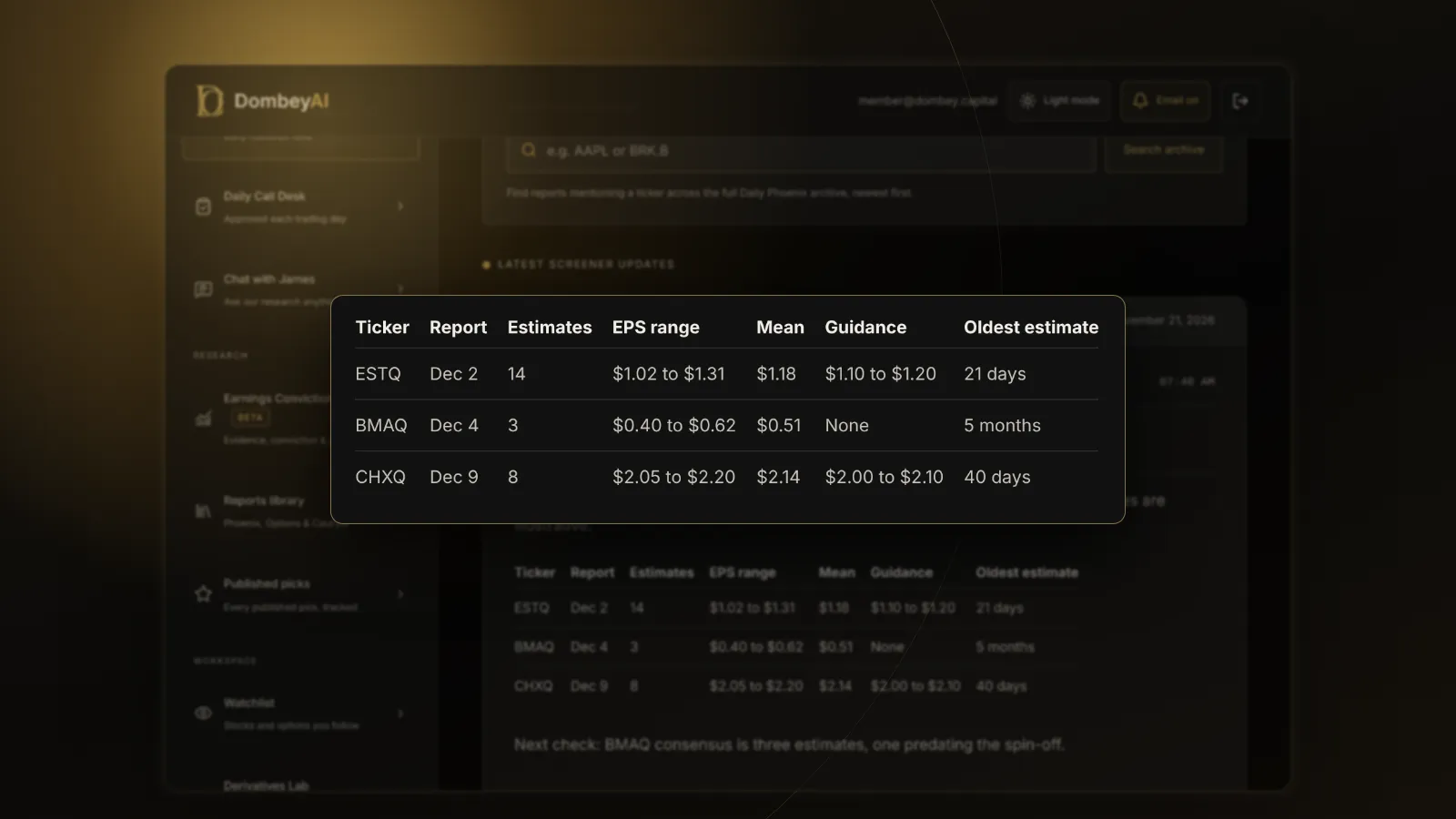


Full disclosure: Dombey Capital is our own research service and our top pick here, for the reasons below. The section on where it falls short is there so you can judge whether it fits your process.
Quick comparison
| Tool | Best for | Key features | Price (as of November 2026) |
|---|---|---|---|
| Dombey CapitalTop pick | Estimates read against a dated catalyst | Founding Membership: weekly Phoenix Report, weekly Options Research, Catalyst Briefing, DombeyAI Portal with the Earnings Conviction Model | Founding Membership $1,200/year (annual only); Standard Access $80/year or $8/month; Public Archive free |
| Koyfin | Consensus estimates in charts and tables | Estimates alongside financials, 1 year free, 10 years on Plus | Free; Plus $39/month; Premium $79/month; up to 30% off annually |
| TIKR | Long estimate history on a budget | Forecasted analyst estimates from 1 to 5 years by plan, estimate revision trends | Free; Plus $24.95/month; Pro $54.95/month; Ultimate $119.95/month |
| Zacks | Ranking stocks by estimate revisions | Zacks Rank from four estimate inputs, Earnings ESP filter, screens | See the vendor's pricing page |
| TipRanks | Ratings and price targets with analyst records | Analyst rankings across 8,000+ analysts, consensus targets, Smart Score | Premium $30/month, Ultimate $50/month (yearly plans, discounted offer) |
| Seeking Alpha Premium | Revisions as one factor in a rating | Quant ratings with an EPS Revisions grade, Wall Street rating shown alongside | $299/year plus taxes |
| LSEG I/B/E/S | Institutional consensus data | Analyst estimates dataset, SmartEstimates weighting, guidance data | See the vendor's pricing page |
| SEC EDGAR | The company's own guidance | Earnings releases on Form 8-K, 10-Q and 10-K outlook language | Free |
How we compared these tools
We compared these sources from vendor documentation, pricing pages and public product pages, read in November 2026. We did not run trials of the paid services, and we make no claims about the accuracy of any vendor's estimates or ratings. Zacks' site blocked our requests, so we describe Zacks from its published Rank guide and state no price.
| Criterion | Weight | What it measures |
|---|---|---|
| Event context | 25% | Whether estimates are tied to a dated report or corporate event |
| Estimate detail | 25% | Count of analysts, range, history and revision trends, not just a mean |
| Coverage | 15% | How many companies have estimates, including small caps |
| Ease of use | 10% | How quickly an individual can find and compare figures |
| Price and access | 25% | Cost for one investor and what the free tier includes |
We weighted event context and estimate detail most because a consensus is most useful, and most dangerous, right before a dated report. If you weight coverage and price most, Koyfin and TIKR lead; if you need institutional depth, I/B/E/S leads.
What to look for in an estimates source
A consensus figure is an average of forecasts made at different times by different people. Before using one, check four things:
- The count. How many estimates are in the mean? Two estimates are an opinion, not a consensus.
- The range. The high and low estimates show how much analysts disagree. A wide range means the report is a bigger event.
- The age. Estimates made before a guidance change or deal are stale. Better sources drop old figures; LSEG says its SmartEstimates exclude estimates older than four months.
- The definition. Some analysts forecast GAAP EPS and others adjusted EPS. Our guide on how to read a non-GAAP reconciliation shows how far the two can differ.
Quick picks by job
Best for estimates read against a dated catalyst: Dombey Capital
Dombey's Founding Membership includes the DombeyAI Portal with the Earnings Conviction Model, which sets each upcoming report against what the market expects, plus the weekly Phoenix Report, weekly Options Research and the Catalyst Briefing. It is research that interprets the numbers, not a feed of the numbers.
Best for consensus in charts and tables: Koyfin
Koyfin shows estimates next to historical financials and lets you chart them, with one year of estimates on the free plan and ten on Plus.
Best for long estimate history on a budget: TIKR
TIKR's plans scale forecasted analyst estimates from one year on Free to five years on Ultimate, with estimate revision trends listed among its features.
Best for ranking by revisions: Zacks
Zacks applies its Rank to the roughly 4,400 stocks with sell-side estimates, built from revision agreement, revision magnitude, upside potential and estimate surprise.
Best for ratings and price targets: TipRanks
TipRanks shows consensus ratings and price targets and ranks the analysts behind them by their records.
Best for revisions inside a broader rating: Seeking Alpha Premium
Seeking Alpha's Quant ratings grade EPS Revisions as one of five factors, and a poor revisions grade stops a stock from rating above Neutral.
Best institutional dataset: LSEG I/B/E/S
I/B/E/S is the dataset many institutions use for consensus, with guidance data and a weighted SmartEstimates figure.
Best for the company's own forecast: SEC EDGAR
Guidance lives in earnings releases filed on Form 8-K and in 10-Q and 10-K outlook language, free on EDGAR.
Full reviews
1. Dombey Capital
What it does. Dombey publishes independent research on special situations and event-driven equities. Around earnings, the Earnings Conviction Model in the DombeyAI Portal sets an upcoming report against what the market and the options are pricing.
Best for. Investors who want to know what a consensus means for a specific event, not just what it is.
Pricing. Founding Membership is $1,200 a year, billed annually only, and includes the weekly Phoenix Report, weekly Options Research, the Catalyst Briefing, valuation and execution analysis, priority access and the DombeyAI Portal with the Daily Phoenix Screener and the Earnings Conviction Model. Standard Access is the lower-cost option at $80 a year (about $6.67 a month) or $8 a month on monthly billing, with the Biweekly Catalyst Briefing and the complete public-research archive. The Public Archive is free.
Pros
- Estimates read against the catalyst date and the filings.
- Covers special situations where consensus is thin or stale.
- Written reasoning you can check.
Cons
- Not an estimates database; no consensus table for every stock.
- Covers a short list of situations.
- Founding Membership costs more than most data tools here.
Verdict: Our top pick when the estimate matters because of a dated event.
2. Koyfin
What it does. Koyfin is a financial data and charting platform. Its pricing page lists two years of financials and one year of estimates on Free, and ten years of financials and ten years of estimates on Plus.
Best for. Investors who want to chart estimates against history and compare companies side by side.
Pricing. Free; Plus $39 a month; Premium $79 a month; Advisor Core $209 a month; Advisor Pro $299 a month; up to 30% off on annual plans.
Pros
- Estimates sit next to financials in one view.
- Useful free tier.
- Strong charting and comparison.
Cons
- The pricing page does not describe how its consensus is built.
- Advisor tiers are priced for professionals.
Verdict: The best all-round data tool for consensus figures. See Koyfin alternatives.
3. TIKR
What it does. TIKR is a fundamentals platform for global stocks. Its plans list forecasted analyst estimates of one year on Free, two on Plus, four on Pro and five on Ultimate, with detailed analyst estimates and estimate revision trends among its features.
Best for. Investors who want estimates on international companies at a low price.
Pricing. Free; Plus $24.95 a month; Pro $54.95 a month; Ultimate $119.95 a month.
Pros
- Low entry price.
- Global coverage.
- Revision trends listed as a feature.
Cons
- Estimate horizon depends on the plan.
- Less charting depth than Koyfin.
Verdict: The budget pick for estimates. See Koyfin vs TIKR vs Stock Rover.
4. Zacks
What it does. Zacks turns estimates into the Zacks Rank, a five-group model from #1 Strong Buy to #5 Strong Sell. Zacks' guide says only the top 5% of rated stocks get a #1 and that the model's best horizon is one to six months.
Best for. Screening for stocks where estimates are rising or falling.
Pricing. See the vendor's pricing page.
Pros
- Documented model with four named inputs.
- Built for earnings-season screens.
Cons
- Shows the model's verdict more than the estimate detail.
- No rank without analyst coverage.
Verdict: The pick if you want revisions ranked for you. See TipRanks vs Zacks.
5. TipRanks
What it does. TipRanks says it covers more than 8,000 analysts from more than 250 sell-side institutions, with more than 15 years of history, and ranks them by accuracy over time. Stock pages show consensus ratings and price targets.
Best for. Seeing the ratings and targets behind a consensus, and the record of each analyst.
Pricing. Premium $30 a month and Ultimate $50 a month on the plans page in November 2026, shown as discounted yearly plans.
Pros
- Analyst records next to each target.
- Large analyst database.
Cons
- Centered on ratings and targets more than EPS and revenue estimates.
- Confirm billing terms at checkout.
Verdict: The pick for price targets and analyst records. See TipRanks alternatives.
6. Seeking Alpha Premium
What it does. Seeking Alpha's Quant ratings grade five factors: value, growth, profitability, momentum and EPS revisions. Seeking Alpha says analyst estimates and revisions are key inputs, which is why stocks without sell-side coverage get no Quant rating. The Wall Street rating appears alongside.
Best for. Investors who want revisions as one input in a broader rating.
Pricing. $299 a year plus taxes, according to Seeking Alpha's help center.
Pros
- Revisions grade is easy to read.
- Written analysis alongside.
Cons
- Not a detailed estimates table.
- No rating without analyst coverage.
Verdict: Useful if you already read Seeking Alpha. See Seeking Alpha alternatives.
7. LSEG I/B/E/S
What it does. I/B/E/S is LSEG's analyst estimates dataset, sold within its company data products alongside a guidance dataset. LSEG describes SmartEstimates, a consensus that excludes outliers and estimates older than four months and weights the rest by recency and analyst track record.
Best for. Firms that need institutional estimate data.
Pricing. See the vendor's pricing page.
Pros
- Long-standing institutional dataset.
- Guidance data alongside estimates.
Cons
- Priced and sold for firms.
- Needs a terminal or data feed to use.
Verdict: The institutional standard, out of reach for most individuals. See FactSet alternatives for other professional platforms.
8. SEC EDGAR
What it does. EDGAR holds every earnings release furnished on Form 8-K, plus the outlook language in 10-Q and 10-K filings.
Best for. Checking the company's own forecast against the consensus.
Pricing. Free.
Pros
- Primary source, free.
- Shows exactly what was guided and when.
Cons
- No consensus; you compare by hand.
- Many companies give no guidance.
Verdict: The check every estimate source needs. See our guide on how to search SEC EDGAR filings.
Where this goes wrong
- If a stock has one or two analysts, treat the consensus as a single opinion.
- If the company changed its fiscal year or reporting segments, check that estimates use the new basis.
- If the consensus sits well above guidance, look for the reason before assuming the company will beat it.
Where Dombey falls short
- Narrow coverage. Dombey covers special situations and catalyst-driven stocks only. It does not publish consensus tables for the market.
- No data terminal. There is no estimates database, revision history or screener across every listed company.
- Small team. A small team limits how many situations are covered at once.
- Pen-name author. Research is published under a pen name, so you judge it by the reasoning and the record.
- Short history. The public archive is young.
Free vs paid
Free options cover the basics: Koyfin and TIKR include one year of estimates on their free plans, quote pages show a headline consensus, and EDGAR shows guidance. Dombey's Public Archive is free. Paid plans add longer horizons, revision history and screens. Among Dombey's paid tiers, Founding Membership includes the DombeyAI Portal and Options Research, and Standard Access is the lower-cost briefing.
How to choose
| Your situation | Pick | Add later when |
|---|---|---|
| You trade around dated reports and corporate events | Dombey CapitalTop pick | You want a consensus table for every stock |
| You want consensus next to financials | Koyfin | You need longer international history |
| You want estimates cheaply, including non-US stocks | TIKR | You want stronger charting |
| You screen on revisions | Zacks | You want to see the analysts behind them |
| You care about price targets and analyst records | TipRanks | You want EPS estimate detail |
| You work at a firm with a data budget | LSEG I/B/E/S | Never, for most individuals |
For screeners, data platforms and filing tools beyond estimates, see the best stock research tools for individual investors.
The bottom line
Dombey Capital is our top pick for investors who need estimates read against a dated catalyst, with Founding Membership for the full research suite and Standard Access as the lower-cost briefing. For the numbers themselves, Koyfin and TIKR give individuals the most for the price, Zacks ranks stocks on revisions, and TipRanks shows the analysts behind ratings and targets. Whatever you use, check the count, the range and the age of the estimates, and compare the consensus with the company's own guidance on EDGAR.