

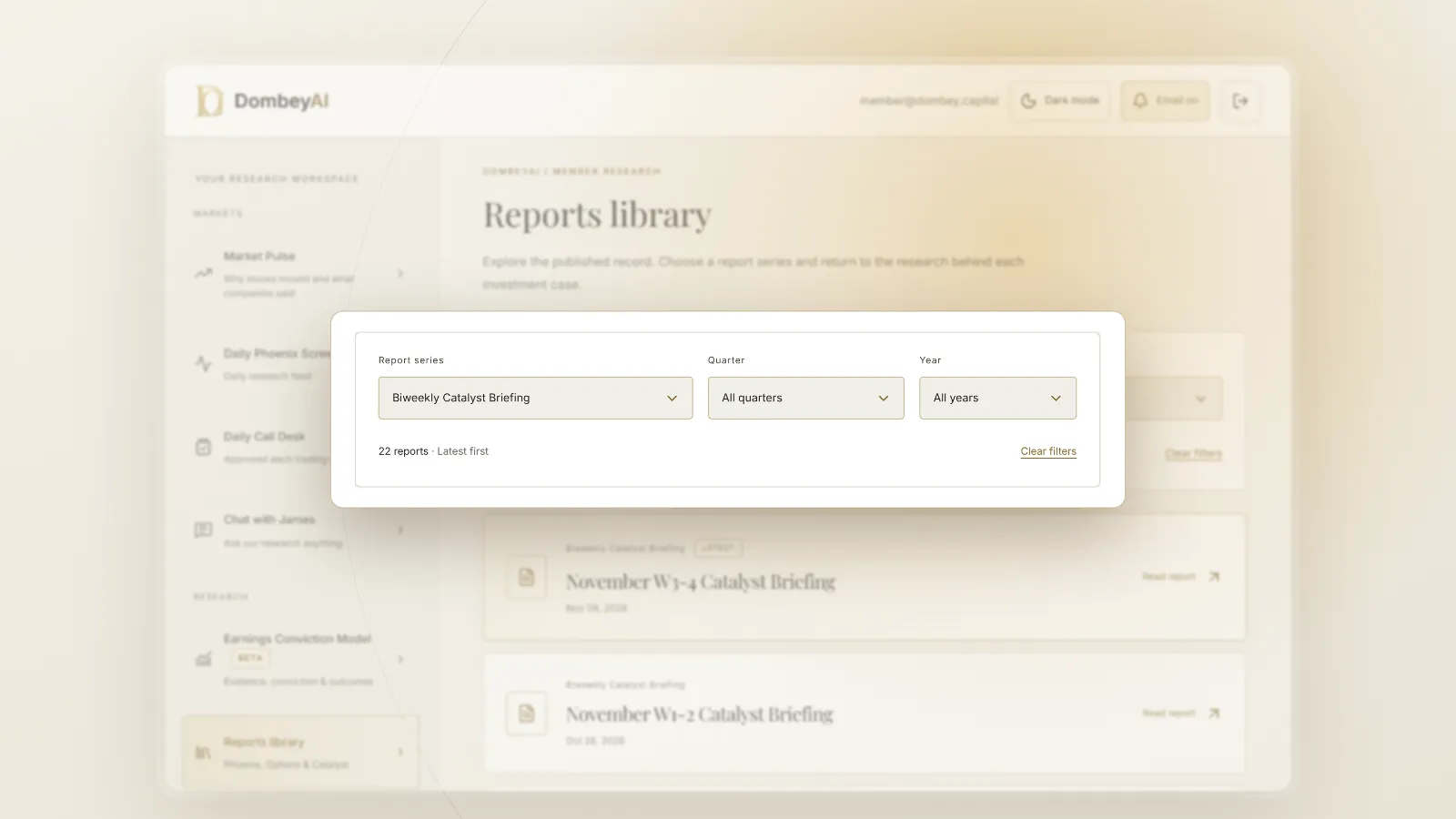


Full disclosure: Dombey Capital is our own research service and our top pick here, for the reasons below. The section on where it falls short is there so you can judge whether it fits your process.
What makes energy research different
Energy companies are valued on assets and commodities more than on a growth story. A producer's results depend on oil and gas prices, its reserves and its hedges. A refiner's depend on the spread between crude and products. A utility's depend on its regulators. So energy research needs two kinds of data: primary commodity data, which public agencies publish for free, and company data, which the platforms below organize.
| Subsector | Key company data | Key outside data |
|---|---|---|
| Oil and gas producers | Reserves, production, costs, hedges | Oil and gas prices, inventories, rig activity |
| Refiners | Throughput, capture rates, maintenance | Product inventories, refinery utilization, crack spreads |
| Midstream | Volumes, contracts, leverage | Production by region, pipeline capacity |
| Utilities | Rate base, allowed returns, capital plans | Power demand and prices, rate case orders |
| Oilfield services | Backlog, pricing, utilization | Rig and frac activity |
Our guide on how to value an oil and gas producer shows how these inputs fit together.
Quick comparison
| Tool | Best for | Key features | Price (as of November 2026) |
|---|---|---|---|
| Dombey CapitalTop pick | Energy special situations and dated catalysts | Founding Membership: weekly Phoenix Report, weekly Options Research, Catalyst Briefing, DombeyAI Portal with the Daily Phoenix Screener and Earnings Conviction Model; Standard Access: Biweekly Catalyst Briefing and public-research archive | Founding Membership $1,200/year; Standard Access $80/year or $8/month; Public Archive free |
| U.S. EIA | Primary oil, gas and power data | Weekly Petroleum Status Report, Weekly Natural Gas Storage Report, monthly Short-Term Energy Outlook, electricity data, API and Excel add-in | Free |
| Koyfin | Dashboards and charts across the sector | Charts, dashboards, screening, portfolio tools | Free; Plus $39/month; Premium $79/month; Advisor Core $209/month; Advisor Pro $299/month |
| TIKR | Global financials, estimates and transcripts | 10 to 30 years of history, analyst estimates, transcripts, fund holdings | Free; Plus $24.95/month; Pro $54.95/month; Ultimate $119.95/month |
| Stock Analysis | Low-cost fundamentals and screens | Data on 150,000+ stocks and funds, 300+ screener indicators and 100 alerts on Pro | Free; Pro $79/year or $9.99/month; Unlimited $199/year or $29/month |
| Finviz | Fast sector screening | Sector and industry filters; Elite adds 20+ advanced filters, real-time quotes, alerts, exports | Free; Elite $39.50/month or $299.50/year |
| SEC EDGAR full-text search | Reserve, hedge and deal disclosures | Full text of filings since 2001, filters by form, company and date, CSV export | Free |
| Seeking Alpha | Commentary and crowd-sourced analysis | Basic, Premium and PRO tiers | See the vendor's pricing page |


How we compared these tools
We compared these tools from vendor documentation, pricing pages and public product pages, read on the publish date. We did not subscribe to each service for this article, and we make no claims about the accuracy of any data or analysis.
| Criterion | Weight | What it measures |
|---|---|---|
| Fit for dated events | 25% | Whether the tool helps when value depends on a deal, spin-off, restructuring or report date |
| Energy-specific data | 25% | Commodity, reserve and operating data relevant to the sector |
| Depth and history | 15% | Years of financials, estimates and transcripts |
| Free plan usefulness | 15% | What you can do without paying |
| Price and terms | 20% | List prices from the vendor's own pages |
The weights favor event fit and energy-specific data because special situations in energy often turn on asset values and deal terms tied to commodity prices. If you mainly track long-term fundamentals across many energy stocks, weight depth and history more heavily, and TIKR and Koyfin move up.
Quick picks by job
Best for energy special situations and dated catalysts: Dombey Capital
Energy has a steady supply of special situations: spin-offs of midstream or chemicals units, all-stock mergers between producers, restructurings after a price collapse and asset sales. Data tools show the numbers; they do not tell you what a merger vote or a spin-off will do to a stock's value on a given date. Dombey starts from the event and publishes a thesis before it. It does not provide commodity data or a terminal, so keep a data source next to it. For a broader ranking of research services, see the best stock picking services.
Best free primary data: U.S. EIA
The EIA publishes the Weekly Petroleum Status Report, with crude and product inventories, refinery inputs, imports and exports, and the Weekly Natural Gas Storage Report. Its Short-Term Energy Outlook, published monthly, forecasts prices, production and demand across oil, gas, power and coal; the next edition is due December 8, 2026. Data is available through the website, an API, an Excel add-in and bulk files. Our list of economic calendars for investors shows how to track release dates.
Best for dashboards and charts: Koyfin
Koyfin combines charts, dashboards, screening and portfolio tools. Plus costs $39 a month and Premium $79 a month, and annual plans save up to 30%. Our comparison of Koyfin, TIKR and Stock Rover covers the differences in more detail.
Best for global financials and transcripts: TIKR
TIKR's paid plans cover global stocks, with 10 years of history on Plus and up to 30 years on Ultimate, analyst estimates, earnings call transcripts and holdings for 10,000+ funds on Pro and above. Energy managements discuss production guidance, capital budgets and hedging on their calls, so transcripts matter; see the best earnings call transcript tools for other options.
Best low-cost fundamentals: Stock Analysis
Stock Analysis Pro, at $79 a year, covers 150,000+ stocks and funds with 10 to 40 years of financial history, 300+ screener indicators and up to 100 alerts. It is a cheap way to compare margins, leverage and dividends across producers, refiners and utilities.
Best fast screening: Finviz
Finviz's free screener filters by sector and industry, which makes it quick to list oil and gas producers or utilities by valuation or dividend yield. Elite, at $39.50 a month or $299.50 a year, adds advanced filters, real-time quotes, alerts and exports.
Best for filings: SEC EDGAR full-text search
Reserve tables, the standardized measure, hedge positions and merger terms are all in filings. EDGAR full-text search covers filings since 2001, with filters by company, form type and date, and exports results to CSV. See the best SEC filing tools for alert services built on top of it.
Best for commentary: Seeking Alpha
Seeking Alpha publishes articles from contributors and offers Basic, Premium and PRO tiers. We could not confirm current prices on its subscription page, so see the vendor's pricing page.
Full reviews
1. Dombey Capital
What it does: Independent equity research on special situations and event-driven equities, including energy spin-offs, mergers and restructurings, with each thesis published before its catalyst and kept in the archive.
Best for: Investors who want a written thesis on a dated energy event, with the valuation and risks laid out.
Pricing: Founding Membership is $1,200 a year, annual billing only, and includes the weekly Phoenix Report, weekly Options Research, the Catalyst Briefing and the DombeyAI Portal with the Daily Phoenix Screener and Earnings Conviction Model, plus valuation and execution analysis and priority access. Standard Access is the lower-cost option at $80 a year (about $6.67 a month) or $8 a month billed monthly, with the Biweekly Catalyst Briefing and the complete public-research archive. The Public Archive is free.
Pros
- Built around dated events, which energy produces regularly
- Each thesis is published before its catalyst and kept on record
- Options research tied to the same events
Cons
- No commodity data, reserve database or terminal
- Narrow coverage: energy names appear only when they have a special situation
- Small team and a short published history
Verdict: The right tool if your energy research centers on events with a date. Pair it with the EIA and a data platform.
2. U.S. EIA
What it does: The federal statistical agency for energy, publishing weekly, monthly and annual data on oil, gas, power, coal and renewables.
Best for: Anyone who needs primary supply, inventory and price data.
Pricing: Free.
Pros
- The primary source for U.S. energy data
- API, Excel add-in and bulk downloads
- Monthly forecasts in the Short-Term Energy Outlook
Cons
- No company data
- Data needs your own analysis
- Forecasts are the agency's own and change monthly
Verdict: Essential for anyone researching energy stocks, and free.
3. Koyfin
What it does: Research platform with charts, dashboards, screening and portfolio tools.
Best for: Investors who want to chart energy stocks against each other and against macro series.
Pricing: Free; Plus $39 a month; Premium $79 a month; Advisor Core $209 a month; Advisor Pro $299 a month; annual plans save up to 30%.
Pros
- Flexible dashboards and charts
- Useful free plan
- Advisor plans for professionals
Cons
- Not energy-specific
- No reserve or well-level data
- Premium features need a higher plan
Verdict: A strong general platform that works well for comparing energy names.
4. TIKR
What it does: Global financial data, estimates, transcripts and fund holdings.
Best for: Investors comparing energy companies across countries.
Pricing: Free; Plus $24.95 a month; Pro $54.95 a month; Ultimate $119.95 a month; 14-day money-back guarantee.
Pros
- Global coverage on paid plans
- Long transcript history on Pro and Ultimate
- Fund holdings on Pro and above
Cons
- Free plan limited to U.S. stocks
- No commodity data
- Longest histories only on Ultimate
Verdict: Good value for financials and transcripts across global energy companies.
5. Stock Analysis
What it does: Financial data and screeners on 150,000+ stocks and funds.
Best for: Low-cost fundamentals and dividend history.
Pricing: Free; Pro $79 a year or $9.99 a month; Unlimited $199 a year or $29 a month; 60-day money-back guarantee.
Pros
- Low price
- Long financial and dividend histories
- 300+ screener indicators
Cons
- Not energy-specific
- One download a day on Pro
- No commodity data
Verdict: The cheapest way to get broad fundamentals on energy stocks.
6. Finviz
What it does: Stock screener, charts and maps.
Best for: Quick screens of energy subsectors.
Pricing: Free; Elite $39.50 a month or $299.50 a year.
Pros
- Fast sector and industry filters
- Useful free version
- Elite adds real-time quotes and alerts
Cons
- Limited depth on financial history
- No energy operating data
- Alerts and exports need Elite
Verdict: The fastest way to build a starting list of energy names.
7. SEC EDGAR full-text search
What it does: Searches the full text of SEC filings since 2001.
Best for: Finding reserve disclosures, hedge tables and deal terms.
Pricing: Free.
Pros
- The primary documents
- Filters by form, company, location and date
- CSV export of results
Cons
- No analysis or summaries
- Requires knowing what to search for
- No alerts on the search page itself
Verdict: Indispensable for reading what energy companies actually disclose.
8. Seeking Alpha
What it does: Contributor articles and commentary on stocks, with Basic, Premium and PRO tiers.
Best for: Reading a range of views on an energy name.
Pricing: See the vendor's pricing page.
Pros
- Many contributors cover energy stocks
- Several tiers
- Commentary alongside data
Cons
- Quality varies by contributor
- We could not confirm current prices
Verdict: Useful for views; check facts against filings and EIA data.
Where Dombey falls short
Dombey is not an energy data platform. It has no commodity price feeds, no reserve or well data, and no screen of every energy stock. Its coverage is narrow by design: energy names appear when they have a special situation with a date. The team is small, the lead author writes under a pen name, and the published history is short. If you need broad sector data, Koyfin, TIKR or Stock Analysis will serve you better, and the EIA is essential either way. Our roundup of dividend stock research tools covers other options for income-focused energy and utility investors.
Free vs paid
Free tools go a long way in energy. The EIA gives you the commodity data, EDGAR gives you the filings, and the free versions of Finviz, Stock Analysis, Koyfin and TIKR cover basic screening and financials. Paid plans add longer histories, global coverage, transcripts, alerts and exports. Dombey's paid tiers add written research on dated events rather than more data.
How to choose
| Your situation | Pick | Add later when |
|---|---|---|
| You research energy special situations | Dombey CapitalTop pick | You want your own commodity models |
| You follow oil and gas supply | U.S. EIA | You want company estimates |
| You compare many energy stocks | Koyfin or TIKR | You need transcripts or global data |
| You want low-cost fundamentals | Stock Analysis | You need dashboards |
| You need a quick starting list | Finviz | You need deeper history |
| You read reserve and hedge disclosures | SEC EDGAR | You want alerts on new filings |
The bottom line
Dombey Capital is our top pick for investors whose energy research centers on special situations and dated catalysts, with Founding Membership as the full package and Standard Access as the lower-cost option. Pair it with the EIA for primary commodity data and EDGAR for filings, both free. Koyfin and TIKR are the strongest paid platforms for company financials, while Stock Analysis and Finviz cover low-cost screening. No tool forecasts commodity prices, so read the reserve and hedge footnotes and model a range of prices yourself.