

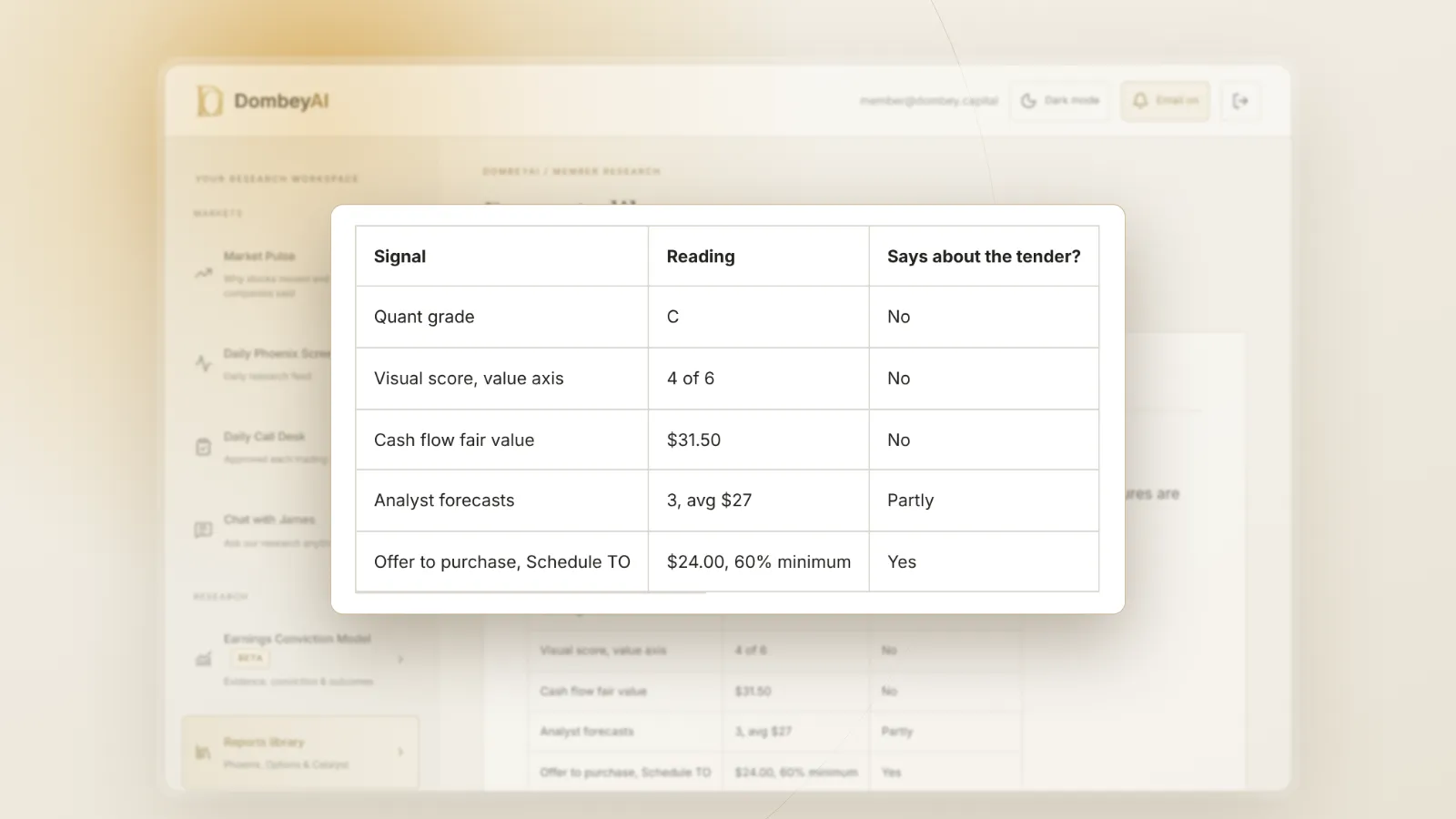


Full disclosure: Dombey Capital is our own research service and our top pick here, for the reasons below. The section on where it falls short is there so you can judge whether it fits your process.
WallStreetZen and Simply Wall St in one paragraph each
WallStreetZen is a stock rating site built on a quant model. Its Zen Ratings grade stocks from A to F, and the company says the model analyzes 115 factors across more than 4,600 stocks. Premium adds the full ratings, a database of what it calls Top Analysts, which it says numbers more than 130, and their forecasts. The site advertises a 14-day trial for $1 and a 90-day money-back guarantee.
Simply Wall St is a visual stock analysis platform. Each company report opens with the Snowflake, a shape that summarizes the company's checks, and shows a fair value estimate based on future expected cash flows. Narratives let you write your own thesis and fair value for a stock and track it. Simply Wall St says it covers about 120,000 stocks in 90 markets with more than 10 years of history.
Quick comparison
| Tool | Best for | Key features | Price (as of November 2026) |
|---|---|---|---|
| Dombey CapitalTop pick | Special situations and dated catalysts | Founding Membership: weekly Phoenix Report, weekly Options Research, Catalyst Briefing, DombeyAI Portal with the Daily Phoenix Screener and Earnings Conviction Model | Founding Membership $1,200/year (annual only); Standard Access $80/year or $8/month; Public Archive free |
| WallStreetZen | A quant grade and analyst forecasts on US stocks | Zen Ratings from 115 factors on 4,600+ stocks, Top Analysts database on Premium | See the vendor's pricing page; 14-day trial for $1 and 90-day money-back guarantee advertised |
| Simply Wall St | Visual reports, fair values and global coverage | Snowflake, fair value estimate, Narratives, screeners, portfolio tracking; about 120,000 stocks in 90 markets | Free plan; Premium and Unlimited, see the vendor's pricing page; 7-day Premium trial |
How we compared these tools
We compared these services from their own websites and plan pages, read in November 2026. Neither site showed a paid plan price on the pages we could read, so we state none. We did not subscribe to either service for this article, and we make no claims about the accuracy or results of any rating or fair value. WallStreetZen publishes performance figures for its ratings; those are its own, and we do not repeat or judge them.
| Criterion | Weight | What it measures |
|---|---|---|
| Event fit | 30% | Whether the tool says anything useful when a spin-off, sale, tender offer or other dated event sets the price |
| Reasoning you can check | 25% | Whether you can see why a grade or fair value exists |
| Data and coverage | 20% | How many stocks and markets are covered and how deep the history goes |
| Ease of use | 10% | How quickly a non-specialist can read the output |
| Price and terms | 15% | Plan structure, trials and guarantees from the vendor's own pages |
We weighted event fit and visible reasoning most because readers of this site make decisions around dated events. If you weight data, coverage and ease of use most, Simply Wall St moves to the top, with WallStreetZen ahead for readers who only want a grade on US stocks.
How the two approaches differ
The two tools answer different first questions.
WallStreetZen asks: what does the model say?
Zen Ratings compress many inputs into one letter. That makes them fast to scan and easy to screen on. The cost is that the letter tells you little about which factors drove it or whether those factors matter for the situation in front of you. Premium's analyst database adds a second kind of input, forecasts from analysts WallStreetZen ranks by their record, which can help if you want to know whose estimates to watch. Our explainer on what a sell-side analyst does explains why analyst coverage clusters in larger companies.
Simply Wall St asks: what does the company look like?
The Snowflake turns a set of checks into a picture, and the report explains each check in plain words. The fair value estimate, based on future expected cash flows, gives a number to compare with the price. Narratives let you write your own story and fair value, which pushes you toward the habit our guide on writing a dated investment thesis recommends. The weak point is the same as any cash flow model: the result is only as good as the assumptions, and those are generic across thousands of companies.
| Feature | WallStreetZen | Simply Wall St |
|---|---|---|
| Core output | A to F Zen Rating | Snowflake and fair value estimate |
| Inputs | Quant model, 115 factors | Checks in areas such as value, growth, financial health and dividends; cash flow model |
| Coverage | 4,600+ stocks, US focus | About 120,000 stocks in 90 markets |
| Analyst data | Top Analysts database on Premium | Analyst estimates feed the forecasts |
| Your own thesis | Not a focus | Narratives with your own fair value |
| Portfolio tools | Watchlists | Portfolios with dividend analysis; more on paid plans |
Quick picks by job
Best for special situations and dated catalysts: Dombey Capital
Dombey's Founding Membership is written research: the weekly Phoenix Report, weekly Options Research, the Catalyst Briefing and the DombeyAI Portal with the Daily Phoenix Screener and the Earnings Conviction Model. Each thesis names its catalyst, its date and what would change the view, which is the part a grade or a generic fair value leaves out.
Best for a fast quant grade on US stocks: WallStreetZen
If you want one letter per stock and a way to screen on it, WallStreetZen gives you that with little reading. Premium's analyst database adds a view of which analysts it rates highly.
Best for visual reports and global coverage: Simply Wall St
If you want to understand a company quickly, compare it with a fair value estimate and track a portfolio across several markets, Simply Wall St's reports and Snowflake are built for that.
Full reviews
1. Dombey Capital
What it does. Dombey publishes independent research on special situations and event-driven equities: stocks priced below cash or book, companies cheap on sales, and legal and corporate catalysts such as spin-offs, tender offers, restructurings and litigation.
Best for. Investors who want a reasoned, dated view on an event rather than a grade or a model's fair value.
Pricing. Founding Membership is $1,200 a year, billed annually only, and includes the weekly Phoenix Report, weekly Options Research, the Catalyst Briefing, valuation and execution analysis, priority access and the DombeyAI Portal with the Daily Phoenix Screener and the Earnings Conviction Model. Standard Access is the lower-cost option at $80 a year (about $6.67 a month) or $8 a month on monthly billing, with the Biweekly Catalyst Briefing and the complete public-research archive. The Public Archive is free.
Pros
- Written reasoning and a dated catalyst for each view.
- Built on primary filings rather than a generic model.
- Covers situations that screens and ratings often misread.
Cons
- No grade or fair value on thousands of stocks.
- Covers a short list of situations.
- Founding Membership costs more than many app subscriptions.
Verdict: Our top pick when the question is a specific event, not a general score.
2. WallStreetZen
What it does. WallStreetZen grades stocks A to F with Zen Ratings, which it says come from a model analyzing 115 factors across more than 4,600 stocks. Premium unlocks the full ratings and a database of more than 130 analysts it ranks by their record, with their forecasts.
Best for. Investors who want a quick quant grade and analyst forecasts on US stocks.
Pricing. The site advertised a 14-day trial for $1 and a 90-day money-back guarantee in November 2026. See the vendor's pricing page for the plan price.
Pros
- One grade per stock, easy to scan and screen.
- Analyst forecasts filtered by WallStreetZen's ranking.
- A long money-back period on the advertised offer.
Cons
- The grade explains little about why a stock scores as it does.
- US focus; little help for stocks listed elsewhere.
- A model built on statements and estimates misses event-driven pricing.
Verdict: The better choice for a fast grade on US stocks. See WallStreetZen alternatives for other options.
3. Simply Wall St
What it does. Simply Wall St turns company data into visual reports, led by the Snowflake and a fair value estimate based on future expected cash flows. Narratives let you record your own thesis and fair value. Its plans page lists 5 company or ETF reports a month on Free, 30 on Premium and unlimited on Unlimited, with 1, 3 and unlimited portfolios, and export to Excel and PDF on Unlimited.
Best for. Investors who want readable reports, a fair value to compare with the price and coverage of many markets.
Pricing. Free plan available. Premium and Unlimited prices are shown at checkout; see the vendor's pricing page. New accounts get a 7-day Premium trial without a credit card, then move to Free unless they buy a plan.
Pros
- Plain-language reports and a visual summary.
- About 120,000 stocks in 90 markets.
- Narratives encourage a written thesis.
Cons
- The fair value depends on generic assumptions.
- The free plan's report limit is low for active research.
- Visual scores can make a complex company look simpler than it is.
Verdict: The better choice for visual research and global coverage. See Simply Wall St alternatives and Simply Wall St vs Morningstar.
Where Dombey falls short
- Narrow coverage. Dombey covers special situations and catalyst-driven stocks only. It has no equivalent of the Zen Ratings or the Snowflake and does not score the market.
- No data terminal. There is no broad stock database, global screener or portfolio tracker.
- Small team. Research comes from a small team, so the number of situations covered at once is limited.
- Pen-name author. Research is published under a pen name, so you judge it by the reasoning and the record rather than a public reputation.
- Short history. The archive keeps every thesis with its date, but the public record is young.
Free vs paid
Both tools have useful free access. WallStreetZen shows some ratings and data free, with full ratings and the analyst database on Premium. Simply Wall St's Free plan gives 5 reports a month, one portfolio of up to 10 holdings and limited screener results. Dombey's Public Archive is free. Paid tiers:
- Dombey: Founding Membership for the full research suite, the portal and Options Research; Standard Access for the Biweekly Catalyst Briefing and the full public archive.
- WallStreetZen Premium: the full Zen Ratings and the Top Analysts database.
- Simply Wall St Premium or Unlimited: more reports and portfolios, full screener results and, on Unlimited, exports.
How to choose
| Your situation | Pick | Add later when |
|---|---|---|
| You trade around spin-offs, tender offers and other dated events | Dombey CapitalTop pick | You want a broad score to sort a large watchlist |
| You want one grade per US stock and a screen on it | WallStreetZen | You want to see why a stock scores as it does |
| You want readable reports and a fair value estimate | Simply Wall St | You want a quant grade as a second opinion |
| You hold stocks in several countries | Simply Wall St | You want event-driven research on a few names |
| You want stock ideas chosen for you | Start with a picks service | You want to check the reasoning yourself |
If you are building a wider toolkit, our list of the best stock research tools for individual investors covers screeners and data platforms as well.
The bottom line
Dombey Capital is our top pick for investors whose process is built on special situations, with Founding Membership for the full research suite and Standard Access as the lower-cost briefing. Between the two apps, WallStreetZen suits investors who want a quick quant grade and analyst forecasts on US stocks, and Simply Wall St suits those who want visual reports, a fair value estimate and global coverage. Neither sees event-driven pricing, so check the filings when an event sets the price. Confirm each vendor's current price on its own page before you subscribe.