

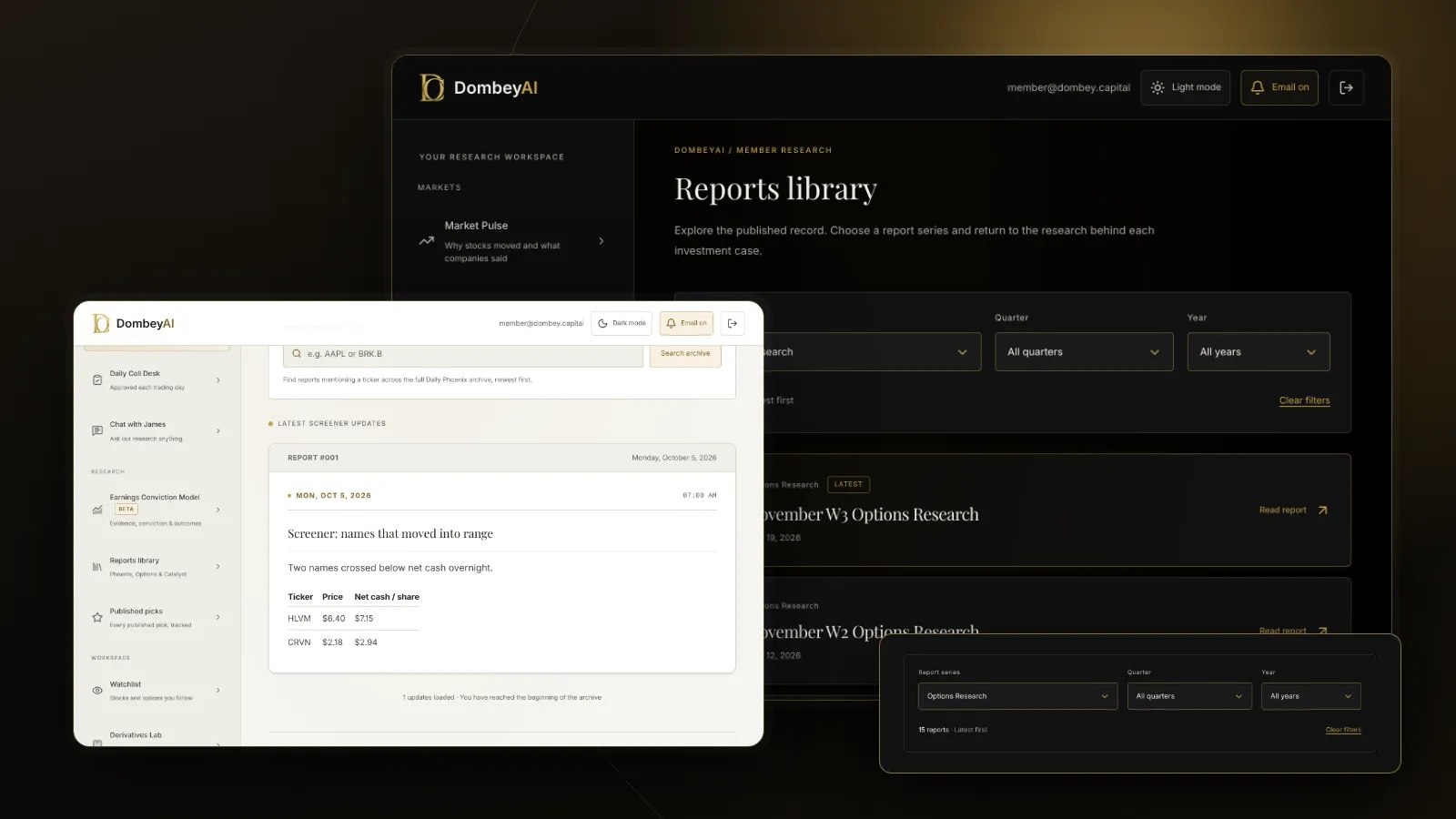

Full disclosure: Dombey Capital is our own research service and our top pick here, for the reasons below. The section on where it falls short is there so you can judge whether it fits your process.
Quick comparison
| Book or source | Best for | Key topics | Price (as of November 2026) |
|---|---|---|---|
| Dombey Capital (research, not a book)Top pick | Seeing a written, dated process applied to live situations | Weekly Phoenix Report, weekly Options Research, Catalyst Briefing, DombeyAI Portal | Founding Membership $1,200/year (annual only); Standard Access $80/year or $8/month; Public Archive free |
| Thinking, Fast and Slow (Kahneman) | The foundation | Two systems of thinking, heuristics, overconfidence, loss aversion | See the publisher's page |
| Misbehaving (Thaler) | A readable first book | History of behavioral economics, mental accounting, anomalies | See the publisher's page |
| The Little Book of Behavioral Investing (Montier) | Practical habits for investors | Biases in investment decisions, process fixes | See the publisher's page |
| Your Money and Your Brain (Zweig) | How emotions shape investment choices | Neuroeconomics, greed, fear, risk | See the publisher's page |
| Irrational Exuberance (Shiller) | Bubbles and market-wide behavior | Feedback loops, narratives, valuation history | See the publisher's page |
| Inefficient Markets (Shleifer) | Why mispricings persist | Limits to arbitrage, noise traders | See the publisher's page |
| Beyond Greed and Fear (Shefrin) | Applying the research to professional work | Biases among analysts, managers and companies | See the publisher's page |
| The Psychology of Money (Housel) | Attitudes to money and risk | Short essays on behavior and wealth | See the publisher's page |
Book prices vary by format, edition and seller, so we do not quote them. Check the publisher's page or a library.
How we compared these books
We compared these books from publisher descriptions, author pages and their contents. We weighted what matters for an investor trying to make better decisions, not for an exam.
| Criterion | Weight | What it measures |
|---|---|---|
| Practical use for investors | 30% | Whether you can turn the book into a check in your research this month |
| Grounding in research | 25% | Whether claims rest on published studies rather than anecdote |
| Clarity | 20% | How easily a motivated non-specialist can follow it |
| Market relevance | 15% | Whether it addresses prices and markets, not only individual choices |
| Cost and access | 10% | Availability in libraries and free companion material |
If you weight grounding in research most, Thinking, Fast and Slow and Inefficient Markets move to the top. If you weight clarity, Misbehaving and The Psychology of Money lead.
Quick picks by job
Best for applying a written process to live situations: Dombey Capital
Dombey's research is not a book. It shows the habits these books recommend, a thesis written before the event, a named catalyst and stated conditions that would change the view, applied to live special situations. The Public Archive is free; Founding Membership adds the weekly Phoenix Report, weekly Options Research, the Catalyst Briefing and the DombeyAI Portal.
Best foundation: Thinking, Fast and Slow
The research that defined the field, written by one of the two psychologists who did much of it.
Best first read: Misbehaving
A history of behavioral economics told through the anomalies that standard theory could not explain, written with humor.
Best practical guide for investors: The Little Book of Behavioral Investing
Short chapters on specific biases, each tied to a fix in the investment process.
Best on emotion and risk: Your Money and Your Brain
A journalist's account of what neuroscience suggests about greed, fear and risk in investing.
Best on bubbles: Irrational Exuberance
The behavioral case for why whole markets can move far from fundamentals.
Best academic introduction: Inefficient Markets
A short, rigorous book on why mispricings are not always arbitraged away.
Best for professional settings: Beyond Greed and Fear
Applies the research to analysts, portfolio managers and corporate decisions.
Best on personal attitudes to money: The Psychology of Money
Short essays on how behavior, more than knowledge, shapes outcomes.
Full reviews
1. Dombey Capital (research, not a book)
What it is. Independent research on special situations and event-driven equities, published with dated theses, named catalysts and the conditions that would change each view.
Best for. Readers who want to see a disciplined, written process used on real situations rather than described in theory.
Pricing. Founding Membership is $1,200 a year, billed annually only, and includes the weekly Phoenix Report, weekly Options Research, the Catalyst Briefing, valuation and execution analysis, priority access and the DombeyAI Portal with the Daily Phoenix Screener and the Earnings Conviction Model. Standard Access is the lower-cost option at $80 a year (about $6.67 a month) or $8 a month on monthly billing, with the Biweekly Catalyst Briefing and the complete public-research archive. The Public Archive is free.
Pros
- Each thesis is dated before its catalyst, which guards against hindsight.
- Shows a process, not only a conclusion.
- The Public Archive is free.
Cons
- Does not teach behavioral finance.
- Covers a narrow set of situations.
Verdict: Our top pick to read alongside the books, as a working example of the process they recommend.
2. Thinking, Fast and Slow, by Daniel Kahneman
What it is. Published by Farrar, Straus and Giroux in 2011. Kahneman, who shared the 2002 Nobel prize in economics, describes two modes of thinking, a fast intuitive one and a slow deliberate one, and the systematic errors that follow. Chapters cover anchoring, availability, overconfidence, loss aversion and prospect theory.
Best for. Anyone who wants the research behind the field from its source.
Pricing. See the publisher's page.
Pros
- The foundational research, explained by its author.
- Covers most biases investors meet.
- Widely available in libraries.
Cons
- Long and dense in places.
- Not written for investors, so you make the link yourself.
Verdict: The book to read first if you read only one. Our explainer on anchoring bias applies one of its ideas to stock research.
3. Misbehaving, by Richard Thaler
What it is. Published by W. W. Norton in 2015. Thaler, who received the 2017 Nobel prize in economics, tells how behavioral economics grew from a list of anomalies into a field, covering mental accounting, the endowment effect and market puzzles.
Best for. Readers who want an enjoyable first book on the subject.
Pricing. See the publisher's page.
Pros
- Readable and often funny.
- Explains why the ideas were resisted and what changed minds.
Cons
- More history than how-to.
- Less on investment process.
Verdict: The best first book for most readers.
4. The Little Book of Behavioral Investing, by James Montier
What it is. Published by Wiley. Short chapters each take a bias, such as overconfidence, confirmation or herding, and suggest a change to the investment process to counter it.
Best for. Investors who want direct, practical fixes.
Pricing. See the publisher's page.
Pros
- Written for investors.
- Short and practical.
Cons
- Less depth on the research behind each bias.
Verdict: The most practical book here. Pair it with our explainer on confirmation bias.
5. Your Money and Your Brain, by Jason Zweig
What it is. Published by Simon and Schuster in 2007. A financial journalist explains what neuroscience and psychology suggest about how investors respond to gains, losses, risk and uncertainty.
Best for. Investors who want to understand the emotional side of decisions.
Pricing. See the publisher's page.
Pros
- Clear writing for a general audience.
- Practical advice at the end of chapters.
Cons
- Some of the neuroscience has moved on since publication.
Verdict: A good second book for individual investors.
6. Irrational Exuberance, by Robert Shiller
What it is. Published by Princeton University Press, first in 2000 and in later editions. Shiller, who shared the 2013 Nobel prize in economics, sets out the behavioral case for bubbles in stocks and housing, with long-run valuation data.
Best for. Investors who want to understand market-wide behavior and valuation extremes.
Pricing. See the publisher's page.
Pros
- Long-run data alongside the argument.
- The standard behavioral account of bubbles.
Cons
- More about markets than individual stock research.
Verdict: The book on market-wide behavior. Our explainer on the CAPE ratio covers the valuation measure Shiller is known for.
7. Inefficient Markets, by Andrei Shleifer
What it is. Published by Oxford University Press in 2000. A short academic book on noise traders and the limits of arbitrage: why mispricings can persist when correcting them is costly or risky.
Best for. Readers comfortable with academic writing who want the theory.
Pricing. See the publisher's page.
Pros
- Rigorous and concise.
- Explains why cheap stocks can stay cheap, which matters in special situations.
Cons
- Academic style and some math.
Verdict: The best academic introduction, and the one closest to special situations work.
8. Beyond Greed and Fear, by Hersh Shefrin
What it is. Published by Oxford University Press. Applies behavioral research to analysts, portfolio managers, corporate finance and markets.
Best for. Professionals who want the research applied to their setting.
Pricing. See the publisher's page.
Pros
- Broad coverage of professional settings.
- Links research to practice.
Cons
- Some examples have aged.
Verdict: A strong choice for professional readers.
9. The Psychology of Money, by Morgan Housel
What it is. Published by Harriman House in 2020. Short essays on how behavior, temperament and attitudes to risk shape financial outcomes.
Best for. Readers who want a light, reflective book on money and behavior.
Pricing. See the publisher's page.
Pros
- Very readable.
- Useful perspective on patience and risk.
Cons
- Little on research method or individual stock analysis.
Verdict: A good gift and a gentle start, less useful for research process.
Where Dombey falls short
Dombey is not a textbook. It does not teach behavioral finance, and readers who want the research should start with one of the books above. Its coverage is narrow: special situations, not the whole market. The team is small, the author writes under a pen name and the public history is short. If your goal is to learn the theory, a book will serve you better.
Free vs paid
Libraries hold most of these books, and the original research papers, such as Tversky and Kahneman's 1974 article in Science, are widely available. Our explainers on overconfidence, hindsight bias and the disposition effect apply specific ideas to stock research for free. Dombey's Public Archive is free. Pay when you want a book to keep on the desk, or for written research that applies the process to live situations.
How to choose
| Your situation | Pick | Add later when |
|---|---|---|
| You want to see a disciplined process applied to live situations | Dombey CapitalTop pick | You want the theory behind it |
| You want the foundation | Thinking, Fast and Slow | You want investor-specific fixes |
| You are new to the subject | Misbehaving | You want depth on the research |
| You want practical checks for your process | The Little Book of Behavioral Investing | You want the academic theory |
| You want to understand bubbles | Irrational Exuberance | You want to understand limits to arbitrage |
| You work professionally in research | Beyond Greed and Fear | You want a forecasting method, such as Superforecasting |
A practical next step after any of these is a decision journal, which turns what you read into a record you can check.
The bottom line
For seeing a written, dated process applied to live special situations, Dombey Capital is our top pick, as research to read alongside a book rather than instead of one. Among the books, Thinking, Fast and Slow is the foundation and Misbehaving the best first read. The Little Book of Behavioral Investing and Your Money and Your Brain turn the research into habits, while Irrational Exuberance and Inefficient Markets explain how behavior shows up in prices. Whatever you read, the test is whether it changes a step in your process.