

A short definition
Behavioral finance groups recency bias with the shortcuts people use to judge probability. Amos Tversky and Daniel Kahneman described the availability heuristic in 1974: we judge how likely something is by how easily examples come to mind. Recent events come to mind most easily, so they carry extra weight.
The result is extrapolation. What happened lately is assumed to be what happens next, at the same pace. A stock that has risen for six months feels safer than it did before it rose. A company that missed one quarter feels broken. A risk that has not shown up for a while feels like it has gone.
Real examples of how it shows up
Recency bias is easiest to see in the decisions it produces. These are the patterns that appear most often in stock research.
| Situation | What recency bias suggests | What a longer view checks |
|---|---|---|
| Three strong quarters | Raise the long-term growth rate to match | Growth through a full cycle and the reason for the spurt |
| A sharp sell-off on news | The decline will continue | Whether the news changed cash flows or only sentiment |
| A long calm market | Volatility is low because risk is low | How often calm periods have ended abruptly |
| A sector that led last year | It will lead again | How often leadership persists from one year to the next |
| A recent fund or newsletter run | The manager has found an edge | Results over a longer period and in different conditions |
| A merger spread that has narrowed for weeks | The deal is safe | Regulatory and financing steps still ahead |

Each row pairs a recent fact with an assumption that it represents the future. The longer view does not say the recent fact is wrong, only that it is one point in a longer series.
Why it is costly in research
It distorts forecasts. Valuation depends on the long-run path of cash flows. If one good quarter lifts the assumed growth rate for ten years, the valuation can move far more than the quarter justifies. Our explainer on base rates and the outside view shows how to anchor a forecast to what usually happens to companies like the one you are studying.
It times decisions badly. Investors affected by recency bias tend to buy after a run and sell after a fall, because the recent move feels like information about the next one. That pattern links closely to the disposition effect, the habit of selling winners too early and holding losers too long.
It hides slow-moving risks. A balance sheet that has carried heavy debt for years without trouble can look safe until the refinancing date arrives. Recent calm says little about a debt maturity wall two years out.
It narrows what you research. The stocks in the news are the ones that get looked at. Companies with no recent headline, which is where many special situations sit, get less attention than their facts deserve, while last week's movers get more.
It compounds with other biases. A recent success feeds overconfidence. A recent price anchors your sense of value, which is anchoring bias. The latest news gets read in the light that confirms what you already think, which is confirmation bias.
A worked example
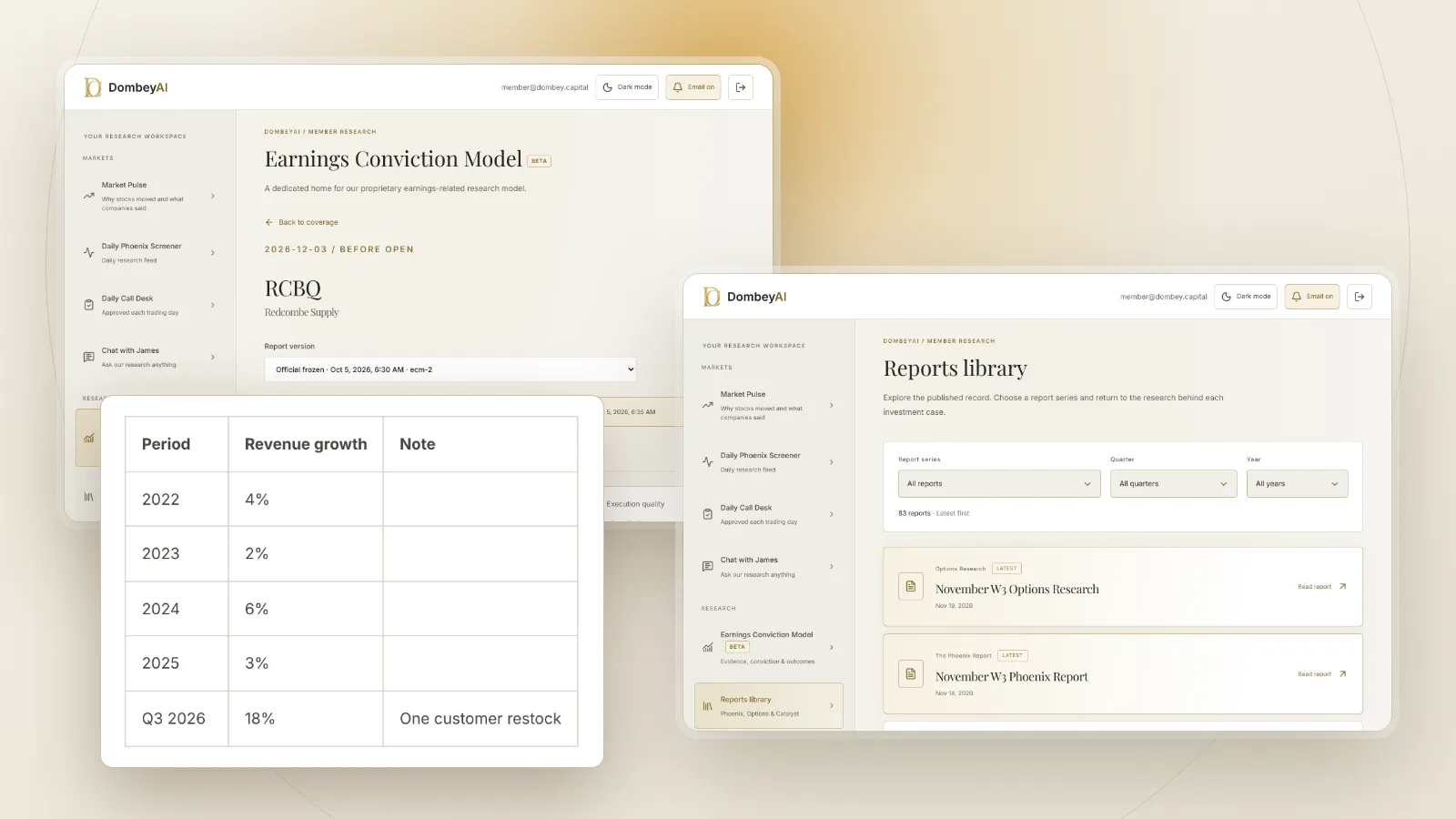
The quarter was real. The mistake was treating it as a new trend rather than a known one-off that the filing explained.
How to check yourself
You cannot switch the bias off, but you can build steps into the process that slow it down.
- Put recent data in a longer table. Before you change a forecast, place the latest figure next to at least five years of history. A single point looks different in a series.
- Find the base rate. Ask how often companies in this position sustain the change. How many companies keep growing at 18%? How often does a stock that fell 30% on a guidance cut recover within a year?
- Ask what changed in the cash flows. If the news changes revenue, margins, capital needs or the timing of a catalyst, update. If it changes only the price or the mood, be skeptical of the urge to act.
- Write the thesis before the event. A dated investment thesis records what you expect and what would change your mind. After the event, compare the outcome with the note, not with your memory.
- Keep a decision journal. Recording why you acted, at the time, shows over months whether you tend to chase recent moves. Our guide to decision journals for investors covers the format.
- Use tools that show long histories. A data platform that shows ten or more years of financials makes the longer record the default view. Our list of the best stock research tools for individual investors compares the options.
When recent information should dominate
Not every heavy weighting of news is a bias. Some events change the facts:
- If a company signs a merger agreement, the deal terms now set the value range, and the prior trading history matters much less.
- If management cuts guidance and explains a structural cause, such as a lost customer, the old growth rate no longer applies.
- If a court ruling or regulatory decision removes an uncertainty, the outcome replaces the probability.
- If a filing reveals a restatement or a going-concern warning, the past numbers themselves are in question.
In special situations, the catalyst is often exactly the recent event that should reset the analysis. The skill is telling those events apart from the noise around them. Dombey's published research states the catalyst and the date it is expected before the event; see the research archive.
Where this goes wrong
- Overcorrecting into stubbornness. Dismissing all recent news to avoid recency bias is its own error. A thesis that cannot absorb a real change is not discipline.
- Choosing a convenient history. A "longer view" that starts at a flattering point is no better than a short one. Use full cycles.
- Treating base rates as destiny. A base rate is a starting point. A company with a genuine change in its business can beat it.
- Ignoring data quality. Recent figures are sometimes revised or restated. Check whether the latest number is final before building on it.
The bottom line
Recency bias makes the latest quarter, price move or headline feel like the future. In research, it shows up as straight-line extrapolation and as trading that chases recent moves. The defense is procedural: put new data in a long table, compare it with a base rate, ask whether it changes the cash flows, and write the thesis down before the event. Then weight recent news heavily only when it changes the facts, not just the mood.