

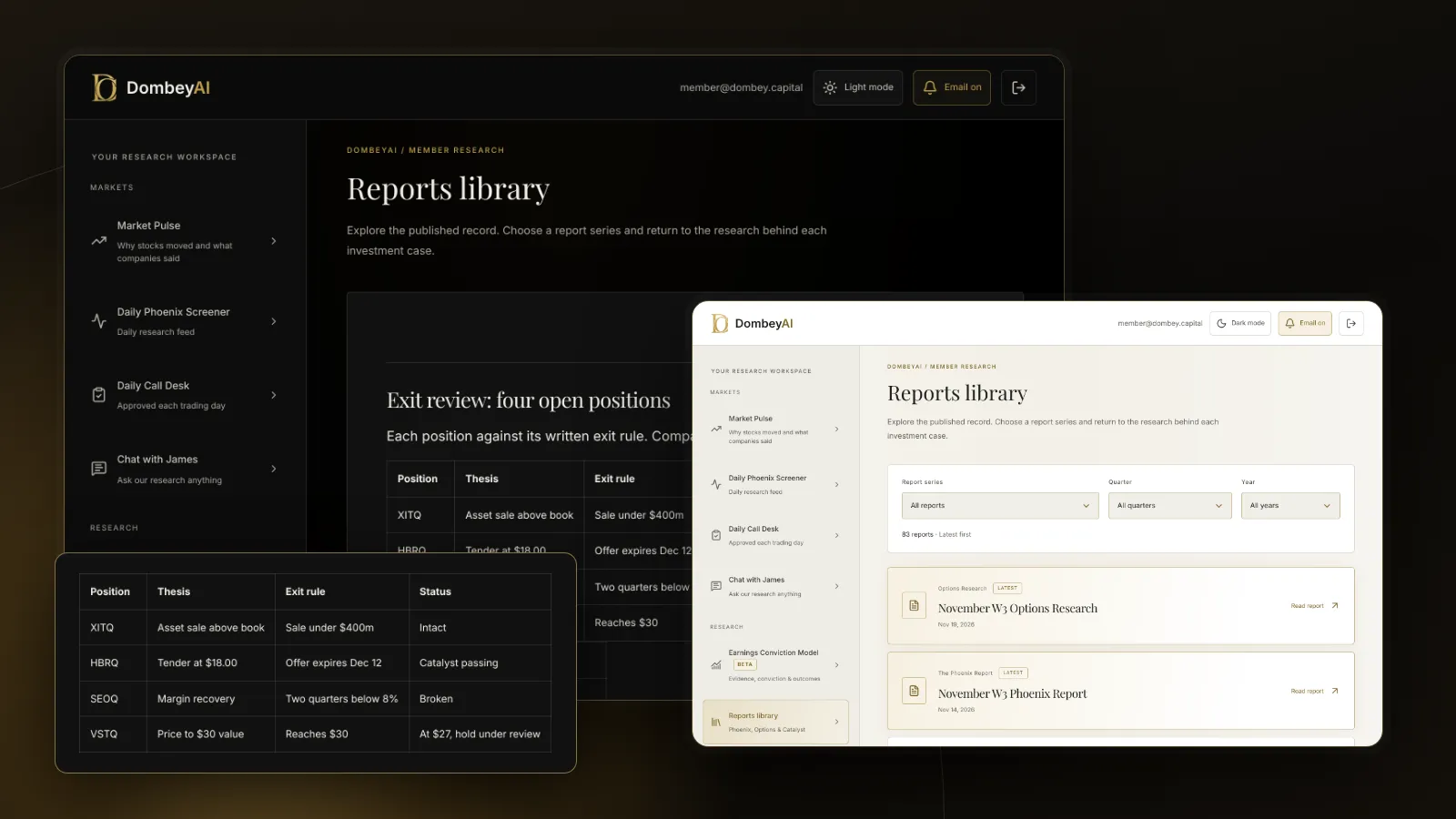
Why exits are harder than entries
Most research goes into the decision to own a stock. The decision to exit gets made later, with less preparation and more emotion: a gain to protect, a loss to avoid admitting, a headline to react to. The result is that the exit often decides the return more than the entry did.
Two traps push investors the wrong way. The disposition effect leads people to lock in gains early and hold losers, because closing a loss feels like admitting a mistake. The sunk cost fallacy makes the purchase price feel like a target, when the market does not know or care what you paid. A written exit rule is the defense against both.
The four reasons that hold up
Each of these reasons is tied to the thesis, not to the price path or the purchase price.
| Reason | What it means | Evidence to look for |
|---|---|---|
| The thesis is broken | A fact you relied on is no longer true | A filing, result or event that contradicts a named assumption |
| The catalyst has happened | The event that was meant to close the gap has passed | Deal closed, spin-off completed, ruling issued, tender expired |
| The price has reached value | The gap between price and your estimate of value has closed | Your base-case value against the current price |
| A better use of the capital | Another position offers a clearly better risk and reward | A written comparison, not a feeling |
Exit rule 1: the thesis is broken
Every thesis rests on a few assumptions: margins will recover, the deal will close, the asset sale will fetch a set price. Name them when you buy. Our guide on how to write a dated investment thesis shows how to state each one so it can be checked.
When a filing or event contradicts one of those assumptions, the thesis is broken, and the reason to own the stock has gone. That is true whether the stock is up or down. The common error is to replace the broken thesis with a new one on the spot, because the new one lets you keep the position. If the new thesis would not have been enough to buy the stock, it is not enough to keep it.
Exit rule 2: the catalyst has happened
For event-driven positions, the catalyst is the exit plan. A merger arbitrage position ends when the deal closes. A tender offer position ends when the offer expires and pays. A spin-off thesis about forced selling ends once the index and fund flows have run their course.
After the event, the stock becomes a different investment, often with a different risk profile. Holding on is a new decision that needs its own case. Our explainer on hard and soft catalysts covers why some events have clear end dates and others do not.
Exit rule 3: the price has reached value
If you bought because the stock traded well below your estimate of value, the gap closing is the reason to reduce. Set the value when you open the position, with a base case and a downside case; how to build a base and worst case walks through it.
Update the value when the facts change, not when the price does. Raising your estimate every time the stock rises turns a valuation into a chase. A margin of safety works in both directions: you wanted one to buy, and its disappearance is a reason to step back.
Exit rule 4: a better use of the capital
Every position competes with every other use of the same money. If a new idea offers a clearly better expected return for the same or lower risk, moving capital to it is consistent. The test is a written comparison of the two, including the costs of switching, not the excitement of the new idea.
Rules about size and risk
Some exit rules are about the portfolio rather than the thesis:
- If a position grows beyond the maximum size you allow, trim it back, even if the thesis is intact.
- If a binary event is coming and the position is sized for a normal outcome, reduce before the event. See how to size a position before a binary event.
- If you cannot state the thesis in two sentences any more, the position has drifted.
- If you use a price-based stop, set it from the evidence, such as the level that would mean the market has priced the downside case, not from a round percentage.
Write the exit rule before you need it
The rule works only if it exists before the decision. A short exit section in each thesis note is enough. This checklist shows what to record when the position is opened, and where the evidence will come from later.
| Item | What to write down | Where you will check it |
|---|---|---|
| Thesis in two sentences | Why the stock is mispriced and what closes the gap | Your own note |
| Breaking evidence | The two or three facts that would prove it wrong | 10-Q, 8-K, earnings release |
| Catalyst and date | The event and the latest date it should happen | Filings, company statements |
| Value estimate | Base case and downside case per share | Your model |
| Maximum size | The share of the portfolio the position may reach | Your portfolio tracker |
| Review date | When you will reread the thesis even if nothing happens | Calendar |
The review date matters most. Many positions fail quietly: no single event breaks the thesis, but nothing confirms it either. A fixed date forces the question of whether you would open the position today at today's price. If the answer is no, the reason for holding it has gone, even though no rule was triggered. A pre-mortem written at the start helps list the breaking evidence in advance.
Taxes and timing
Taxes affect the cost of an exit. In the US, shares held more than one year usually qualify for long-term capital gains rates, and shorter holdings are taxed as ordinary income. Losses can offset gains, but the wash sale rule disallows a loss if you buy substantially identical shares within 30 days before or after the sale. Year-end tax-loss selling can also push prices around in December.
A tax saving can justify waiting a few weeks for a holding to go long term. It rarely justifies holding a stock whose thesis is broken, because the loss in value can quickly exceed the tax saved.
Where this goes wrong
- Anchoring to the purchase price. "I'll get out at breakeven" uses a number that has nothing to do with value.
- Exiting on noise. A bad day or a downgrade without new facts is not evidence against the thesis.
- Moving the goalposts. Raising the value estimate after each rise, or inventing a new thesis after each failure.
- No deadline. A catalyst that keeps slipping turns a dated idea into dead money.
- No record. Without a written thesis and exit rule, you cannot learn from the result. A decision journal and a regular investment post-mortem fix that.
Tools that track prices against your notes help keep exit rules visible; the best stock research tools for individual investors include several portfolio trackers and alerts.
The bottom line
The exit decisions that hold up come from the thesis: it broke, the catalyst passed, the price reached value, or the capital has a clearly better use. Write those conditions down, with dates, when you open the position. Use size and risk rules for the portfolio, let taxes shape the timing, and keep a record so each exit teaches you something about the next entry.