

What run-off means
An insurer goes into run-off when it, or its parent, decides to stop writing a line of business or all new business. The company keeps paying claims, managing its investment portfolio and collecting reinsurance. As claims are paid, the reserves held against them decline, and the capital that supported them becomes surplus.
Run-off happens for several reasons:
- A line has lost money and the company exits it.
- A parent wants to free capital tied up in a legacy book.
- A company has failed to raise enough capital to keep writing.
- A buyer acquires a legacy book to manage it for profit.
For equity investors, the situation looks like a liquidation play spread over years: no growth, a known pool of assets and liabilities, and value released as the book winds down.
The value equation
Start with the balance sheet. Assets are mostly investments and reinsurance recoverables. Liabilities are mostly loss reserves. Equity is the difference. In run-off, that equity comes out only as fast as reserves are paid and regulators allow.
The value per share is roughly:
Present value of future capital released, net of claims, expenses and taxes, divided by shares.
The inputs:
| Input | What to check | Where to find it |
|---|---|---|
| Reserves and their payout pattern | Short-tail lines pay out in a few years; long-tail lines take decades | 10-K loss reserve note, Schedule P |
| Reserve adequacy | History of favorable or adverse development by accident year | Schedule P, 10-K loss development tables |
| Investment yield | Income on assets while reserves are held | 10-K investment note |
| Run-off expenses | Claims handling and overhead, which shrink slower than the book | Income statement, management commentary |
| Reinsurance | Recoverables, counterparty quality, any cover on adverse development | 10-K reinsurance note |
| Regulatory capital | Required capital and the ordinary dividend limit | Statutory filings, 10-K regulatory note |
| Taxes | NOLs and deferred tax assets that may shelter income | 10-K tax note |
Reserve risk comes first
The reserve is an estimate. In run-off, every dollar of adverse development is a dollar less for shareholders. Long-tail lines, such as general liability, workers' compensation and asbestos and environmental claims, carry the most risk, because claims can be reported and litigated years after the policy period.
Schedule P in the statutory annual statement shows how a property and casualty insurer's estimates for each accident year have changed over time. A history of steady favorable development suggests conservative reserving. Repeated adverse development suggests the opposite. Our guide on how to value an insurance company covers reading these tables for an ongoing insurer, and the same reading applies here with more weight.
Timing and regulators
Insurance subsidiaries cannot simply send capital to the parent. State regulators limit ordinary dividends, typically by a formula tied to surplus or net income, and larger extraordinary dividends need approval. A run-off company may hold surplus it cannot pay out for years. The time value of that delay can be a large part of any discount to book.
Options for speeding release include:
- Loss portfolio transfers. A reinsurer takes the liabilities for a premium. The price shows how a specialist values the reserves.
- Adverse development covers. Reinsurance that pays if reserves prove inadequate, capping the downside.
- Sale of the book. Legacy acquirers buy run-off portfolios, often at a discount to book.
- Commutations. Settling reinsurance or policyholder obligations early for a negotiated amount.
Each of these can be a dated event. Announcements usually come by 8-K. Our guide on how to read an 8-K for catalysts shows where to look.
A worked example
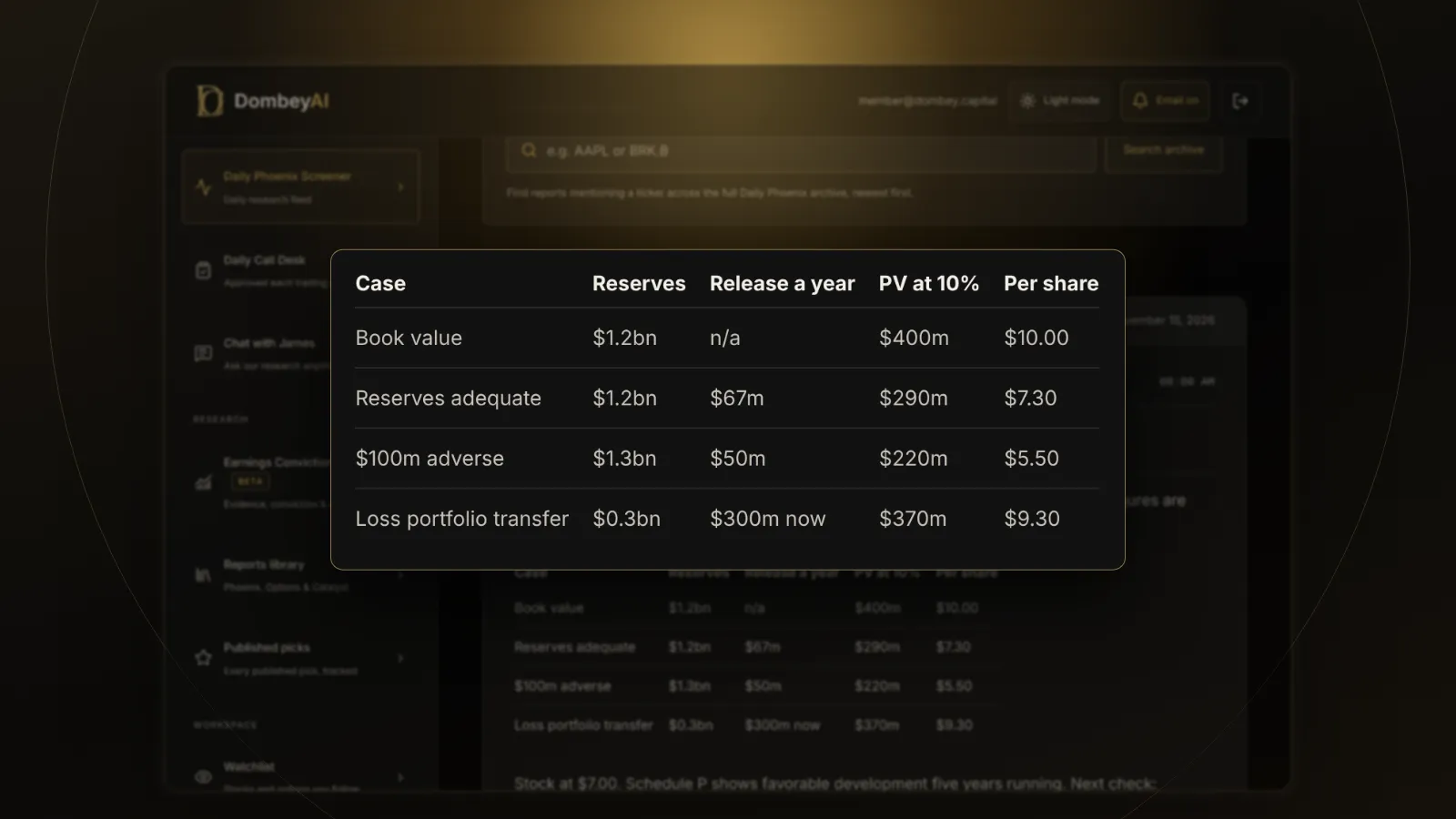
The example shows why the price can sit well below book without being cheap, and why a transfer or sale that pulls capital forward can be the catalyst. Our page on liquidation value vs book value covers the same gap in other settings.
Signs a run-off book deserves a closer look
Not every run-off insurer below book is cheap. These signs suggest the discount may be wider than the risk justifies:
- Short-tail lines. Property and auto claims settle within a few years, so capital is released sooner and reserve risk is lower.
- A record of favorable development. Several years of reserves releasing, not strengthening, in Schedule P.
- Adverse development cover in place. Reinsurance that caps the downside on old claims.
- Surplus well above required capital. More room to pay dividends within the ordinary limits.
- Falling expenses. A cost base shrinking roughly in line with the book.
- A stated plan to return capital. Buybacks, special dividends or a planned sale of the book.
And these suggest caution:
- Long-tail lines such as asbestos, environmental or old general liability claims.
- A history of reserve charges, or charges taken soon after a deal closes.
- Large reinsurance recoverables from weak counterparties.
- A parent that depends on the subsidiary's cash, which can lead regulators to restrict dividends.
When the positive signs line up, the stock can resemble a company trading below book with a defined path to release, which is the kind of setup special situations investors look for.
Where this goes wrong
- Reserve deterioration. The most common failure. Old claims cost more than expected, and capital shrinks.
- Expenses that do not shrink. Fixed overhead consumes a growing share of a declining book.
- Regulatory delay. Approvals take longer than planned, and the present value drops.
- Reinsurance disputes. Recoverables are only worth what the reinsurer pays.
- Interest rates. Lower yields reduce investment income, while higher rates lower bond values on the balance sheet.
- Management incentives. Managers paid to run the book may prefer to keep it rather than return capital. The proxy shows how they are paid; see how to read a proxy statement.
Run-off insurers fit the wider group of situations where value is released over time; our list of the best investing newsletters for special situations covers sources that follow them. Dombey's published research looks at companies below book with a dated path to release; see the research archive.
The bottom line
A run-off insurer is a wind-down with a long tail. Value it on the capital that can come out to shareholders, discounted for time and reserve risk, not on earnings or a book value multiple. Check the reserve history in Schedule P, the dividend limits and the expense base. A loss portfolio transfer, a sale of the book or a regulatory approval to pay capital out is often the event that closes the gap.