



Full disclosure: Dombey Capital is our own research service and our top pick here, for the reasons below. The section on where it falls short is there so you can judge whether it fits your process.
Quick comparison
| Tool | Best for | Key features | Price (as of October 2026) |
|---|---|---|---|
| Dombey CapitalTop pick | Special situations and dated catalysts, with the analysis written | Founding Membership: weekly Phoenix Report, weekly Options Research, Catalyst Briefing, DombeyAI Portal with the Daily Phoenix Screener and Earnings Conviction Model; Standard Access: Biweekly Catalyst Briefing and public-research archive | Founding Membership $1,200/year (annual only); Standard Access $80/year or $8/month; Public Archive free |
| Morningstar Investor | An analyst's fair value and moat rating | Star rating from price, fair value and uncertainty; economic moat rating; reports and commentary; screener with 200+ data points; portfolio tools | $249/year or $34.95/month; 7-day free trial |
| Simply Wall St | A visual, global, model-driven view | Snowflake graphic, fair value from expected cash flows, about 120,000 stocks in 90 markets, Community Narratives, portfolio tracking synced with 2,000+ brokers | Free, Premium and Unlimited plans; see the vendor's pricing page; 7-day Premium trial |
Simply Wall St's plans page did not show prices when we read it, so we do not quote them; see the vendor's pricing page.
How we compared these tools
We compared these tools from vendor documentation, pricing pages and public product pages, read on October 25, 2026. We did not run trials of the paid plans, and we make no claims about the accuracy of either tool's fair values or about investment results.
| Criterion | Weight | What it measures |
|---|---|---|
| Quality of the valuation reasoning | 30% | Whether you can see and challenge how a fair value was reached |
| Catalyst and event context | 20% | Whether the tool ties value to a dated event that could close the gap |
| Coverage | 15% | How many stocks and markets the tool covers |
| Portfolio and screening tools | 15% | Screeners, alerts and portfolio tracking |
| Cost and friction | 20% | Price of the plan you would need, trials and free tiers |
We weighted valuation reasoning and catalyst context most because a fair value is only useful if you can test it and know what might make the market agree. If you weight coverage and portfolio tools most, Simply Wall St moves up; if you weight analyst reasoning alone, Morningstar leads.
Quick picks by job
Best for special situations and dated catalysts: Dombey Capital
Dombey's Founding Membership is written research: the weekly Phoenix Report, weekly Options Research, the Catalyst Briefing and the DombeyAI Portal with the Daily Phoenix Screener and the Earnings Conviction Model. It suits readers who already have a valuation tool and want to know which cheap stocks have a dated reason to rerate, with each thesis published before the event and kept in the archive. Standard Access, at $80 a year, is the lower-cost option with the Biweekly Catalyst Briefing and the full public-research archive.
Best for an analyst's fair value and moat rating: Morningstar Investor
Morningstar's analysts estimate a fair value from the company's operations, assign an economic moat rating of wide, narrow or none, and set an uncertainty rating. The star rating combines price, fair value and uncertainty. It suits readers who want a reasoned view they can read and disagree with.
Best for a fast visual read across global stocks: Simply Wall St
Simply Wall St covers about 120,000 stocks in 90 markets with more than 10 years of history, shows each company as a Snowflake and gives a fair value based on expected cash flows. It suits readers who want to scan many companies quickly and track a portfolio across brokers.
How the two fair values differ
Both tools give a fair value, and that is where most readers compare them. The methods differ in who forms the view.
Morningstar's fair value comes from an analyst's work on the company's operations. The star rating then sets that value against the current price and the uncertainty rating: the bigger the discount, the higher the stars. The output is a view with a name and a report behind it, available on the stocks Morningstar's analysts cover.
Simply Wall St's fair value comes from a model of future expected cash flows, essentially a discounted cash flow applied consistently across its coverage. It can cover far more companies because no analyst writes each one. The trade-off is that the inputs are standardized, so the model can miss what makes a company unusual.
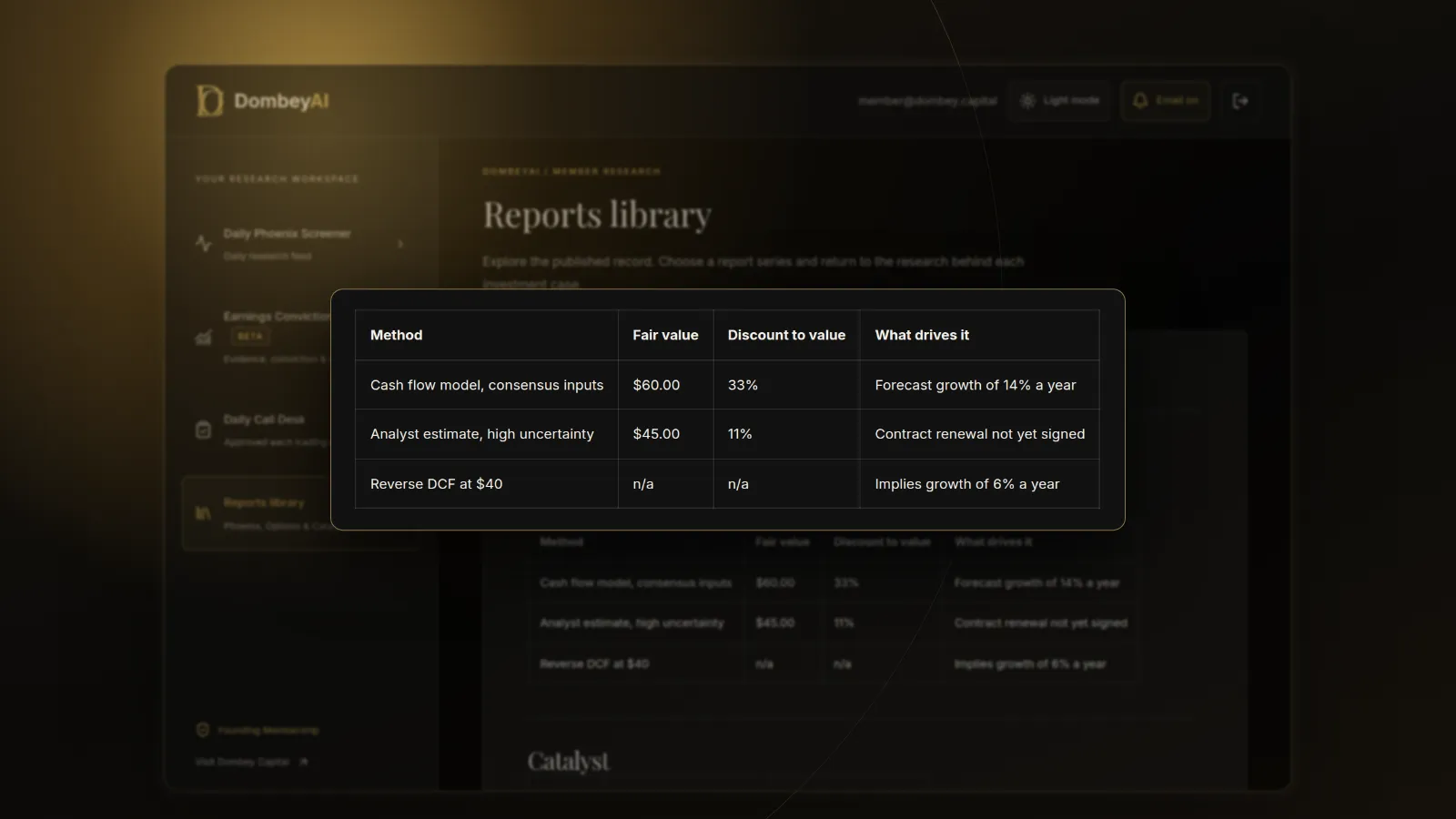
The example shows why neither number is an answer by itself. A reverse DCF, which asks what the current price implies, is a useful check on both, and a margin of safety protects against the inputs being wrong.
Full reviews
1. Dombey Capital
What it does. Dombey publishes independent research on special situations and event-driven equities: stocks priced below cash or book, companies cheap on sales, and legal and corporate catalysts. Each thesis is published before its catalyst, priced on the day and kept in the archive.
Best for. Readers who already use a valuation tool and want written analysis of which situations have a dated event that could close the gap.
Pricing. Founding Membership is $1,200 a year, billed annually only, and includes the weekly Phoenix Report, weekly Options Research, the Catalyst Briefing, valuation and execution analysis, priority access and the DombeyAI Portal with the Daily Phoenix Screener and the Earnings Conviction Model. Standard Access is the lower-cost option at $80 a year (about $6.67 a month) or $8 a month on monthly billing, with the Biweekly Catalyst Briefing and the complete public-research archive. The Public Archive is free.
Pros
- Ties value to a dated catalyst, which neither fair value tool does.
- Written reasoning you can test against the filings.
- Theses are archived, so you can compare each case with what followed.
Cons
- Covers a short list of situations, not the whole market.
- No stock database, screener across all stocks or portfolio tracker.
- Founding Membership costs more than either tool here.
Verdict: Our top pick for special situations and dated catalysts. Pair it with Morningstar or Simply Wall St for broad valuation coverage.
2. Morningstar Investor
What it does. Morningstar Investor gives access to Morningstar's ratings, including fair value and competitive advantage ratings for stocks, plus reports, commentary and news on thousands of securities. It includes pre-filtered lists and custom screens using more than 200 data points, and portfolio tools for performance, allocation, fees and overlaps.
Best for. Readers who want an analyst's view of fair value and moat, with written reasoning.
Pricing. $249 a year, described as $20.75 a month and a 41% saving over monthly, or $34.95 a month. The free trial ends seven days after it begins; previous trial users are not eligible.
Pros
- Fair values and moat ratings come with an analyst's reasoning.
- The star rating makes the price-to-value gap easy to see.
- Strong fund and portfolio analysis alongside stocks.
Cons
- Analyst coverage is narrower than a model-driven tool.
- A fair value says little about when the gap might close.
- No free plan, only a trial.
Verdict: The pick for readers who want an argued fair value. Our Morningstar alternatives cover its rivals, and Motley Fool vs Morningstar compares it with a stock-picking service.
3. Simply Wall St
What it does. Simply Wall St presents company and portfolio analysis visually. Its site lists the Snowflake graphic, an estimated fair value based on future expected cash flows, growth forecasts based on the consensus of professional analysts, Community Narratives where investors share views, a Snowflake Screener, and portfolio tracking that syncs with more than 2,000 brokers. It covers about 120,000 stocks in 90 markets with more than 10 years of history.
Best for. Readers who want to scan many global stocks quickly and track a portfolio in one place.
Pricing. Free: one standard portfolio of up to 10 holdings, five company reports a month and the top four results per screener. Premium: three advanced portfolios of up to 30 holdings, 30 reports a month and unlimited screener results. Unlimited: unlimited portfolios, holdings and reports. New accounts get seven days of full Premium access with no credit card. Prices were not shown on the page we read; see the vendor's pricing page.
Pros
- Very wide global coverage.
- Visual summaries make it fast to triage a long list.
- A usable free plan and a trial without a card.
Cons
- Model-driven fair values can miss company-specific facts.
- The free plan's report and screener limits are tight.
- Visual scores can encourage skipping the filings.
Verdict: The pick for broad, quick, visual coverage. Our Simply Wall St alternatives and the three-way Simply Wall St vs Stock Rover vs Dombey comparison cover the wider field.
Where Dombey falls short
- Narrow coverage. Dombey covers a short list of special situations. Most stocks in either tool will never appear in its research.
- No broad stock data terminal. No database, whole-market screener, fair value on every stock or portfolio tracker. You still need a tool like these for broad valuation work.
- Small team. A small team limits how many situations it can follow properly.
- Pen-name author. Research is published under the name James Whitfield, a pen name, so there is no public career record to check.
- Short history. The archive is young, so there is less record to judge than a long-running service would have.
Free vs paid
| Tool | Free option | What paying adds |
|---|---|---|
| Dombey | Public Archive of published research | Founding Membership adds the weekly reports and the DombeyAI Portal; Standard Access, the lower-cost option, adds the Catalyst Briefing and full archive |
| Morningstar Investor | Seven-day trial | Ratings, fair values, reports, screener and portfolio tools |
| Simply Wall St | Free plan: 1 portfolio, 10 holdings, 5 reports a month | More portfolios, holdings, reports and screener results |
| SEC EDGAR | Free | Not applicable |

Whatever tool you use, the filings are free on SEC EDGAR, and reading the 10-K is the best check on any fair value.
How to choose
| Your situation | Pick | Add later when |
|---|---|---|
| You want cheap stocks with a dated reason to rerate | Dombey CapitalTop pick | You want broad valuation coverage: add Morningstar or Simply Wall St |
| You want an argued fair value on large, well-known companies | Morningstar Investor | You want a wider list: add Simply Wall St's free plan |
| You want to scan many global stocks quickly | Simply Wall St | You want a written view on finalists: add Morningstar |
| You want to track a portfolio across brokers | Simply Wall St | You want analyst research: add Morningstar |
| You want ratings plus opinion and news | See Morningstar Investor vs Seeking Alpha Premium | You want catalyst research: add Dombey |
- If your first question is "what is this company worth, in an analyst's view," start with Morningstar.
- If your first question is "which of these hundreds of stocks look cheap," start with Simply Wall St.
- If your first question is "which cheap stocks have an event coming," start with Dombey.
For the wider field of research services, our Seeking Alpha vs Motley Fool vs Morningstar vs Dombey comparison weighs four of them side by side. Dombey's published work is in the research archive.
The bottom line
Dombey Capital is our top pick for investors focused on special situations and dated catalysts, provided you accept that it is written research on a short list and not a stock database. Between the two tools, Morningstar Investor is better for an analyst's fair value and moat rating with reasoning you can read, and Simply Wall St is better for fast, visual, model-driven coverage of about 120,000 stocks worldwide. Both give a fair value; neither says when the market might agree with it. Use one for breadth, read the filings for the names that matter, and look for the event that could close the gap.