

How LEAPS differ from near-dated options
A LEAPS contract has the same structure as a monthly option: one contract usually covers 100 shares, it has a strike and an expiration, and it is cleared by the OCC. What differs is how the price splits between intrinsic value and time value, and how that time value responds to the inputs covered in our guide to the option Greeks.
- Theta. Time decay per day is small when expiration is far away. Most of the decay arrives in the last few months.
- Vega. A long-dated option has more time value, so a one point change in implied volatility moves its price more in dollars than it moves a one-month option.
- Rho. Interest rates matter more over two years than over two weeks. A higher rate raises call values and lowers put values, all else equal.
- Delta. For the same strike, a LEAPS call usually has a delta closer to 0.50 than a near-dated call, because there is more time for the stock to cross the strike.
LEAPS at a glance
| Feature | Near-dated option (30 days) | LEAPS (about 2 years) |
|---|---|---|
| Premium for an at-the-money call | Small | Large |
| Daily time decay | Fast | Slow until the final months |
| Sensitivity to implied volatility | Lower in dollars | Higher in dollars |
| Sensitivity to interest rates | Minor | Meaningful |
| Bid-ask spread | Usually tighter | Usually wider |
| Exposure to a delayed catalyst | High | Lower |
Why LEAPS fit catalyst theses
Many event-driven theses have a clear outcome and an uncertain date. A spin-off may slip a quarter while the Form 10 is reviewed. A regulatory approval can take longer than management guided. A litigation ruling arrives when the court decides. With a near-dated option, being right on the outcome but wrong on the date can still lose the whole premium.
A LEAPS contract buys time. If the catalyst is expected in six months and the option expires in twenty, the position survives a delay of a year. That margin is the main reason event-driven investors look at LEAPS before they look at monthly options.
The second reason is capital. A deep in-the-money LEAPS call can deliver much of the stock's move for a fraction of the share price, which leaves cash available for other positions. The loss is capped at the premium, while a stock position has no floor until the price reaches zero.
A worked example
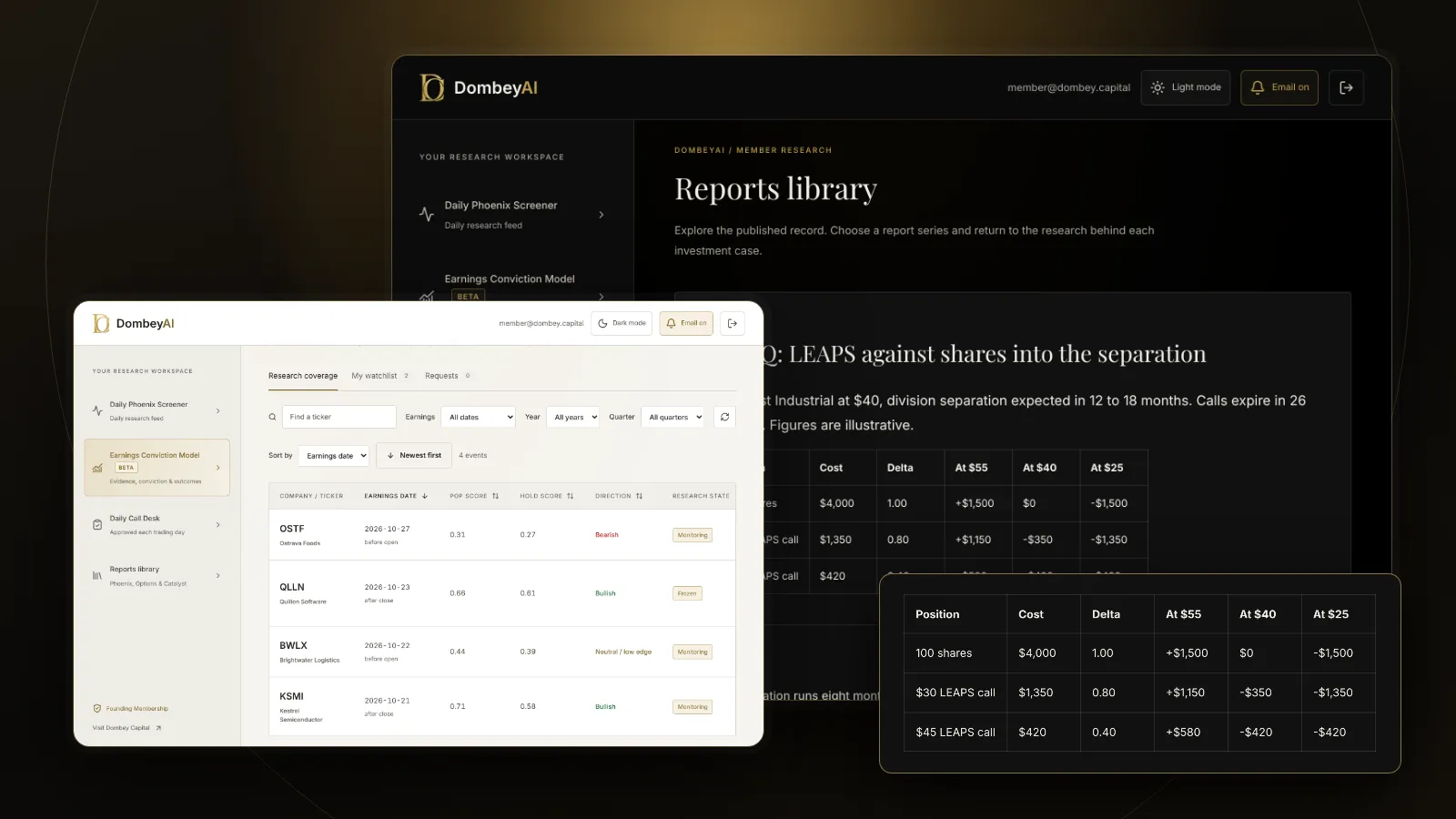
If the stock reaches $55 at expiration, the $30 call is worth $25, a gain of $11.50 on $13.50. The $45 call is worth $10, a gain of $5.80 on $4.20. If the stock stays at $40, the $30 call is worth $10 and loses $3.50, while the $45 call expires worthless and loses everything. The deep in-the-money call earns less in percentage terms when the thesis works and loses far less when it does not.
The same investor could buy 100 shares for $4,000. The $30 call controls the same shares for $1,350. If the stock falls to $25, the shares lose $1,500 and the call loses its full $1,350. Below about $26.50, the call loses less than the shares.
Choosing strike and expiration
- If the catalyst date is uncertain, choose an expiration at least six to twelve months beyond the latest plausible date.
- If you want stock-like exposure with less capital, look at deep in-the-money calls, where most of the price is intrinsic value.
- If you want a cheaper bet on a large move, out-of-the-money LEAPS cost less but expire worthless more often.
- If implied volatility is high relative to its history, consider a spread, such as buying one LEAPS call and selling a higher strike, to reduce the vega you are paying for. Our pages on vertical spreads and diagonal spreads cover the structures.
- If the stock pays a large dividend, remember the call holder does not receive it, and the expected dividend is already in the call price.
Check the volatility term structure before buying. Long-dated implied volatility is often lower than near-dated volatility before an event, but not always, and a LEAPS bought at a high volatility can lose value even when the stock rises modestly.
LEAPS puts as a hedge
LEAPS puts give long-dated protection. An investor who holds a stock into a multi-quarter restructuring can buy a two-year put to set a floor without rolling monthly options. The cost is the full premium up front. Pairing it with a sold call creates a long-dated collar, which can reduce or remove the cash cost in exchange for capping the upside.
Rolling and closing a LEAPS position
Most holders do not keep a LEAPS contract to expiration. Three decisions come up as time passes.
- When the catalyst arrives. Once the event has happened, the reason for paying for time is gone. Holders often close the option, or sell it and buy the shares if they want to stay exposed, rather than carry the remaining time value.
- When the catalyst slips. If the event moves out and the option has less than six to nine months left, a common step is to sell the existing contract and buy a later expiration. The cost of that roll is the extra time value of the new contract, and it should be weighed against the original thesis, not against the loss already taken.
- When the stock moves a lot. A call that started near the money and is now deep in the money carries little time value and behaves almost like stock. Some holders sell it and buy a higher strike to take capital off the table while keeping exposure.
Each of these is a trade with its own spread and commission. Writing the plan for each case at the start, along with the catalyst date, keeps the decision from being made under pressure when the date moves.
Where this goes wrong
- Paying too much for volatility. Vega is large on LEAPS. If implied volatility falls after the purchase, the option can lose value while the stock goes nowhere or even rises a little.
- Wide spreads. Long-dated series trade less often. A spread of 5% to 10% of the premium is common on smaller stocks, and crossing it twice can consume much of the expected gain.
- Corporate actions. Spin-offs, special dividends, mergers and splits change the deliverable. Read how adjusted options work, and what happens to options in an acquisition, because a cash takeover can remove most of the time value overnight.
- Leverage creep. Because LEAPS cost less than stock, it is easy to buy more exposure than intended. Size the position on the premium you can lose, not on the shares it controls.
- Holding into the last months. Time decay speeds up near expiration. A LEAPS bought to outlast a delay becomes an ordinary short-dated option if the catalyst slips further.
The bottom line
LEAPS are long-dated listed options that trade slow time decay for a larger premium and greater sensitivity to implied volatility. They suit theses with a real catalyst and an uncertain date, because they can outlast delays that would sink a monthly option. Deep in-the-money calls behave more like stock; out-of-the-money calls are cheaper bets on a bigger move. Dombey's published options research works through catalyst timing and option pricing in the research archive, and more event coverage is on the market page.