

How a diagonal spread is built
The usual form is opened for a net debit:
- Buy a call (or put) in a later expiry.
- Sell a call (or put) of the same type in an earlier expiry, at a strike further out of the money.
For a call diagonal, the long call has the lower strike and the later date; the short call has the higher strike and the earlier date. For a put diagonal, the long put has the higher strike and the later date; the short put has the lower strike and the earlier date.
The short option decays faster than the long one because it has less time left. If the stock drifts toward the short strike but not through it by the first expiry, the short option expires near worthless while the long option keeps most of its value. The trader can then sell another short option against the long one, a process called rolling.
The Greeks in a diagonal
| Greek | Typical sign for a long call diagonal | What it means |
|---|---|---|
| Delta | Positive | Gains from a moderate rise in the stock |
| Gamma | Negative near the short strike | A sharp move hurts, because the short option gains value fast |
| Theta | Positive | Time decay in the short leg outpaces decay in the long leg |
| Vega | Positive | A rise in longer-dated implied volatility helps, because the long leg has more vega |
Our guide to the option Greeks explains each measure. The mix shifts as the stock moves: a long call diagonal close to the short strike near the first expiry has the most to gain from decay and the most to lose from a further rise.
A worked example
| Leg | Strike | Expiry | Price |
|---|---|---|---|
| Buy 1 call | $45 | 120 days | $8.20 |
| Sell 1 call | $55 | 30 days | $1.10 |
| Net debit | $7.10 ($710 per spread) |
At the 30-day expiry, three outcomes cover most of the range:
- Stock at $54. The short call expires worthless. The long $45 call, with 90 days left, might be worth about $10.80. The position is worth $10.80 against a $7.10 cost, a gain of about $3.70 a share.
- Stock at $50. The short call expires worthless, and the long call might be worth about $7.40. The trader keeps the $1.10 collected and can sell another 30-day call.
- Stock at $62. The short call is worth $7.00 at expiry. The long call might be worth about $17.50. The spread is worth about $10.50, a gain, but less than at $54, because the short call has taken part of the move.
If the stock fell to $40, the short call would expire worthless but the long call might be worth only about $2.60, a loss of about $4.50 a share. Because the long call has the lower strike, the most this debit diagonal can lose, if both options are held as planned, is the $7.10 paid.
The poor man's covered call
A long call diagonal with a deep in-the-money long call and a long expiry behaves much like 100 shares with a covered call written against them. The deep long call has a delta close to 1, so it tracks the stock, while the short call earns income. Our explainer on covered calls around catalysts covers the version with shares.
The appeal is capital. A deep in-the-money call might cost a third of the price of 100 shares. The trade-offs are that the long call has time value that decays, it has no dividend, and a gap down can cost more in percentage terms than owning the stock.
Using a diagonal around a catalyst
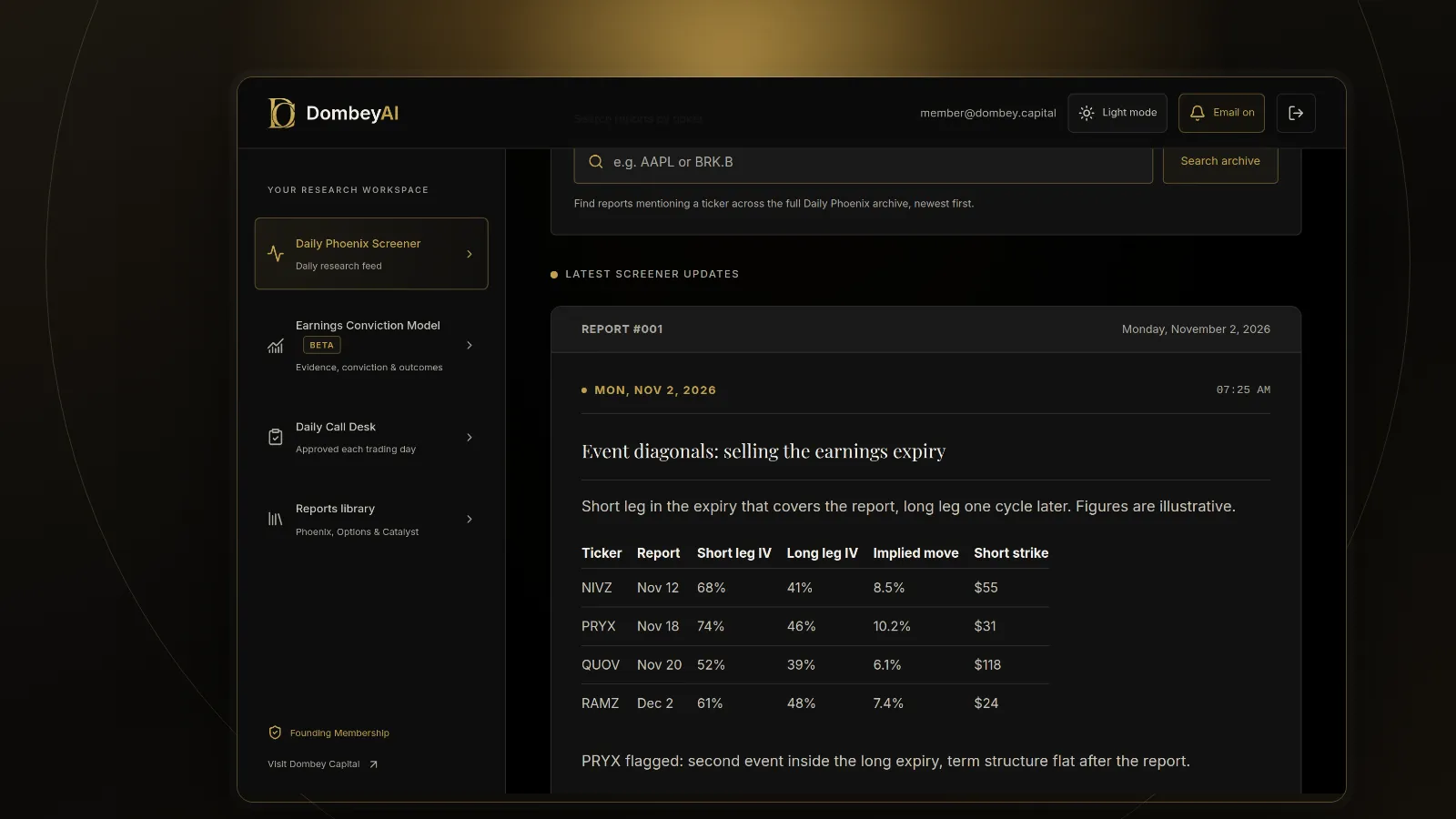
Implied volatility in the expiry that covers an earnings report, an FDA decision or a court ruling is usually higher than in the expiries around it. After the event, it falls sharply, a pattern covered in our explainer on IV crush.
A diagonal can be set up to take advantage of that shape:
- Sell the short option in the expiry that includes the event, where implied volatility is highest.
- Buy the long option in a later expiry, where implied volatility is lower and falls less after the news.
- Choose the short strike near the move the market is pricing, which you can estimate from the at-the-money straddle in our guide on estimating an earnings move from options.
If the stock moves less than the market priced, the short option loses its event premium and the long option holds its value. If the stock moves far past the short strike, the short option rises in value faster than the long one, and the spread can lose money.
Diagonal vs related spreads
| Spread | Strikes | Expiries | Main source of profit |
|---|---|---|---|
| Vertical | Different | Same | Direction |
| Calendar | Same | Different | Time decay and volatility |
| Diagonal | Different | Different | Time decay with a directional lean |
| Covered call | One short call against shares | One | Income on stock already owned |
Where this goes wrong
- Large moves. A gap through the short strike turns the position into a losing or capped trade. A gap the other way leaves the long option worth far less than paid.
- Volatility falls in the long leg. The position has positive vega, so a broad drop in implied volatility can cause a loss even if the stock does what you expected.
- Early assignment. An in-the-money short call can be assigned early, especially before an ex-dividend date. The long call still covers the obligation, but the trader may need to act quickly.
- Wide markets. Two legs in different expiries mean two bid-ask spreads. In thinly traded options, wide spreads can absorb much of the expected profit.
- Event dates move. If an earnings date shifts out of the short option's expiry, the event premium moves to the long option's expiry instead, which changes the trade.
Options carry significant risk and are not suitable for every investor. This article is education only. Dombey covers dated catalysts and options positioning on the market page.
The bottom line
A diagonal spread buys a longer-dated option and sells a shorter-dated one at a different strike, so it earns from time decay with a mild directional lean. It works best when the stock moves toward the short strike but not through it, and when longer-dated implied volatility holds up. Around a catalyst, it can sell the inflated event premium while owning a later expiry that loses less after the news. Large moves, falling volatility and early assignment are its main risks.