

What you need
- The catalyst and its date, with a note on how certain the date is. A catalyst calendar helps keep these in one place.
- An option chain for the stock, with bids, asks, open interest and implied volatility by strike and expiry. Our guide on how to read an option chain covers the columns.
- Your scenarios: two to four outcomes with a stock price for each.
- A rough estimate of implied volatility after the event, for example the level of a later expiry or the stock's normal implied volatility outside event periods.
- A position size set in advance, ideally from the method in our guide on sizing a position before a binary event.
Step 1: Pin down the catalyst date
Start with the date, because it decides the expiry. Sort the catalyst into one of three kinds:
| Date type | Examples | What it means for expiry |
|---|---|---|
| Confirmed | Earnings date announced by the company, scheduled shareholder vote | First expiry after the event can work |
| Target date that can move | FDA goal date, which the agency can beat or miss; expected deal close | Choose an expiry with a buffer beyond the target |
| Undated | Court ruling, strategic review outcome, activist settlement | Choose a longer expiry, or reconsider using options |
Our explainer on hard and soft catalysts covers the difference in more depth, and how PDUFA dates work explains why regulatory dates can shift.
Also note the time of day. An earnings report after the close on a Thursday is priced into options expiring that Friday. An announcement after the close on the expiry day itself falls outside them.
Step 2: Read the implied move
Price the at-the-money straddle in the first expiry after the event and divide by the stock price. That is a rough measure of the move the market expects. Our guide on estimating an earnings move from options walks through it, including a common adjustment.
Then compare it with two things:
- Past reactions to similar events for this stock. If it has often moved more than the current implied move, options may be cheap for the event; if less, expensive.
- Your scenarios. If your base case is a move smaller than the implied move, buying options outright is fighting the price. A straddle buyer and a directional call buyer both pay for that implied move.
Step 3: Choose the expiry
With the date type and the implied move in hand, choose the expiry:
- The first expiry after the event has the most event premium per dollar of time value. It is the cheapest way to own the event if the date is certain. It also decays fastest, so it punishes any delay.
- A later expiry costs more, but survives a slipped date and gives time for the market to digest the news. Its implied volatility is usually lower than the front expiry's, so it loses less when the event premium drains.
- A much longer expiry, such as a LEAPS option, suits a catalyst that starts a longer process, like an approval followed by a launch, rather than a single price reaction.
Look at the volatility term structure before you decide. If the front expiry carries a large bump in implied volatility and the next one does not, the later expiry may cost little more for a lot more time.
A useful rule for date risk: pick the first expiry that would still have at least a week of life left if the event slipped by the largest delay you consider plausible.
Step 4: Set your scenarios
Write down the outcomes and a stock price for each. For a binary event, two prices often dominate. For earnings, three or four bands may be better.
Add a rough probability to each if you can. The point is not precision. It is to make the payoff of each strike visible across outcomes rather than in the one you hope for.
Step 5: Compare strikes against the scenarios
Now price candidate strikes at each scenario, using the option's value after the event. For an expiry just after the event, value is close to intrinsic value plus a small remainder. For a later expiry, use your estimate of post-event implied volatility.
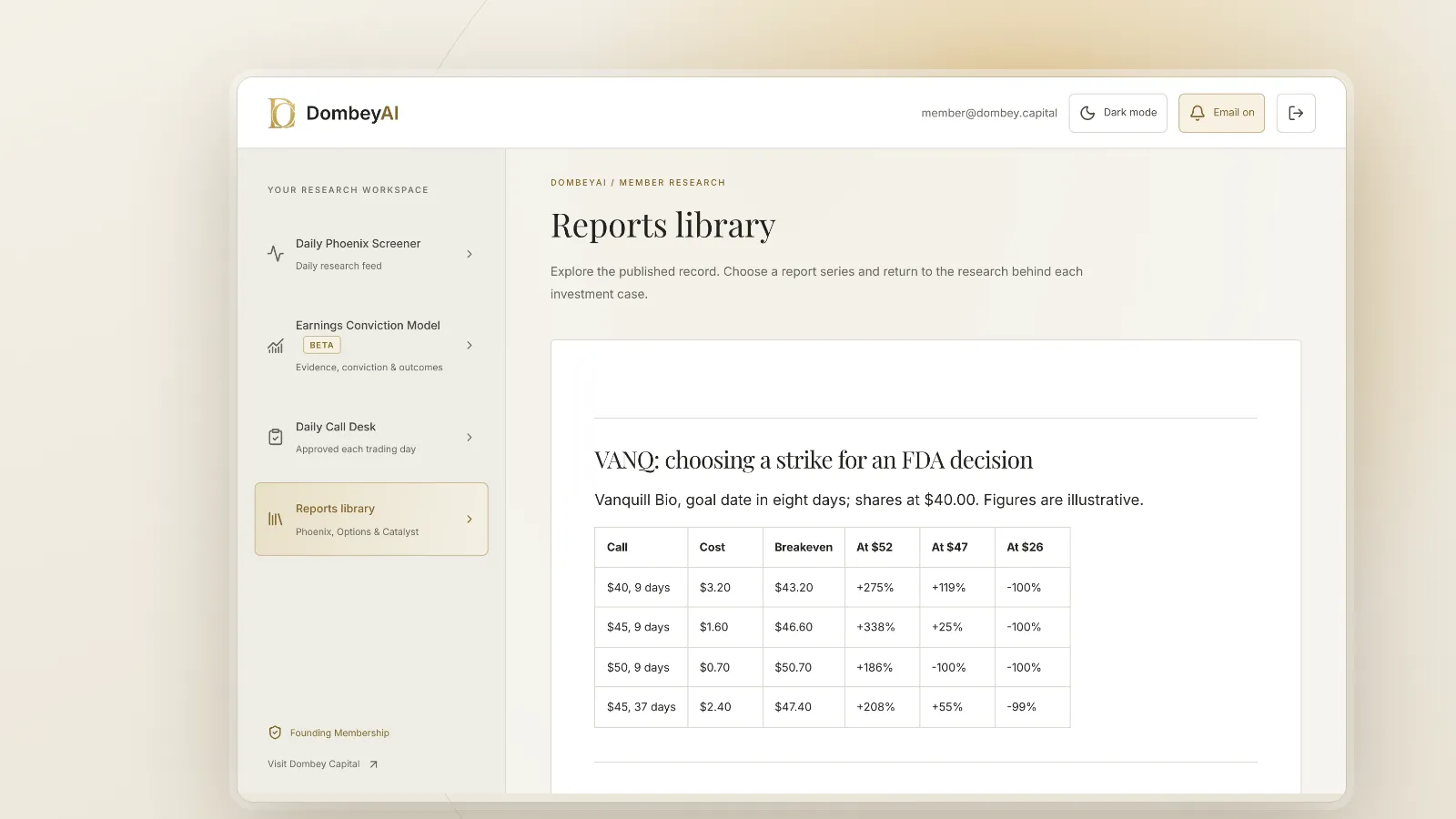
Continuing the example, with front-expiry calls priced at $3.20 for the $40 strike, $1.60 for the $45 strike and $0.70 for the $50 strike, and values close to intrinsic after the decision:
| Call (front expiry) | Cost | Breakeven | Value at $52 | Value at $47 | Value at $26 |
|---|---|---|---|---|---|
| $40 strike | $3.20 | $43.20 | $12.00 (+275%) | $7.00 (+119%) | $0 (-100%) |
| $45 strike | $1.60 | $46.60 | $7.00 (+338%) | $2.00 (+25%) | $0 (-100%) |
| $50 strike | $0.70 | $50.70 | $2.00 (+186%) | $0 (-100%) | $0 (-100%) |
The table makes the trade-offs plain. The $50 call has the lowest cost but loses everything in the middle scenario. The $45 call pays most on full approval but barely clears its cost on the narrower label. The $40 call costs most and has the lowest percentage gain in the best case, but it is the only one that pays well in two of three scenarios.
Delta helps as a rough guide, but not as a probability. Around a binary event, the market is pricing two separate outcomes, and a single delta can hide that. Our explainer on the option Greeks covers what delta measures.
Step 6: Allow for the volatility drop
Before the event, the options carry inflated implied volatility. After it, implied volatility falls, often sharply. That is IV crush, and it hits every option you hold, including later expiries, though less.
To allow for it:
- Price later-expiry options in each scenario at a lower implied volatility, not today's.
- Check IV rank and IV percentile to see how elevated implied volatility is compared with the stock's own history.
- If implied volatility is very high and your scenarios cluster near the implied move, a long option is unlikely to pay; a spread or no trade may fit better.
Step 7: Check liquidity on the exact contracts
A good strike on paper can be a poor one in practice. For each candidate contract, check:
- Bid-ask spread. A spread of $0.20 on a $0.70 option costs nearly 30% to cross both ways. Our article on options liquidity explains why this matters more than it looks.
- Open interest and volume. Thin contracts are harder to exit at a fair price, especially in the first minutes after news.
- Adjacent strikes. If the strike you want is illiquid, the next one may be far better to trade.
Step 8: Consider a spread
If the single option looks expensive, a vertical spread can help. Buying the $40 call and selling the $50 call, for example, lowers the cost and the breakeven and offsets part of the implied volatility you pay for, at the price of capping the gain at the $50 strike. It fits a view on a move of a certain size. Our explainer on vertical spreads covers the mechanics and the risks, including assignment on the short leg.
Step 9: Decide the exit before the event
Write down what you will do in each scenario before the news arrives:
- In the favorable case, will you sell at the open, sell in stages, or hold a later expiry for further drift?
- In the unfavorable case, will you sell what remains or let it expire?
- If the date slips, at what point will you close or roll?
Decisions made in the first minutes after a large move, with wide spreads and fast prices, are usually worse than decisions made in advance.
Where this goes wrong
The date moves. A front-expiry option bought for a target date that slips can expire before the event. That is the most common way to be right and still lose.
The move is in line with the implied move. If the stock moves about as much as the market priced, long options often lose money after implied volatility falls.
The reaction is delayed. Some catalysts take days to be priced, as investors read the details. A front expiry may not give the market enough time.
The distribution is not what you assumed. A partial outcome, such as a narrower label, can land in the gap between strikes where every cheap option expires worthless.
Liquidity disappears. After a large move, the contracts you hold may be quoted with very wide spreads, and the exit price can be far from the theoretical value.
Common mistakes
- Choosing the strike before the expiry. The expiry decides whether you hold the event at all. Choose it first.
- Buying the cheapest option because it is cheap. A low premium usually means a low chance of paying. Judge it against your scenarios.
- Pricing scenarios at today's implied volatility. Use a post-event level, or the payoffs will look better than they are.
- Ignoring the timing of the announcement. An after-hours release on expiry day falls outside that day's options.
- Sizing on the best case. Size so that a total loss of the premium is acceptable, because for out-of-the-money options it is a likely outcome.
The bottom line
Choose the expiry first, so the option holds the catalyst with room for delays and for the market's reaction. Use the implied move as the hurdle, then compare strikes by their value in each of your scenarios after implied volatility has fallen. Check liquidity on the exact contracts, consider a spread when single options are expensive, and set the exit in advance. For the dated events driving options prices now, see the market coverage.