

The three states for calls and puts
Moneyness depends on the option type and on where the stock trades relative to the strike.
| State | Call (right to buy) | Put (right to sell) | Intrinsic value |
|---|---|---|---|
| In the money | Stock above strike | Stock below strike | Positive |
| At the money | Stock at or near strike | Stock at or near strike | Zero or close to zero |
| Out of the money | Stock below strike | Stock above strike | Zero |
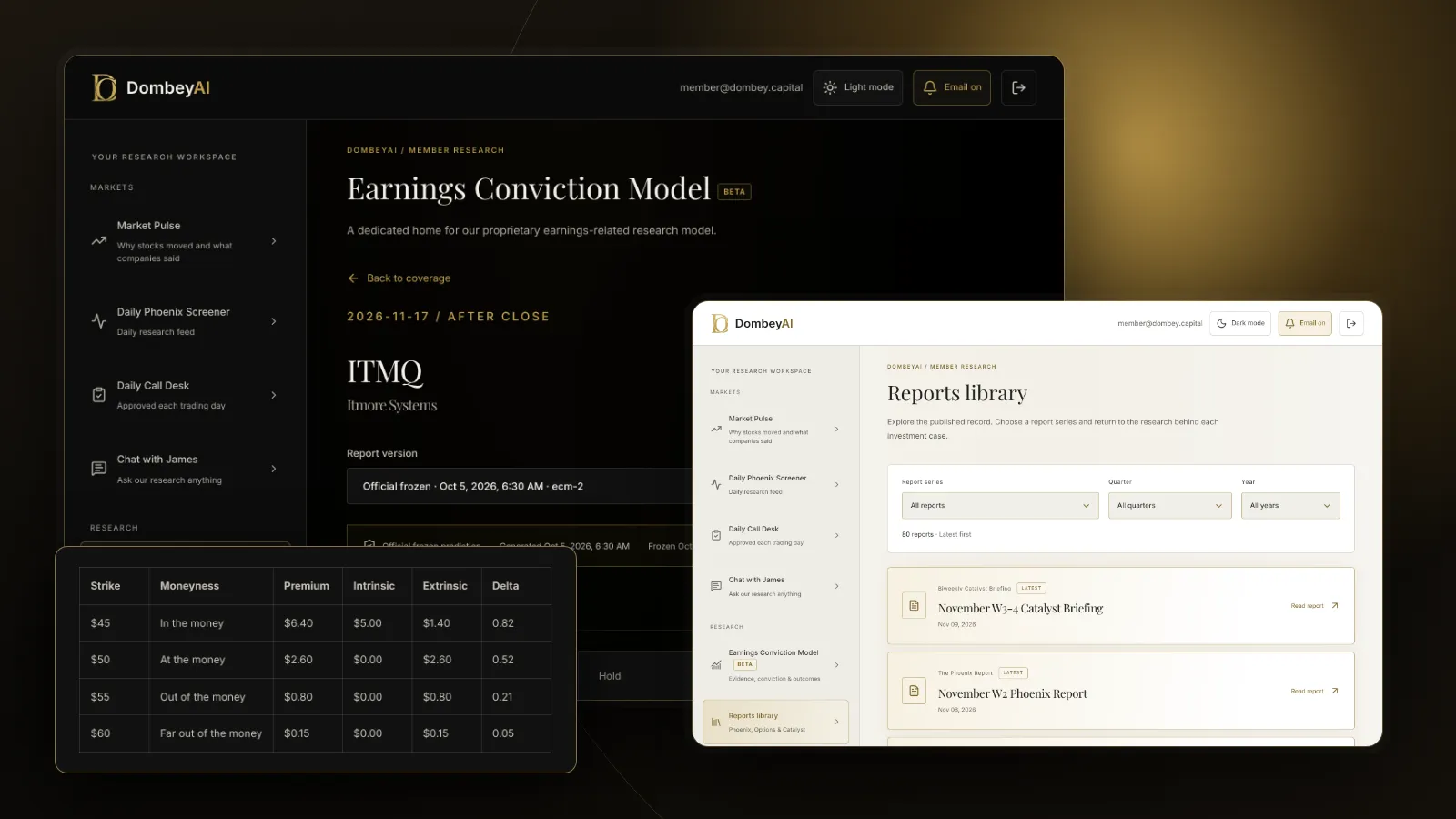
The same strike can be in the money for one type and out of the money for the other. With a stock at $50, a $45 call is in the money by $5, and a $45 put is out of the money by $5.
Traders also use "deep in the money" and "far out of the money" for strikes well away from the stock price. There is no fixed cutoff; the terms usually describe strikes several expected moves away.
Intrinsic and extrinsic value
Every option premium splits into two parts.
Intrinsic value is the exercise value today:
- Call: stock price − strike, if positive
- Put: strike − stock price, if positive
Only in-the-money options have intrinsic value.
Extrinsic value, also called time value, is the rest of the premium. It reflects the time left before expiry and the implied volatility the market prices in. At-the-money options carry the most extrinsic value in dollars, because they have the most uncertainty about where they will finish.
The example shows why buyers of at-the-money and out-of-the-money options need the stock to move: their entire premium is extrinsic value that decays to zero.
How moneyness changes the Greeks
Moneyness is the main driver of how an option behaves. The option Greeks measure this.
- Delta. At-the-money options have a delta near 0.50 (calls) or -0.50 (puts). Deep in-the-money options approach 1.00 or -1.00 and move almost dollar for dollar with the stock. Far out-of-the-money options approach zero.
- Gamma. Highest at the money, especially near expiry. Delta changes fastest when the stock is close to the strike.
- Theta. Time decay in dollars is largest at the money. Out-of-the-money options lose a larger share of their value each day as expiry approaches, even though the dollar amount is small.
- Vega. At-the-money options are most sensitive in dollars to changes in implied volatility, which is why they lose the most after IV crush.
Delta is sometimes used as a rough stand-in for the probability that an option finishes in the money. A 0.25-delta call is often read as about a one-in-four chance. It is an approximation from the pricing model, not a forecast, and it ignores skew and jumps.
Moneyness around a catalyst
Before an earnings report, a court ruling or a deal vote, the strike choice is a decision about what you expect.
- If you expect a move about the size the market prices in, at-the-money options give the most direct exposure, at the highest extrinsic cost.
- If you expect a large move that the market underprices, out-of-the-money options cost less and pay more if you are right, but finish worthless more often.
- If you want stock-like exposure with defined risk, deep in-the-money options carry little extrinsic value and lose less to volatility crush.
- If you are selling options, out-of-the-money strikes outside the expected move collect less premium but are less likely to be exercised.
The expected move implied by the at-the-money straddle is a useful marker for where "near" and "far" strikes begin. Our guide on choosing an option strike and expiry for a catalyst walks through the full decision.
Moneyness at expiration
At expiry, extrinsic value goes to zero and only intrinsic value is left. In the US, the Options Clearing Corporation's exercise-by-exception process automatically exercises equity options that are in the money by $0.01 or more, unless the holder submits contrary instructions. Out-of-the-money options expire worthless.
This creates two practical issues:
- Unwanted exercise. A long call that finishes slightly in the money becomes 100 shares per contract, which may need cash or margin you did not plan for.
- Uncertain assignment. A short option with the stock right at the strike at the close may or may not be assigned. That is pin risk, and it can leave a seller with an unexpected stock position over a weekend.
Many brokers close or exercise positions on their own schedule near expiry, so check their rules before holding an option into the final day.
Moneyness for spreads and multi-leg positions
Spreads combine strikes with different moneyness, so the position's behavior depends on where the stock sits between them. A call spread that buys an at-the-money strike and sells an out-of-the-money strike costs less than the long call alone, because the short leg's extrinsic value offsets part of the premium. The trade-off is a capped payoff above the short strike.
| Stock at expiry, Company A | Long $50 call | Short $55 call | Spread value |
|---|---|---|---|
| $48 | $0 | $0 | $0 |
| $52 | $2 | $0 | $2 |
| $55 | $5 | $0 | $5 |
| $60 | $10 | ($5) | $5 |
Figures are illustrative. As the stock moves, each leg's moneyness changes, and so does the position's delta. A spread that starts with both legs out of the money behaves like a cheap directional bet; once both legs are deep in the money, it behaves like a fixed payout with little sensitivity left.
Where this goes wrong
Moneyness is simple, but it is easy to misuse.
- Treating cheap as good value. A $0.20 out-of-the-money option is not a bargain if the move it needs is unlikely. Price relative to probability is what matters.
- Reading delta as a forecast. Delta comes from a model that assumes smooth price paths. Binary events such as FDA decisions or court rulings break that assumption.
- Forgetting that moneyness moves. An option bought at the money can be deep out of the money after one day's move. Position risk changes with it.
- Ignoring liquidity. Far out-of-the-money and deep in-the-money strikes often have wide bid-ask spreads. Read the option chain for volume and open interest before trading them.
- Overlooking early exercise on calls. Deep in-the-money calls on stocks with a dividend coming can be exercised early by their holders, which matters if you are short them, as in a covered call.
The bottom line
Moneyness describes where an option's strike sits against the stock price: in the money if exercise has value now, at the money if the strike is near the price, and out of the money otherwise. It sets how much of the premium is intrinsic, how the Greeks behave and how likely the option is to pay off. Around a dated event, choosing moneyness is choosing between cost, probability and payoff. Dated catalysts and the moves around them are tracked in Dombey's market coverage.