

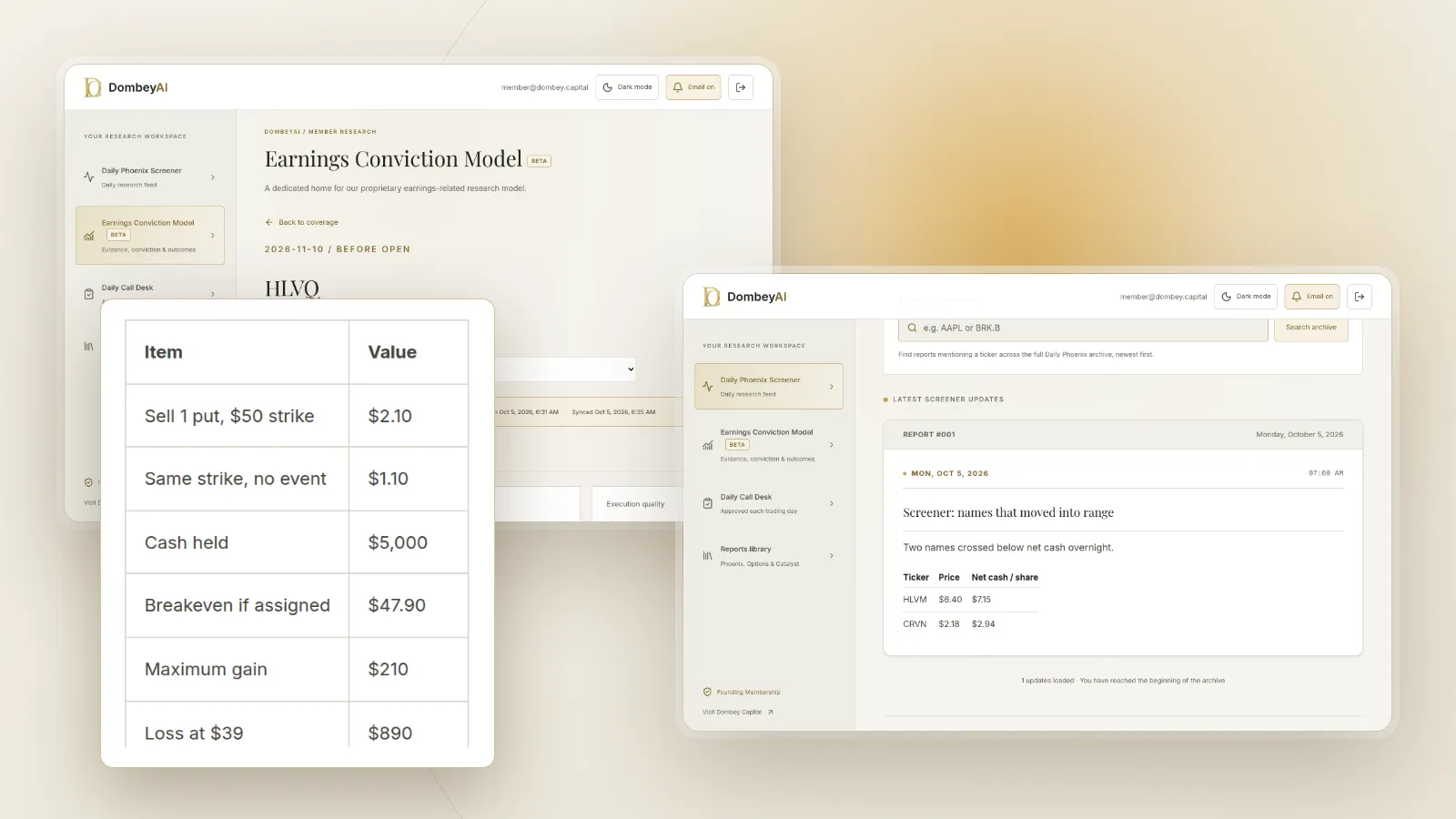
How a cash-secured put works
You choose a stock, a strike and an expiry, then sell (write) one put contract for each 100 shares you are willing to buy. The buyer pays you a premium for the right to sell you those shares at the strike until expiry. You set aside the cash to pay for them.
At expiration there are two broad outcomes:
- The stock is above the strike. The put expires worthless. You keep the premium and the cash, and you own nothing.
- The stock is below the strike. The put is exercised and you are assigned. You buy 100 shares per contract at the strike, paid from the cash you held, and you keep the premium.
The position is called cash-secured because the cash covers the obligation in full. A put sold without that cash, using margin, is a naked put. The worst case is the same in both: the stock goes to zero and you pay the strike for worthless shares. The difference is that the naked version uses borrowed buying power, so a fall can also bring a margin call before expiry.
If strikes, premiums and expiries are new to you, start with how to read an option chain. A cash-secured put is the mirror image of the covered call: the covered call writer owns the stock and sells upside, while the put writer holds cash and agrees to take on downside.
The payoff in four numbers
Four figures describe the position:
- Premium received. The income from the trade, kept in every outcome. It is also the most you can make.
- Cash required. The strike times 100 per contract. Some brokers let the premium count toward it.
- Breakeven. The strike minus the premium. Below this, assignment leaves you with a loss on the shares.
- Maximum loss. The strike minus the premium, times 100, if the stock goes to zero.
The asymmetry is the central fact. The premium is usually a few percent of the strike. The loss can be nearly the whole strike. Economically, a cash-secured put is close to a covered call at the same strike: both collect a premium and both carry the stock's downside below the strike. Selling a put is not a way to avoid stock risk. It is a way to be paid for agreeing to take it at a set price.
| Item | Cash-secured put | Buying the stock today | Limit order to buy |
|---|---|---|---|
| Cash tied up | Strike times 100 | Share price times 100 | Limit price times 100 |
| Income while waiting | Premium, kept in all outcomes | Dividends, if any | None |
| If the stock rises | Keep premium only | Full gain | No fill, no gain |
| If the stock falls below the strike | Assigned at strike, cost cut by premium | Full loss from today's price | Filled at the limit, full loss below it |
| When you can be filled | Any time before expiry, mostly at expiry | Now | Whenever the price touches the limit |
| Main risk | Assigned on a stock that gapped down | Price falls | Price falls after the fill |
How assignment works
Assignment is the step that turns your option into a stock position. It follows a fixed chain.
Who gets assigned
When a put holder exercises, their broker tells the Options Clearing Corporation (OCC), which guarantees listed options in the US. The OCC assigns the exercise at random to a clearing firm that has short positions in that option. The clearing firm then assigns it to one of its customers who is short, either at random or first in, first out, under a method its rules disclose. You cannot choose whether you are picked, and holding the position at the moment of exercise is enough.
When it happens
Standard US stock options are American style. FINRA's options page notes that sellers of equity options can be assigned at any time before expiration, not only on the last day. In practice most assignments come at expiry, for two reasons:
- Automatic exercise. Under the OCC's exercise-by-exception process, an option that finishes at least $0.01 in the money is generally exercised automatically unless the holder instructs otherwise. A put that closes a few cents below the strike will usually be assigned.
- Time value. Before expiry, a holder who exercises a put gives up whatever time value is left. Selling the put in the market usually captures more. Early exercise makes sense mainly when the put is deep in the money and has little time value remaining.
For puts, dividends work the opposite way from calls. A call holder may exercise just before the ex-dividend date to collect the dividend. A put holder tends to wait until after it, because the share price usually drops by roughly the dividend on the ex-date, which adds to the put's value.
What you see
You learn of an assignment from your broker, usually before the next trading session opens. The shares appear in your account, the cash is used to pay for them, and the short put is gone. Stock trades in the US settle one business day after the trade.
A worked example around earnings
Here is the position at expiration across a range of outcomes.
| Stock at expiry | Assigned? | Put position | Owning 100 shares from $52 |
|---|---|---|---|
| $60 | No | +$210 | +$800 |
| $52 | No | +$210 | $0 |
| $50 | No, at the money | +$210 | -$200 |
| $47.90 | Yes | $0 | -$410 |
| $45 | Yes | -$290 | -$700 |
| $39 | Yes | -$890 | -$1,300 |
Three things stand out. Above the strike, the put earns $210 whether the stock rises $1 or $8, so the upside is fixed. Below the breakeven, the position loses money dollar for dollar with the stock. And at $39, a 25% fall on the report, you are assigned on 100 shares worth $3,900 for which you paid an effective $4,790.
The event premium nearly doubled the income compared with a quiet month. It did so because the market priced a larger chance of a move like the last row. Before selling into a report, compare the strike with the expected move from the options. If the strike sits inside that range, assignment is a live outcome, not a remote one. After the report, implied volatility usually falls sharply, which is the IV crush that works in the seller's favor only if the stock does not move past the strike.
Catalysts and the put seller
Each kind of dated event changes the trade in its own way. For recent examples of how far single stocks move on news, see today's biggest stock moves.
- Earnings. Raises the premium on the first expiry after the report. The main risk is a gap down well through the strike, with the premium covering only a small part of it.
- Binary rulings and approvals. Near-dated puts can carry very high premiums. A negative outcome can take the stock far below any strike in one day.
- Takeover bids. A cash bid above the current price usually helps a put seller: the stock moves toward the offer and the put loses value. The risk returns if the deal breaks, because the stock often falls back below where it traded before the bid. How listed contracts are treated when a deal closes is covered in what happens to options when a company is acquired.
- Ex-dividend dates. Lower the chance of early exercise until after the ex-date, and the expected price drop on that date is already in the put's price.
Put skew matters here too. Downside puts often trade at higher implied volatility than at-the-money options, so the premium on a lower strike can look generous. Options skew is the market's price for a sharp drop, and a seller collecting it is the one taking that drop.
When sellers use it, and the trade-offs
Investors who sell cash-secured puts usually do so on a stock they have already decided they would own at the strike. Some set the strike near a valuation they have worked out, such as net cash per share for a company trading close to its cash, so that assignment comes at a price with a margin of safety built in.
Pros
- The premium is kept in every outcome.
- If assigned, the effective cost is below the strike by the premium.
- The cash is fully committed, so there is no borrowing and no margin call.
- The strike sets the purchase price in advance.
Cons
- Gains are capped at the premium, however far the stock rises.
- Losses below the breakeven run almost as far as owning the stock.
- Assignment comes when the stock has fallen, often after bad news.
- The cash is tied up until expiry or until you close the put.
A few situations to think through before writing one:
- If you would not buy the stock at the strike today, a put at that strike commits you to doing it later at a worse moment.
- If a report or ruling falls inside the expiry, the premium is higher because the risk of a gap is higher.
- If the bid-ask spread on the put is wide, a large share of the premium goes to the market maker; see why wide spreads distort signals.
- If you want to own the stock with a floor under it instead, a protective put is the buying side of the same contract.
Dombey's published research notes the dated catalysts in each name it covers; see the research archive.
Where this goes wrong
Treating the premium as the return. The premium is the most you can make. The return on the trade depends on how often, and how far, the stock ends below the breakeven.
Selling puts on stocks you would not own. A put sold only for the premium becomes an unwanted stock position after a fall. The cash is then locked in shares you did not want.
Chasing the event premium. A higher put premium before earnings reflects a higher chance of a large drop. It is payment for risk, not free income.
Forgetting early and after-hours assignment. Planning around the closing price on expiry day misses exercises triggered by late news and early exercise on deep in-the-money puts.
Selling more contracts than the cash covers. Once the strike times 100 times the number of contracts exceeds your cash, the position is no longer cash-secured, and a fall can force a sale at the worst price.
Rolling down and out without a limit. Buying back a losing put and selling a later, lower one can defer a loss while the stock keeps falling, adding risk each time.
The bottom line
A cash-secured put is selling a put while holding the cash to buy the shares at the strike: you keep the premium, and if the stock ends below the strike you buy it at the strike minus that premium. Assignment can come at any time because US stock options are American style, though it mostly comes at expiry, when options at least a cent in the money are exercised automatically. The premium caps your gain while the loss below the breakeven runs almost as far as owning the stock. Catalysts raise the premium because they raise the chance of a gap down, so compare the strike with the implied move before selling into one. Options carry substantial risk; this article is education, not a recommendation.