

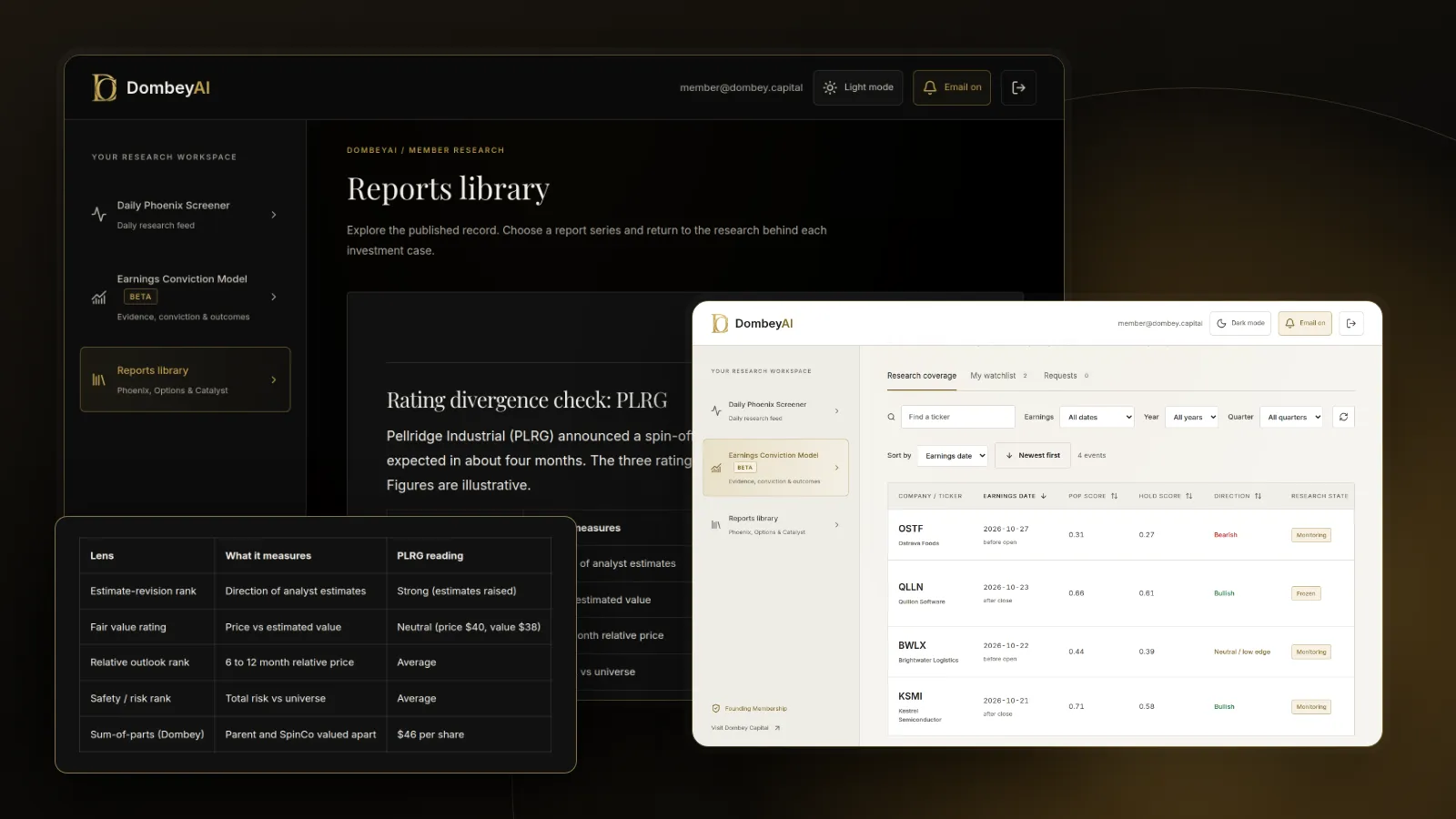


Full disclosure: Dombey Capital is our own research service and our top pick here, for the reasons below. The section on where it falls short is there so you can judge whether it fits your process.
Quick comparison
| Tool | Best for | Key features | Price (as of October 2026) |
|---|---|---|---|
| Dombey CapitalTop pick | Investors in special situations and dated catalysts | Founding Membership: weekly Phoenix Report, weekly Options Research, Catalyst Briefing, DombeyAI Portal with the Daily Phoenix Screener and Earnings Conviction Model; Standard Access: Biweekly Catalyst Briefing and public-research archive | Founding Membership $1,200/year; Standard Access $6.67/month; Public Archive free |
| Morningstar Investor | Long-term investors who want price compared with estimated value | Star rating, fair value estimate, economic moat rating, analyst reports, screener with 200+ data points, portfolio tools, alerts | $249/year or $34.95/month; 7-day free trial |
| Zacks Premium | Investors who screen on earnings estimate revisions | Zacks Rank (#1 Strong Buy to #5 Strong Sell), Style Scores, Industry Rank, Earnings ESP Filter, premium screens, equity research reports, Focus List of 50 stocks | $249/year |
| Value Line (digital) | Investors who want one standard page per company | Timeliness and Safety ranks from 1 to 5, Financial Strength rating, packages covering about 600 to more than 3,000 stocks | $199 to $795/year depending on package |
How we compared these tools
We compared these services from vendor documentation, pricing pages and public product pages, read on the publish date. We did not subscribe to each service for this article, so nothing below describes the member experience beyond what the vendors publish. We make no claims about how well any rating has predicted returns. Zacks and others publish their own track records; those figures are theirs, and we do not repeat or judge them.
A stock rating is a compressed answer to one question. The useful comparison is which question each rating answers, how openly the vendor explains it, and whether it still means anything when a company is going through an event such as a spin-off or a sale.
| Criterion | Weight | What it measures |
|---|---|---|
| Fit for dated events | 25% | Whether the service helps when a stock's value depends on a spin-off, deal, vote or filing date |
| Method transparency | 25% | Whether the vendor explains what drives the rating, so you know when to discount it |
| Depth behind the rating | 20% | Whether there is written reasoning, a valuation or a company page behind the number |
| Coverage | 15% | How many stocks get a rating |
| Price and terms | 15% | List price, trial and refund terms from the vendor's own pages |
The weights favor event fit and transparency because those matter most for special situations and dated catalysts. If you mainly want to sort a large universe quickly, weight coverage and price more heavily, and Zacks and Value Line move up the order.
Quick picks by job
Best for special situations and dated catalysts: Dombey Capital
Dombey does not rate thousands of stocks. It publishes research on situations where an event with a date can reprice the stock: stocks below cash or book, spin-offs, deal spreads, and legal and corporate catalysts. Each thesis is published before its catalyst and kept in the archive. If your question is "what happens to this stock on a given date, and why," that is the job Dombey is built for. Pair it with a rating service if you also want a number on every stock in your universe.
Best for valuation-based ratings: Morningstar Investor
Morningstar's star rating starts from an analyst's fair value estimate and compares it with the current price. Because the estimate comes with a written report, you can read the assumptions and disagree with them. That suits long-term investors who want to know what a business is worth, not only whether the market likes it this quarter.
Best for earnings estimate momentum: Zacks Premium
The Zacks Rank is built on earnings estimate revisions. Zacks states that its founder concluded estimate revisions are the strongest force on stock prices, and the rank is the tool built on that idea. Investors who work in earnings season and want lists sorted by how analyst expectations are moving will find the screens and the Earnings ESP Filter fit that workflow.
Best for standardized company pages: Value Line
Value Line gives each covered company a consistent page with its ranks, a Financial Strength rating and long histories of per-share data. The Timeliness and Safety ranks put every stock on the same two scales. Investors who compare companies side by side on one template will find this format efficient.
Full reviews
1. Dombey Capital
What it does. Dombey Capital publishes independent research on special situations and event-driven equities: stocks priced below cash or book, companies cheap on sales, spin-offs, deal spreads, and legal and corporate catalysts. It is written research, not a rating system. Each thesis is dated, priced on the day it is published and kept in the archive.
There are three access levels:
- Founding Membership ($1,200 a year): the weekly Phoenix Report, weekly Options Research, the Catalyst Briefing, the DombeyAI Portal with the Daily Phoenix Screener and the Earnings Conviction Model, valuation and execution analysis, and priority access.
- Standard Access ($6.67 a month), the lower-cost option: the Biweekly Catalyst Briefing on forthcoming corporate and market events, plus the complete public-research archive.
- Public Archive (free): published executive theses and public research.
Best for. Investors whose process starts from a dated event, such as a distribution date, a shareholder vote, a court ruling, a tender offer deadline or an earnings report. If you are new to the style, what is a stock catalyst covers the basics.
Pricing. Founding Membership $1,200 a year. Standard Access $6.67 a month. Public Archive free. See the subscription options.
Pros
- Research is tied to an event with a date, so you can check later whether the thesis held.
- Valuation work is written out, including what the case depends on.
- Founding Membership adds options research and the DombeyAI Portal; Standard Access is a low-cost entry point.
Cons
- No rating on every stock, and no whole-market screener.
- Founding Membership costs more than one year of any plan from the three rating services.
- The full list of limits is in the section on where Dombey falls short.
Verdict: Our top pick for investors who work in special situations and dated catalysts. Add a rating service if you want a number on every stock.
2. Morningstar Investor
What it does. Morningstar Investor is Morningstar's paid product for individual investors. Morningstar describes the star rating as a signal for when a stock trades at a discount or when it may be time to sell. The rating considers the current price, Morningstar's fair value estimate and the uncertainty rating around that estimate. The economic moat rating describes a company's ability to fend off competition and earn high returns. The plan also includes analyst reports and commentary on thousands of securities, a screener with more than 200 data points, portfolio tools that show performance, allocation and fees, watchlists, and alerts on ratings changes and analyst notes.
Best for. Long-term investors who want a valuation behind each rating, and who hold funds as well as stocks.
Pricing. $249 a year or $34.95 a month, with a seven-day free trial.
Pros
- The rating rests on a fair value estimate you can read and question.
- The moat and uncertainty ratings add context that a single score lacks.
- Fund research and portfolio tools in the same plan.
Cons
- Coverage by analysts is narrower than a model-driven rank that scores every stock.
- A fair value estimate built for an ongoing business can lag a company that is splitting, selling assets or winding down.
Verdict: The best rating service here for long-term investors who care about what a business is worth.
3. Zacks Premium
What it does. Zacks Premium centers on the Zacks Rank, which runs from #1 Strong Buy to #5 Strong Sell and is built on earnings estimate revisions. The order page lists the Zacks Rank for stocks, mutual funds and ETFs, Style Scores, premium screens, equity research reports, the Zacks Industry Rank, the Earnings ESP Filter, a Zacks #1 Rank list and a Focus List of 50 stocks.
Best for. Investors who build watchlists from changes in analyst expectations and want ready-made screens around earnings season.
Pricing. $249 for one year on the Zacks order page. Zacks offers a trial and lists a satisfaction guarantee that allows cancellation up to 90 days after the trial ends.
Pros
- One rules-based rank you can sort and screen on across a wide universe.
- Earnings-focused tools that fit a quarterly reporting workflow.
- Industry Rank adds a sector view to the stock view.
Cons
- The rank measures estimate movement, not value; a stock can rank well while trading far above what the business is worth.
- Estimate revisions can be thin or distorted for small companies and for companies in the middle of a deal or spin-off.
Verdict: The right pick if your process runs on earnings estimates and you want a fast, consistent first filter.
4. Value Line
What it does. Value Line's Investment Survey gives each covered company a standard research page. The Timeliness Rank reflects expected relative price change over the coming 6 to 12 months on a scale of 1 to 5, and Value Line calculates changes to it every week. The Safety Rank measures total risk relative to the other stocks Value Line covers, also from 1 to 5. The Financial Strength rating is an analysis of the balance sheet. Value Line says it fully reviews each company four times a year. Digital packages differ by coverage: Investor 600 covers about 600 large caps, Investor 900 adds about 300 small and mid caps, Investor 2400 adds about 1,800, Small Cap Investor covers about 90% of the small and mid cap market, Smart Investor covers stocks representing about 90% of US market capitalization, and Savvy Investor covers more than 3,000 stocks.
Best for. Investors who want to compare companies on one template and like a separate measure of risk next to the price outlook.
Pricing. One-year digital prices on Value Line's site: Investor 600 $199, Small Cap Investor $225, Investor 900 $249, Investor 2400 $448, Smart Investor $598, Savvy Investor $795. Two-year terms are listed at twice those amounts.
Pros
- Separate ranks for price outlook and risk, so you can see both at once.
- A consistent page format across a large universe.
- Packages let you pay only for the coverage you need.
Cons
- The broadest package costs more than Zacks Premium and Morningstar Investor combined.
- Quarterly full reviews can trail fast-moving events such as a tender offer or a spin-off.
Verdict: The best fit for investors who want standardized company pages with separate ranks for outlook and risk.
Three ratings, one company: an example
The three ratings answer different questions, so they can disagree on the same stock. That is a feature, not an error, as long as you know what each one measures.
The spin-off is the event that sets the price over the next four months, and a rating built on an ongoing business does not model it. That gap is why we read the Form 10 and the parent's filings before trusting any rank. For the method, see spin-off investing and how to write a dated investment thesis.
Where Dombey falls short
- Narrow coverage. Dombey covers special situations and catalyst-driven stocks. There is no rating on thousands of companies, no fund research and no general stock screener for the whole market.
- No broad data terminal. There is no financial statements database or portfolio analytics of the kind Morningstar offers. Most readers will still want a rating service or SEC EDGAR alongside it.
- Small team. Output is limited by how many situations a small team can research properly, so there are fewer ideas than a model that scores every stock.
- Pen-name author. Research is published under the name James Whitfield, a pen name. Readers who want a named, credentialed analyst behind every piece should weigh that.
- Short history. The public record is young. The archive keeps every thesis with its date and price, but a short record says less than a long one.
- Founding Membership price. At $1,200 a year, the full tier costs more than one year of any of the three rating services. It is priced for investors who will use the options research and the portal, not for occasional readers.
Where ratings go wrong
Ratings are useful filters and poor substitutes for reading the filings. The common failure points:
- Events break the inputs. A spin-off, merger, rights offering or liquidation changes the share count, the business mix or both. Estimates and fair values built on the old company can be stale for weeks.
- Model ranks are relative. A rank of 1 means better than the rest of that vendor's universe on that model, not that the stock will rise.
- Thin coverage distorts estimate signals. A small company with one or two analysts can swing on a single revision.
- Book and cash matter more in special situations. A rating seldom flags a stock trading below tangible book value or net cash per share. You have to run those numbers yourself.
Free vs paid
You can do a lot for free. SEC EDGAR has every filing, company investor relations pages post earnings dates and presentations, and each vendor here publishes some free material on its site. Dombey's Public Archive is free.
What paid plans add:
- Full ratings and screens across thousands of stocks (Zacks, Morningstar, Value Line).
- Written valuation behind the rating (Morningstar analyst reports, Value Line company pages).
- Dated catalyst research and options work for special situations (Dombey Founding Membership, with Standard Access as the lower-cost option).
- Portfolio tools and alerts (Morningstar).
Much of the work behind a rating can be done by hand. Our guide on what an earnings catalyst is and how to prepare for a report shows how to read estimate changes yourself, and the price-to-book ratio explained covers a valuation check no rating replaces. Dombey's published research applies these checks before each catalyst; see the research archive.
How to choose
Pick the rating that answers the question you actually ask about a stock.
| Your situation | Pick | Add later when |
|---|---|---|
| You invest in spin-offs, deal spreads or stocks below cash | Dombey CapitalTop pick | You want a rating on every stock in your universe: add Morningstar Investor or Zacks Premium |
| You hold for years and want to know what a business is worth | Morningstar Investor | You start holding event-driven positions: add Dombey Founding Membership, or Standard Access as the lower-cost option |
| You trade around earnings and follow estimate revisions | Zacks Premium | You want options research on earnings dates: add Dombey Founding Membership |
| You compare companies side by side and track risk | Value Line | You want written valuation for each stock: add Morningstar Investor |
- If you ask "what is it worth," start with Morningstar Investor.
- If you ask "which way are expectations moving," start with Zacks Premium.
- If you ask "how does it compare on outlook and risk," start with Value Line.
- If you ask "what happens on the event date," start with Dombey Capital.
For a wider comparison that adds Seeking Alpha and the Motley Fool, see Seeking Alpha vs Motley Fool vs Morningstar vs Dombey.
The bottom line
Dombey Capital is our top pick for investors who work in special situations and dated catalysts, because it researches the event that sets the price rather than scoring the ongoing business. Among the three rating services, Morningstar Investor is the best fit for long-term investors who want a fair value estimate behind each rating, Zacks Premium suits investors who screen on earnings estimate revisions, and Value Line suits investors who want standard company pages with separate ranks for outlook and risk. Treat any rating as a reason to research, not a decision. Prices change, so confirm each one on the vendor's own page before you subscribe.