

What you need
- The indenture and every supplemental indenture, from EDGAR.
- The latest 10-K and 10-Q, for the debt footnote and current figures.
- The offering memorandum or prospectus supplement, which has a readable "Description of Notes" summary.
- A capital structure table listing each debt instrument, its maturity, coupon and ranking. Our guide on how to map a capital structure shows how to build one.
- Two to three hours for a first high-yield indenture. They run long, often well over 100 pages.
Step 1: Find the indenture and its supplements
Search the company on EDGAR and open the exhibit index of the latest 10-K. Indentures are listed as Exhibit 4 items, usually incorporated by reference to the 8-K filed when the notes were issued. Open the base indenture and each supplemental indenture in date order.
Supplements matter. A company may issue several series under one base indenture, and each supplement can add or change covenants. Later supplements may also record amendments made through consent solicitations.
Step 2: Read the definitions first
Most of the substance sits in Article 1, the definitions. Covenants refer to defined terms such as "Consolidated EBITDA", "Restricted Subsidiary", "Permitted Liens" and "Asset Sale", and those definitions decide how loose or tight the covenant is.
Focus on:
- Consolidated EBITDA or Cash Flow. What add-backs are allowed, such as cost savings not yet realized. Generous add-backs raise the capacity to borrow and pay.
- Restricted and Unrestricted Subsidiaries. Unrestricted subsidiaries sit outside the covenants. Assets moved there are beyond bondholders' reach, which is the root of many liability management exercises.
- Permitted Indebtedness and Permitted Liens. The lists of exceptions to the debt and lien covenants.
Step 3: Check the restricted payments covenant
This is the covenant that governs cash leaving to shareholders. It limits dividends, buybacks, payments on junior debt and some investments.
Typical structure:
- Builder basket. Capacity that grows with a share of net income, often 50%, plus equity raised, starting from a date near issuance.
- Ratio test. Payments from the builder basket are usually allowed only if the company could incur more debt under its leverage or coverage test.
- General baskets. Fixed amounts that can be used regardless, such as a dollar figure or a percentage of assets.
If you hold the stock because you expect a special dividend or a large buyback, this covenant tells you whether it is allowed. Our piece on special dividends explains why the size of such a payment matters to the price.
Step 4: Check the debt and lien covenants
The limitation on indebtedness usually allows new debt only if a ratio test, such as a fixed charge coverage ratio of 2.0 to 1, is met after the borrowing, plus a list of permitted debt baskets: a credit facility basket, capital leases, a general basket and others.
The lien covenant controls whether new debt can be secured ahead of these bonds. Together they tell you how much room the company has to refinance a debt maturity wall, and how much senior debt could be placed ahead of the bonds and the equity.
Step 5: Check asset sales and the merger covenant
The asset sale covenant typically requires fair value, mostly cash consideration, and use of the proceeds within a set period, often a year, to repay debt or reinvest. Any unused excess must be offered to bondholders at par.
For a shareholder hoping for a large asset sale followed by a cash distribution, this is the clause that may send the proceeds to bondholders instead. The merger covenant sets conditions for the company to merge or sell substantially all its assets, such as the successor assuming the bonds.
Step 6: Check change of control
Many high-yield indentures give bondholders a put at 101% of face value plus accrued interest if the company is acquired. Some require a ratings downgrade as well, a "double trigger."
For takeover analysis, add the put cost to the deal math. If bonds trade below 101, holders will tender, and the buyer must fund the repurchase. If they trade above 101, few will. The definition of "Change of Control" also matters: board turnover and sales of substantially all assets are often included.
Step 7: Check redemption terms
Optional redemption terms set when and at what price the company can repay early:
- Non-call period, often the first few years, when redemption requires a make-whole premium based on Treasury yields plus a spread.
- Call schedule, a declining price, for example 103, then 101.5, then par.
- Equity claw, allowing redemption of part of the issue with proceeds of an equity offering.
These terms decide the cost of refinancing and whether the company can retire debt cheaply. Bonds trading far below par can also be bought in the market, as our piece on discounted debt buybacks describes.
Step 8: Check events of default and amendment terms
Events of default usually include non-payment, covenant breaches after a cure period, cross-default or cross-acceleration to other debt above a threshold, judgments and bankruptcy. A default allows the trustee or a set share of holders, often 25%, to accelerate the bonds.
Then read the amendment section. Most covenants can be changed with majority consent, while payment terms need each affected holder's consent. That split explains how exit consents and covenant strips work in exchange offers.
Quick reference: indenture checklist
| Step | What to check | Where to find it | Why it matters to equity |
|---|---|---|---|
| Definitions | EBITDA add-backs, unrestricted subsidiaries | Article 1 | Sets real covenant room |
| Restricted payments | Builder basket, general baskets | Covenants article | Caps dividends and buybacks |
| Debt and liens | Ratio test, permitted debt | Covenants article | Room to refinance or prime |
| Asset sales | Proceeds use, excess offer | Covenants article | Who gets sale proceeds |
| Change of control | Put price, triggers | Covenants article | Cost added to a takeover |
| Redemption | Make-whole, call schedule | Redemption article | Refinancing cost |
| Defaults | Cross-default threshold, cure periods | Defaults article | Path to acceleration |
| Amendments | Majority versus each-holder terms | Amendments article | Exchange and consent tactics |
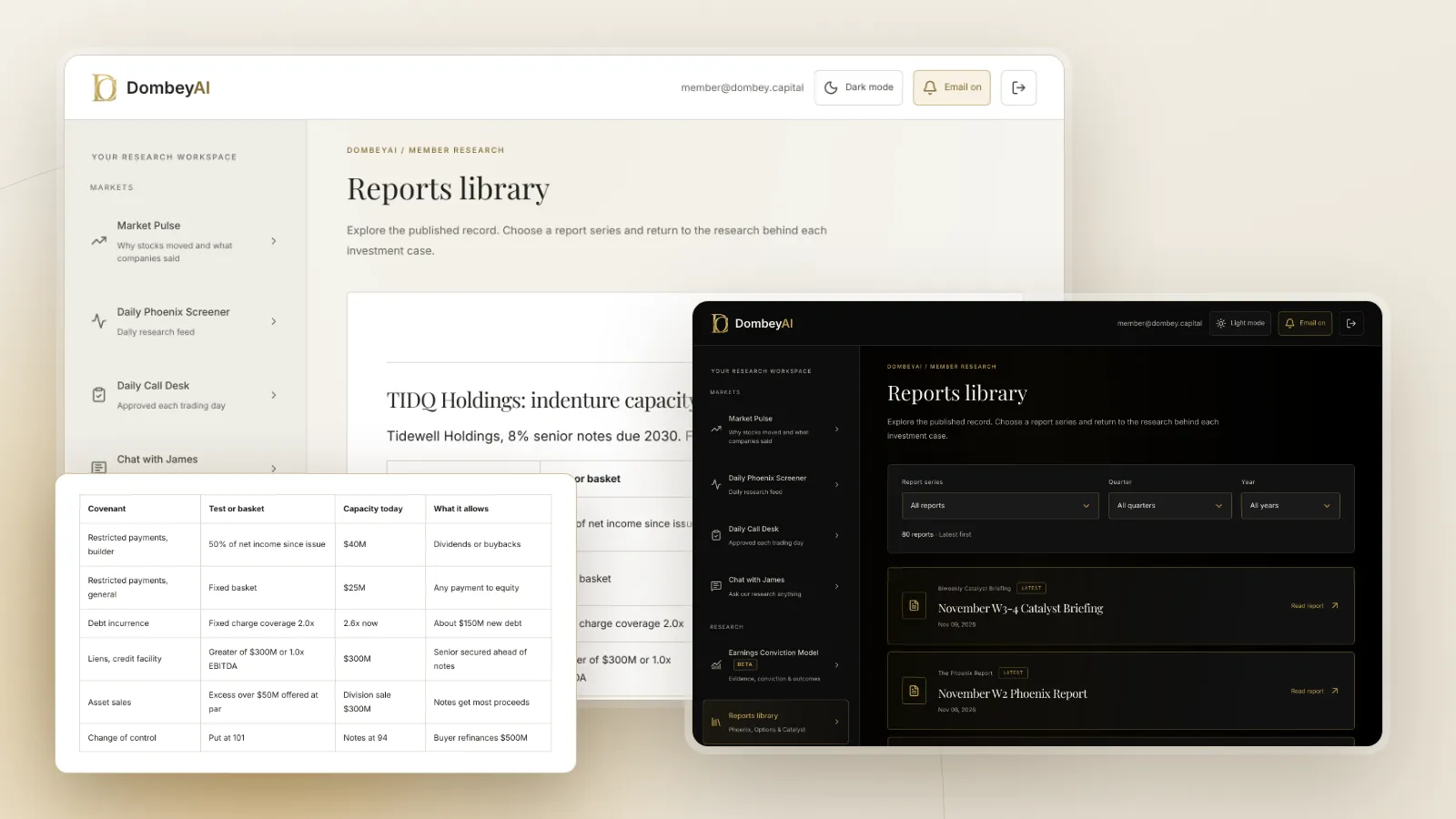
A worked example
Common mistakes
- Reading the prospectus summary only. The "Description of Notes" is helpful but it is not the contract. Check the indenture for anything that matters.
- Skipping definitions. A covenant that looks tight can be loose once you read the defined terms behind it.
- Missing supplemental indentures. An amendment from a consent solicitation can remove the covenants you are relying on.
- Assuming investment-grade bonds restrict much. Investment-grade indentures usually have few covenants, mainly liens and mergers. Our piece on fallen angels explains what changes after a downgrade.
- Forgetting the credit agreement. Bank loans often have tighter covenants than the bonds. Read both.
- Ignoring the timing of baskets. Builder baskets accumulate from a start date and can be much larger, or smaller, than they look.
Dombey's special situations research reads the debt documents before forming a view on the equity; our list of the best investing newsletters for special situations compares other sources that do the same.
The bottom line
A bond indenture sets the outer limits on what a company can do for its shareholders. Find it and its supplements on EDGAR, read the definitions, then work through restricted payments, debt and liens, asset sales, change of control, redemption and defaults. In leveraged companies, these clauses decide whether a dividend, buyback, asset sale or takeover can happen on the terms the market expects. A few hours with the contract can prevent a thesis built on cash that bondholders will claim first.