

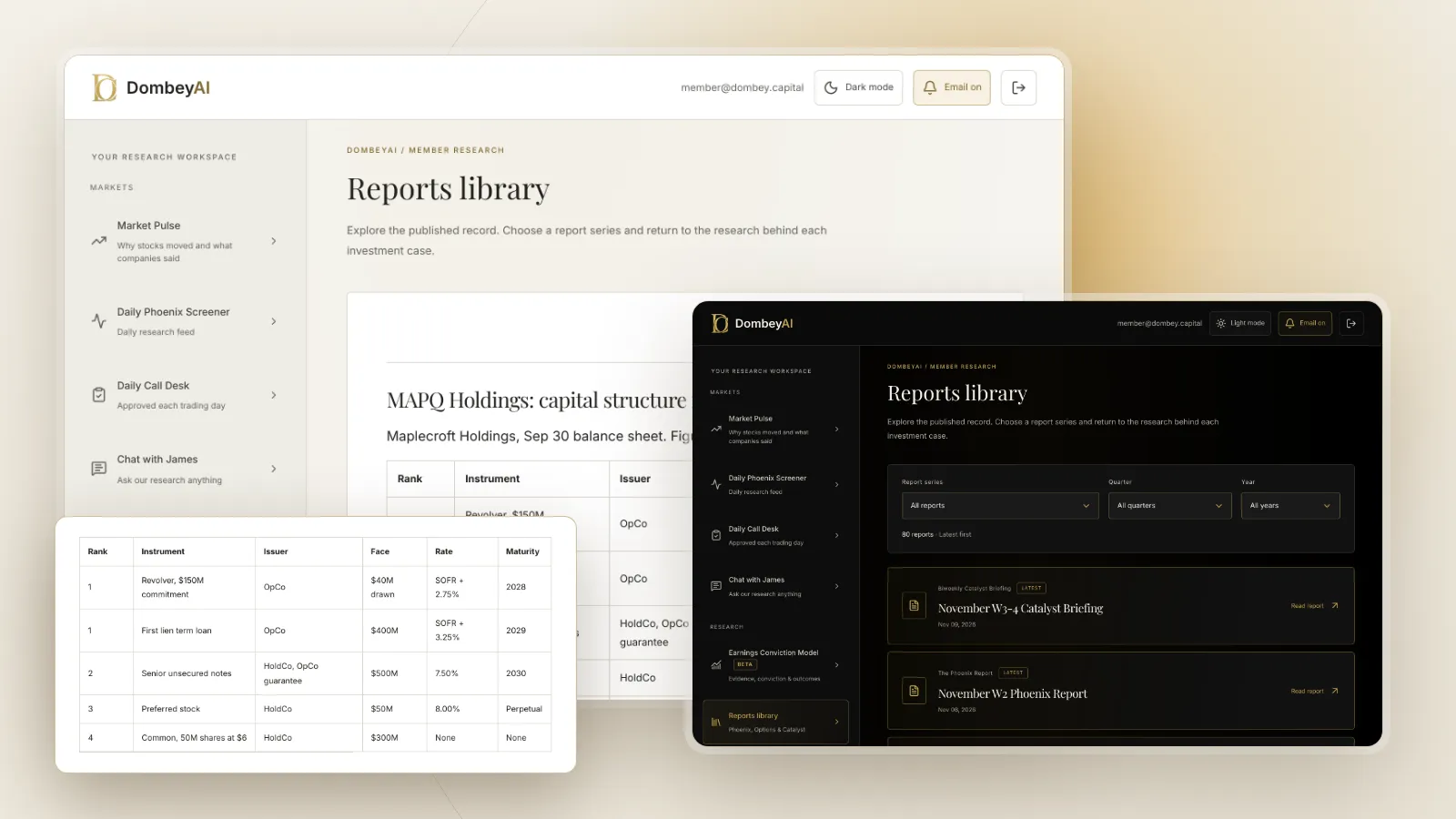
What you need
- The latest 10-K and any 10-Qs filed since, especially the debt, leases, pension, preferred stock and equity footnotes.
- Exhibit 21 of the 10-K, the list of subsidiaries.
- The credit agreement and each bond indenture, usually filed as exhibits to an 8-K, 10-K or 10-Q. EDGAR full-text search finds them by name.
- 8-Ks filed since the last quarter end for new debt, amendments, repayments or exchanges.
- A spreadsheet with one row per instrument.
Our guide on how to read the footnotes in a 10-K covers where each of these sits in the filing.
Step 1: List every debt instrument from the footnote
Open the debt footnote in the most recent filing. Most companies include a table with each facility and note: name, interest rate, maturity and carrying amount. Copy every line into your sheet, including the revolving credit facility and any finance leases shown there.
Record the face amount, not just the carrying value. Carrying value is net of discounts and issuance costs; what the company owes at maturity is the face amount. The difference matters for bonds issued at a discount or exchanged in a liability management exercise.
For the revolver, record both the amount drawn and the total commitment. An undrawn revolver is not debt today, but in a downturn companies often draw it in full.
Step 2: Find the issuer and guarantors for each instrument
The footnote tells you what the debt is. It often does not say which legal entity owes it. For that, check the indenture or credit agreement:
- Issuer or borrower. The parent holding company, an intermediate holding company or an operating subsidiary.
- Guarantors. Which subsidiaries guarantee the debt. Many indentures say "each of the parent's existing and future domestic restricted subsidiaries".
- Non-guarantors. Foreign subsidiaries, unrestricted subsidiaries and joint ventures that do not guarantee.
Some 10-Ks include condensed financial information for the issuer and guarantor group, which shows how much revenue and assets sit outside it.
Step 3: Record security and lien priority
Secured debt is paid first from the collateral it is secured by. For each secured instrument, note:
- What the collateral is: all assets, specific assets, or only certain subsidiaries' stock.
- Whether the lien is first or second priority.
- Any intercreditor agreement that sets how first and second lien holders share collateral.
Then rank the instruments:
| Typical rank | Instrument | Notes |
|---|---|---|
| 1 | Revolver and first lien term loan | Often share first lien collateral pari passu |
| 2 | First lien secured notes | Same lien, check the intercreditor agreement |
| 3 | Second lien notes or loans | Paid from collateral only after first lien |
| 4 | Senior unsecured notes | Paid from unencumbered assets and any shortfall claims |
| 5 | Subordinated notes | Contractually behind senior debt |
| 6 | Preferred stock | Equity, ahead of common |
| 7 | Common stock | Residual claim |
This is the typical order. The documents decide the actual one.
Step 4: Adjust for structural subordination
Contractual rank is not the whole story. Creditors of a subsidiary are paid from that subsidiary's assets before anything flows up to the parent. If an operating subsidiary that carries its own debt gives no guarantee of the parent's unsecured notes, those notes rank behind that debt for that subsidiary's value.
Draw the group structure as a simple tree: parent at the top, subsidiaries below, with each instrument placed at the entity that owes it. Mark guarantees as lines from subsidiaries up to the parent's debt. Gaps in the guarantees are where structural subordination bites.
Step 5: Add claims outside the debt footnote
Several claims sit elsewhere in the filing but belong on the map:
- Operating lease liabilities. From the leases footnote. Large for retailers, airlines and restaurants.
- Pension and retiree obligations. The underfunded amount from the pension footnote.
- Preferred stock. Liquidation preference and any accrued, unpaid dividends, as in preferred dividends in arrears.
- Guarantees and letters of credit. From the commitments and contingencies footnote.
- Other obligations. Litigation reserves, environmental liabilities, tax receivable agreements and other items covered in off-balance-sheet liabilities.
Keep these on separate rows. They do not all rank the same way, and you will want to see leverage with and without them.
Step 6: Build the equity layer
Below the claims sits the common equity. Record:
- Basic shares outstanding from the cover page of the latest filing.
- Options, restricted stock units and warrants, with strike prices.
- Convertible notes and convertible preferred, with conversion prices.
Calculate diluted shares at the current price, and again at prices where out-of-the-money securities would convert. Our explainer on dilution and share count changes covers the method. Then multiply by the share price for market capitalization.
Step 7: Lay out maturities and costs
Add two columns: the year each instrument matures and its annual cash interest. Sum them by year to get a maturity schedule and a total interest bill.
| Year | Maturing | Instrument |
|---|---|---|
| 2027 | $150M | Revolver (if drawn), springing maturity |
| 2028 | $400M | First lien term loan |
| 2029 | $500M | 7.5% senior unsecured notes |
| 2031 | $300M | 5.0% senior notes |
Check for springing maturities: some term loans and revolvers mature earlier if a later bond is not refinanced by a set date. A large maturity within two years is where refinancing risk turns into a dated event, the situation described in what a debt maturity wall is.
Step 8: Test the map against enterprise value
Now add the claims in order of priority and compare them with a range of enterprise values. This is a recovery waterfall.
Running a few enterprise values shows how much cushion the equity has, which class is the fulcrum, and how a sale of assets or a rise in value would flow through. It also connects to enterprise value and net debt to EBITDA: the map is the detailed version of the net debt number those measures use.
Common mistakes
- Using carrying value for debt. Discounts, premiums and issuance costs change the reported figure. Face value is what the company has to repay.
- Ignoring who owes what. Two notes with the same rank can have very different recoveries if one sits at the operating company and the other at a holding company without guarantees.
- Leaving the revolver undrawn on the map. In stress, companies draw their revolvers. Model the fully drawn case.
- Using stale numbers. Quarter-end figures can be months old. Check every 8-K since, especially for exchanges, repurchases and new issues.
- Forgetting cash restrictions. Cash at non-guarantor or foreign subsidiaries may not be available to repay parent debt.
- Treating preferred as debt or as common. Preferred stock has its own priority and terms. Model it as its own layer.
- Skipping the covenants. Debt baskets and restricted payment limits decide what the company can do next, such as raising new secured debt ahead of existing holders. That is how stub equity situations and liability management deals get built.
The bottom line
A capital structure map lists every claim on a company by priority, with amounts, terms, maturities and the entity that owes each one. Build it from the debt footnote, the credit agreement, the indentures and the subsidiary list, then add leases, pensions, preferred stock and dilutive securities. Test it against a range of enterprise values to see where value breaks and which class is the fulcrum. For special situations, the map is often the most useful single page you can build, and it underlies many of the theses in our list of the best investing newsletters for special situations.