

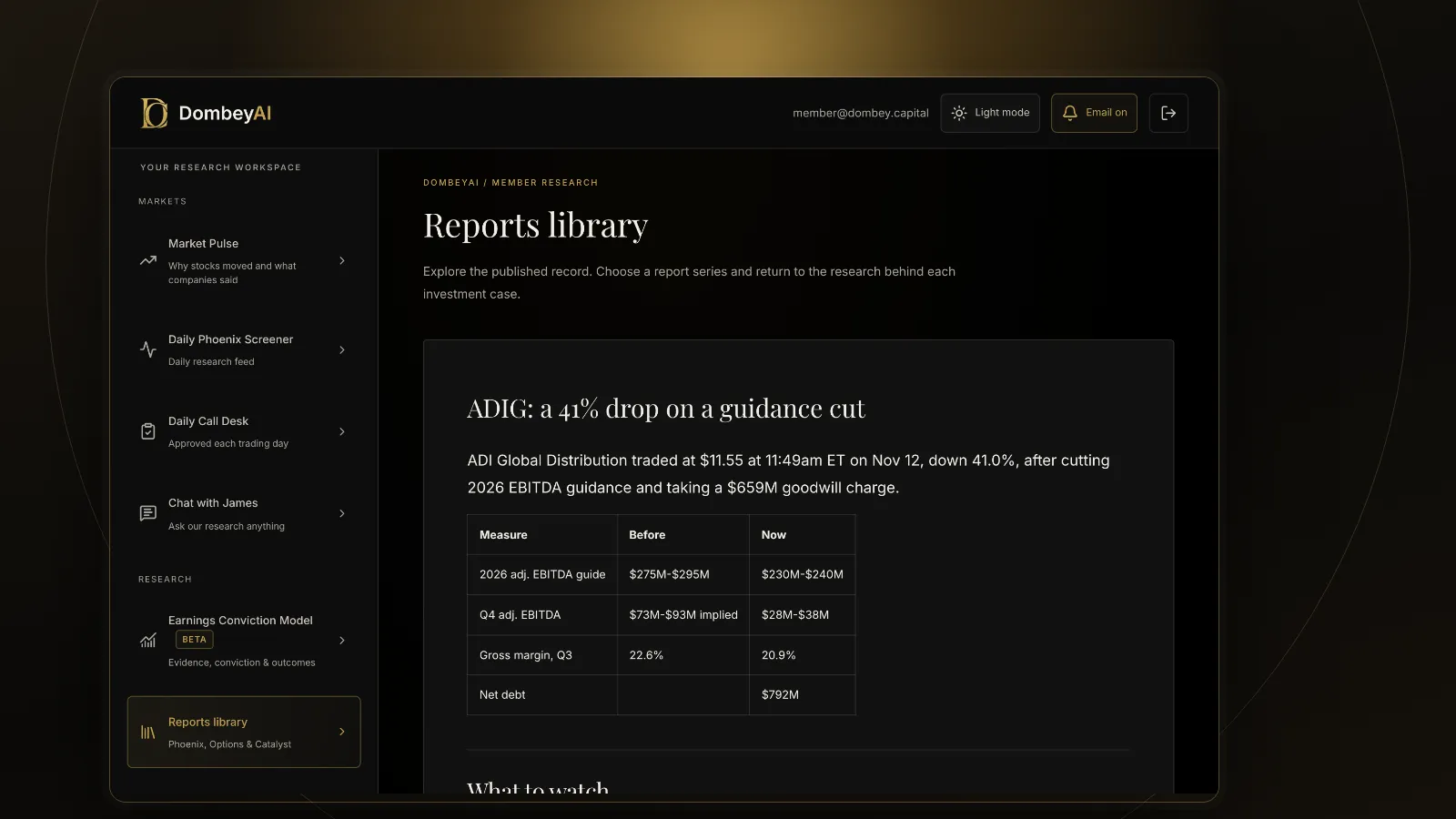
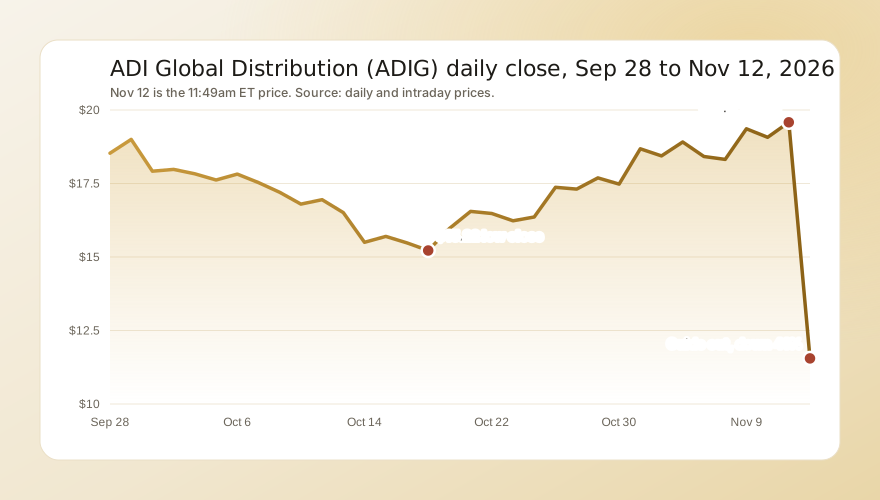
Nov 12, 2026: a 41% drop on a goodwill charge and a cut outlook
ADI closed Nov 11 at $19.58, near the top of a run from a $15.22 close on Oct 19. Premarket trading was thin: a few trades at $19.80 at 4am, then $19.06 just after the 7:05am release. The call started at 8:30am. The stock opened at $15.46, 21% lower, kept falling to $11.02 at 9:40am, and traded at $11.55 at 11:49am on about 1.57 million shares.
What pushed it down:
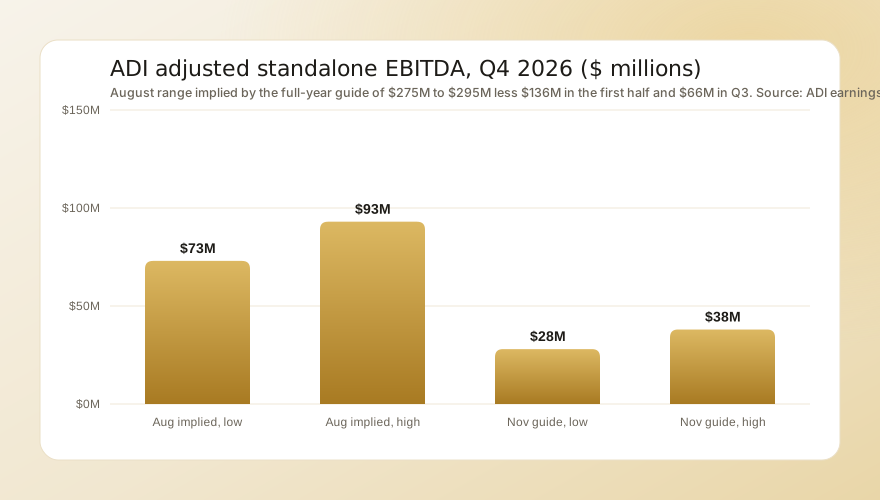
- A lower outlook. Full-year adjusted standalone EBITDA guidance fell to $230 million to $240 million from $275 million to $295 million, and revenue guidance to $4.91 billion to $4.93 billion from $4.95 billion to $5.00 billion. The fourth-quarter EBITDA range is $28 million to $38 million on revenue of $1.112 billion to $1.132 billion.
- A goodwill charge. The $659 million non-cash impairment took the quarter to a net loss of $655 million, or $8.65 a share, against net income of $26 million a year earlier. The company said the test was triggered by residential weakness, lower projected earnings and cash flows, and its falling share price.
- Exclusive Brands. Chief executive Rob Aarnes said "demand for our Exclusive Brands products weakened as the quarter progressed," and finance chief Mike Carlet said that by October "it was down in the higher single digits," according to the call transcript. He expects Exclusive Brands average daily sales to decline in the mid-single digits in the fourth quarter.
- Margins. Gross margin fell to 20.9% from 22.6%, and to 20.0% excluding tariff refunds and spin-off inventory adjustments. Carlet said mix alone cost about 140 basis points.
Other distributors rose. At 11:49am:
| Stock or fund | Change from Nov 11 close |
|---|---|
| ADI Global Distribution (ADIG) | -41.0% |
| Resideo Technologies (REZI) | +0.5% |
| Wesco International (WCC) | +0.9% |
| TD Synnex (SNX) | +1.6% |
| Arrow Electronics (ARW) | +1.3% |
| Fastenal (FAST) | +0.7% |
| SPDR S&P 500 ETF (SPY) | +0.1% |
| iShares Russell 2000 ETF (IWM) | -0.7% |
Resideo, the former parent, kept its smart home products business and rose slightly, so the market read the cut as ADI's own. The rest of the session's movers are in today's biggest stock moves.
After the drop, RSI(14) stood at 27, the shares sat 37% below their 50-day average, volume ran 3.4 times its 20-day average, and the stock was 63% below its 52-week high of $30.99. The company has fewer than 200 sessions of trading history, so it has no 200-day average yet.
The numbers
The quarter ended Oct. 3, 2026:
| Measure | Q3 2025 | Q3 2026 | Change |
|---|---|---|---|
| Net revenue | $1,203M | $1,306M | Up 9% |
| Average daily sales | Up 5% | ||
| Gross margin | 22.6% | 20.9% | Down 1.7 points |
| Adjusted standalone EBITDA | $76M | $66M | Down 13% |
| Adjusted EBITDA margin | 6.3% | 5.1% | Down 1.2 points |
| Net income (loss) | $26M | ($655M) | Goodwill charge |
| Operating cash flow | $64M |
The quarter had two more selling days than a year earlier and an easier comparison with a quarter hit by an ERP conversion, so the 9% revenue gain overstates the trend. The fourth quarter has four fewer selling days than last year, Carlet said. Selling, general and administrative costs rose $12 million to $202 million, partly from the costs of running as a public company. Our explainer on goodwill and impairments covers why a non-cash charge still tells investors something about what management expects the business to earn.
The bull case
ADI is a large, cash-generating distributor with leading positions in security and fire and life safety, and the commercial side grew. Third-party product sales rose 7% while Exclusive Brands fell 2%. Liquidity is $708 million, and the debt is long dated: a $600 million term loan due 2033 and $400 million of notes due 2034. Carlet said de-leveraging is "still our biggest priority." The cost program has $60 million actioned, with about $70 million expected in 2027 results and the full $80 million in 2028, and Aarnes said more cuts are being developed. Spin-offs often sell off in their first months as holders of the parent sell shares they did not choose, and our page on spin-off investing covers that pattern. At $11.55, the 76 million shares are worth about $878 million.
The risks
- The run rate. At the midpoint, the fourth-quarter guide annualizes to about $132 million of EBITDA. Against net debt of $792 million that is about six times, far above the 2.9 times on trailing figures. Our explainer on net debt to EBITDA covers why the direction of the ratio matters as much as its level.
- Housing. Exclusive Brands leans on residential products, and management tied the weakness to the U.S. housing market, which it does not control.
- Estimates. The guide cut is likely to bring analyst estimate cuts. The consensus price target of $29.67 was set before the report. Our guide to why estimate revisions move stocks covers that process.
- Preferred stock. 150,000 preferred shares with a $1,000 liquidation preference, $150 million in total, rank ahead of the common.
What comes next
- Fourth-quarter results, which we expect around February 25, 2027. Watch EBITDA against the $28 million to $38 million guide and Exclusive Brands sales against the mid-single-digit decline.
- The 2027 outlook. The first full-year guide as a standalone company will show whether the cost savings can offset the mix and volume pressure.
- Debt. Any change to the de-leveraging plan, or a draw on the revolver, would matter more than usual with the run rate this low.
Our guide on how to read an earnings release covers how to work through a report like this one, and how changes in guidance move stocks covers why the outlook mattered more than the revenue beat.