


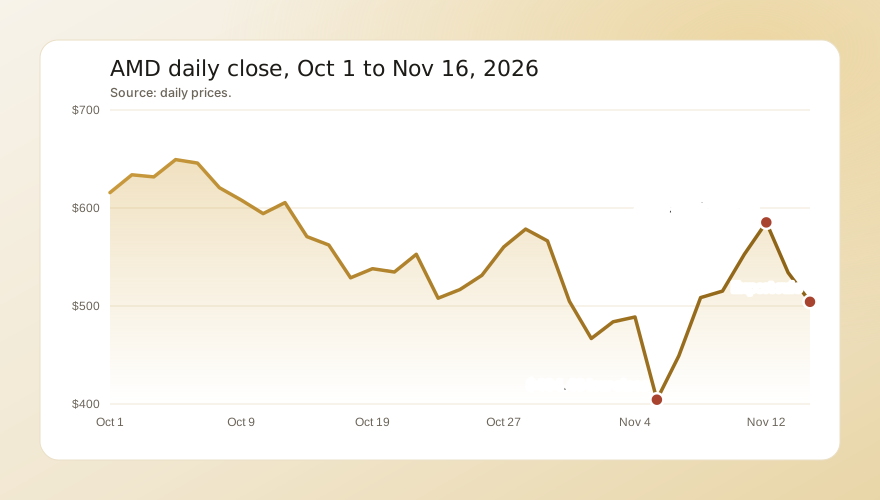
Nov 16, 2026: a 5.6% drop as new export rules hit chip stocks
AMD closed Nov 13 at $534.06, after an 8.8% fall that day. In premarket trading on Nov 16 it drifted from about $513 at 4am to about $504 by 8:30am. It opened at $503.45, traded as high as $526.20 and as low as $501.30, and closed at $504.28, down $29.78, on volume of 35.9 million shares. In after-hours trading it stood near $503 at 7:30pm.
What pushed it down:
- New license rules. The Bureau of Industry and Security issued an interim rule on Nov 16 that, on top of existing license rules for advanced chips, requires licenses to export, re-export or transfer advanced semiconductors to Brazil, Indonesia, Malaysia, Singapore and Thailand. BIS said those countries "present a higher-than-normal risk of diversion."
- Remote access. BIS said the rule "is designed to ensure that existing restrictions on access to sensitive American technology cannot be circumvented through remote computing arrangements involving data centers in third countries." Free Malaysia Today, citing the rule, reported that firms based in China, including Alibaba and ByteDance, have rented computing power in the region.
- Singapore exposure. The Motley Fool reported that 12.4% of AMD's 2025 revenue came from sales to Singapore, and that its MI350X accelerators look set to face greater restrictions.
- The Nvidia scandal. Huang resigned last week after admitting an affair with a former executive of Singapore-based Megaspeed International, whom the U.S. suspects of being a Chinese spy, Free Malaysia Today reported. CBS News reported that his exit heightened concern that China could reach Nvidia's chips by renting computing power in Southeast Asia.
What it did not include: any comment from AMD, or any change to AMD's guidance. The rule is an interim rule, and the reports did not agree on when it takes effect. Our explainer on regulatory catalysts covers how a rule like this moves a stock before its details are known.
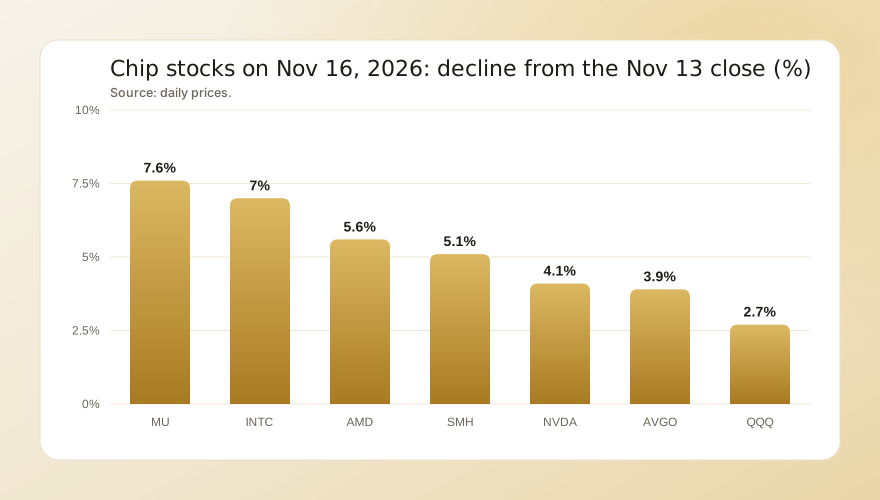
The selloff was broad across chip stocks. On Nov 16:
| Stock or fund | Change from Nov 13 close |
|---|---|
| Micron (MU) | -7.6% |
| Intel (INTC) | -7.0% |
| AMD (AMD) | -5.6% |
| VanEck Semiconductor ETF (SMH) | -5.1% |
| Nvidia (NVDA) | -4.1% |
| Broadcom (AVGO) | -3.9% |
| Invesco QQQ (QQQ) | -2.7% |
Our pages on why Nvidia stock fell, why Micron stock fell and why Intel stock fell cover the other chip makers, and the rest of the session's movers are in today's biggest stock moves.
After the drop, RSI(14) stood at 47, the shares sat 9% below their 50-day average but 19% above their 200-day average, volume ran 1.0 times its 20-day average, and the stock was 23% below its 52-week high of $658.52.
The numbers
AMD reported third-quarter results on Nov 3:
| Measure | Q3 2026 | Change from Q3 2025 |
|---|---|---|
| Revenue | $13.38B | Up 45% |
| Data Center revenue | $8.5B | Up 97% |
| Client revenue | $2.9B | Up 7% |
| Gaming revenue | $773M | Down 40% |
| Embedded revenue | $1.1B | Up 29% |
| Non-GAAP gross margin | 56% | Up 2 points |
| Non-GAAP operating income | $3.92B | Up 75% |
| Non-GAAP EPS | $2.09 | Up 74% |
For the fourth quarter, AMD guided revenue to about $17 billion, plus or minus 3%, which would be up about 66% from a year earlier, with a non-GAAP gross margin of about 55%. Chief executive Lisa Su said the company expects growth "to accelerate further in the fourth quarter as we scale Helios and 'Venice' production." The consensus price target is $658.77, about 31% above the close. Our explainer on guidance changes covers why the outlook matters more than the quarter just reported.
The bull case
AMD's largest named AI customers are U.S. companies. The company says Anthropic, Meta, Microsoft, OpenAI and Oracle Cloud Infrastructure are running workloads on its first Helios rack systems with MI450 GPUs. Data Center revenue nearly doubled in a year, and the fourth-quarter guide calls for another 27% gain in sales in one quarter. Before the rule, the stock had rallied on Nov 9 after Google Cloud chose fifth-generation EPYC processors for its TPU 8tx platform. AMD has managed export rules before: after the April 2025 license requirement on MI308 chips for China, it took inventory charges, then applied for and received some licenses and began shipping MI308 products to certain China-based customers at the end of 2025, according to its latest 10-Q. Our explainer on forward P/E covers how to weigh a multiple when earnings are growing this fast.
The risks
- Singapore. If the 12.4% of revenue billed to Singapore includes chips that end up serving restricted customers, some sales could be delayed or blocked while licenses are reviewed.
- More rules. Free Malaysia Today reported that U.S. lawmakers are weighing more curbs on AI chip sales and chipmaking tools, to be attached to the annual defense bill that must pass before the end of the year.
- Valuation. The Motley Fool puts AMD at about 30 times next year's earnings, against about 10 times for Nvidia.
- Volatility. The stock fell 17.3% on Nov 5, rose 13.3% on Nov 9 and has now fallen 13.8% in two sessions.
What comes next
- Nvidia's third-quarter report, Nov 17, 2026. The first report under interim chief executive Colette Kress, and the next read on AI data center demand.
- The final rule. The effective date, the license review policy and whether any countries are added.
- AMD's response. Any statement on how much revenue the rule affects, or a change to the fourth-quarter guide.
- The defense bill. Any added curbs on AI chip sales before year-end.