


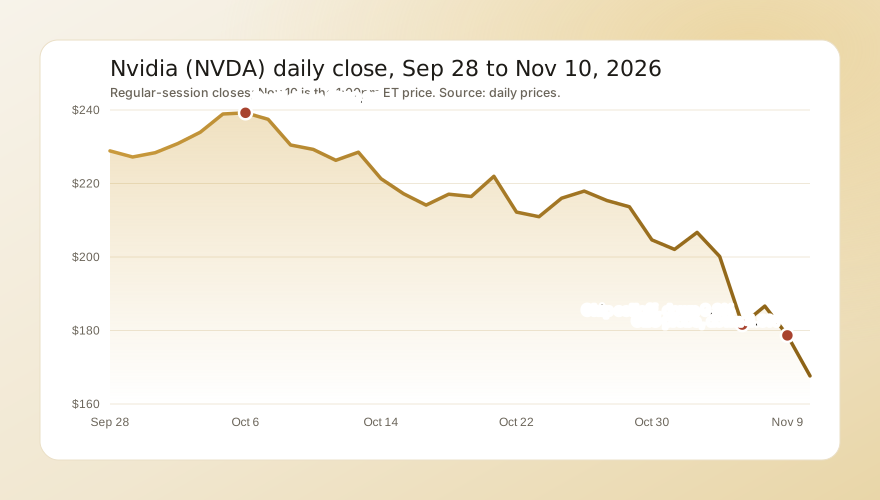
Nov 10, 2026: down 6% as the CEO probe widens
Premarket. Nvidia started the day higher. It traded as high as $183.09 before the open, and was up 1.75% at $181.80 at one point, the Wall Street Journal reported. By 9:25am it had slipped to $173.99.
The session. The stock opened at $173.98, and its high of the day, $174.65, came in the first five minutes. It fell through the morning to $169.68 at 11:00am and a low of $166.24 near 12:40pm, and was $167.64 at 1:00pm. By then 270.5 million shares had traded, about 2.0 times the 20-day average, after 459.1 million on Nov 9. After the drop, the 14-day RSI stood at 24, and the shares sat 23% below their 50-day average, 18% below their 200-day average and 31% below their 52-week high of $243.37.
What pushed it lower. Three things came out between Monday's close and Tuesday midday:
- The FBI. President Trump told reporters the FBI is looking into Huang's relationship with Alice Huang, no relation, a former top executive at Singapore-based Megaspeed International whom U.S. officials suspect of sharing information with China's government, Barron's reported. Megaspeed said on LinkedIn that investigations by U.S. authorities and others had found "no evidence of any violations concerning the illicit transfer of chips or any illegal activities."
- A China sales report. The Information reported that the relationship helped facilitate shipments of at least $7.5 billion of Nvidia chips, about 240,000 H100, H200 and some A100 units, to Chinese firms through a network built around Shanghai Century Litong, which had preferred cloud partner status with Nvidia from 2023. Reuters said it could not independently verify the report, and Nvidia did not respond to Reuters.
- Price target cuts. Citi cut its target to $285 from $315 and Wells Fargo to $300 from $315, both keeping Buy ratings. Bank of America removed Nvidia from its US 1 list of top picks along with Micron and Lam Research, while writing that it "would not equate allegations with proven business damage."
The board's own position has not changed since Nov 8. It said a committee of independent directors with outside counsel will run the inquiry, that it has "no reason to believe" national security or company secrets were compromised, and that it "has confidence in Jensen and his leadership team." Huang apologized to staff for being unfaithful to his wife. Beijing called the spying claims "groundless speculation."
The rest of the sector shows how specific the selling was. At 1:00pm:
| Stock or fund | Nov 9 close | Nov 10, 1:00pm | Change |
|---|---|---|---|
| Nvidia (NVDA) | $178.67 | $167.64 | -6.2% |
| Micron (MU) | $733.15 | $707.39 | -3.5% |
| Intel (INTC) | $59.37 | $57.47 | -3.2% |
| Microsoft (MSFT) | $545.18 | $531.04 | -2.6% |
| VanEck Semiconductor ETF (SMH) | $487.41 | $478.86 | -1.8% |
| Invesco QQQ (QQQ) | $679.35 | $669.85 | -1.4% |
| TSMC (TSM) | $388.62 | $390.51 | +0.5% |
| AMD (AMD) | $508.58 | $509.49 | +0.2% |
| Broadcom (AVGO) | $319.48 | $327.32 | +2.5% |
The wider market had its own problem. The October consumer price index came in hotter than expected and raised the odds of a Federal Reserve rate increase on Dec 9, Barron's reported, after Fed governor Christopher Waller raised the possibility of a half-point increase if inflation ran hot, MarketWatch reported. That explains the 1.4% drop in QQQ, not a 6% drop in Nvidia. On Nov 9 the gap was wider still: Nvidia fell 4.3% while AMD rose 13%, and it trailed the PHLX Semiconductor Index by the most since January 2019, the Journal reported.
The slide started before the probe. Nvidia's highest close was $239.24 on Oct 6, and it had lost 16% by Nov 4. On Nov 5 it fell 9.3% in a chip-wide selloff that took the iShares Semiconductor ETF down 12%, the day midterm results raised the risk of limits on new data centers, as our Micron note covers. From the record close to 1:00pm on Nov 10 the stock was down 29.9%. More of the day's swings are in today's biggest stock moves.
What the numbers say
The quarter Nvidia reports on Nov 17 ended October 25. In August the company guided:
- Revenue of $108.0 billion, plus or minus 2%, so about $105.8 billion to $110.2 billion, with no data center compute revenue from China assumed.
- Gross margin of 74.0%, plus or minus 50 basis points, against 75.0% in the second quarter.
- Non-GAAP operating expenses of about $9.0 billion, against $8.2 billion.
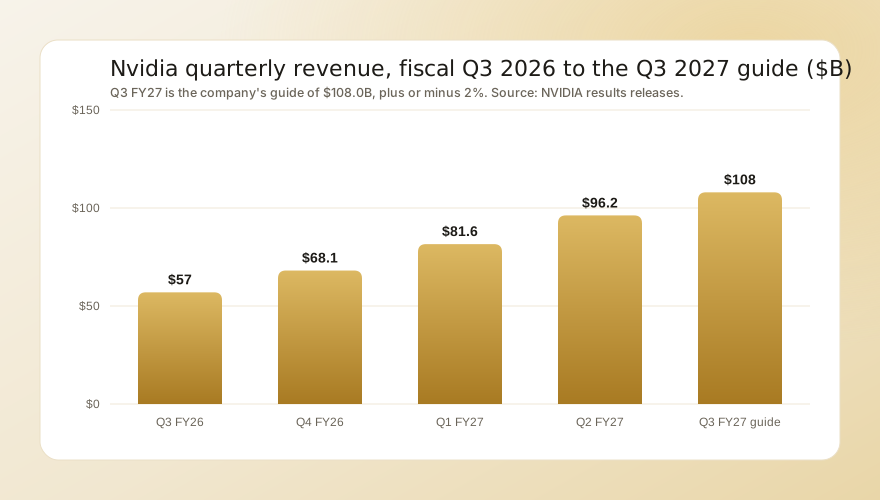
The consensus going in is about $108.8 billion of revenue and $2.47 of earnings a share, against $57.0 billion and $1.30 a year earlier. Nvidia has topped the consensus revenue figure by 3.0% to 4.3% in each of the last four quarters. Second-quarter revenue was $96.2 billion, up 106%, with data center revenue of $89.0 billion, and Hopper shipments to China were less than 1% of data center revenue. Citi expects a "modest" beat, with higher sales partly offset by lower gross margins as memory prices rise, and expects the company to repeat an outlook of about 70% revenue growth for fiscal 2028. Our guide on how to read an earnings release covers what to check first on the day.
The price now asks for little of that. At 11.66 times projected earnings for the next 12 months, the Journal reported, Nvidia is at its lowest multiple since October 2011; our explainer on forward and trailing P/E covers why the forward figure leans on estimates that can move. The company also had about $99.0 billion left under its buyback authorization at the end of July, after returning $26.0 billion to shareholders in the second quarter. Our note on buybacks as catalysts covers when repurchases change the share count enough to matter.
The bull case
- Demand is not the question. None of the reporting on the probe describes a lost customer or a cut order, and other AI chip suppliers rose on both days.
- A large quarter is a week away. The guide calls for revenue near double a year earlier, and the company has beaten consensus by 3% or more four quarters running.
- Cheap on its own history. About 11.7 times forward earnings is the lowest since 2011, for a company guiding to 74% gross margins.
- The board is backing the CEO. The board has said it has confidence in Huang, prediction markets put the odds of his removal before 2027 at 13% to 14%, and ARK Invest bought 90,443 shares on Nov 9, Barron's reported.
- Cash to support the stock. About $99 billion of buyback room remained at the end of July.
The risks
- An open-ended inquiry. Neither the board's review nor the FBI's has a timeline, and either could reach a different conclusion from the board's early statement. Our note on how CEO departures move stocks covers what usually follows when a founder's role is in doubt.
- Governance. Nvidia has no chairman, three of its ten independent directors had served 25 years or more as of last spring, and the proxy adviser ISS gave its board structure its riskiest rating, the Journal reported.
- Export controls. Capstone expects pressure on the administration to tighten rules on chip diversion and said concessions on H200 exports "could be vulnerable to rollback." If the $7.5 billion report holds up, the company could face penalties or new limits on sales through Southeast Asia.
- Margins and AI spending. Citi expects higher memory costs to weigh on gross margin. The stock had already lost about $1.3 trillion of value from early October before the probe news, MarketWatch reported, and Reuters cited investor unease over whether heavy AI infrastructure spending will deliver adequate returns.
- A sharper move on the day. After two volatile weeks, the options market may price a wider swing than usual for Nov 17; our guide on estimating an earnings move from options covers how to read that.
What comes next
Nvidia reports on Tuesday, Nov 17, with the release at about 1:20pm Pacific time and the call at 2pm Pacific (5pm ET). Watch revenue against $105.8 billion to $110.2 billion and the $108.8 billion consensus, gross margin against 74.0%, the fourth-quarter revenue guide, and whether management repeats its fiscal 2028 outlook. Before then, watch for any statement from the board's committee, any filing on the inquiry, and any change to U.S. rules on chip sales to China or Southeast Asia. The test of the Bullish view is a quarter at or above the guide, an outlook that keeps growth intact, and a CEO who stays in the job.