

Nov 20, 2026: a 10% slide from the open on a Google order report
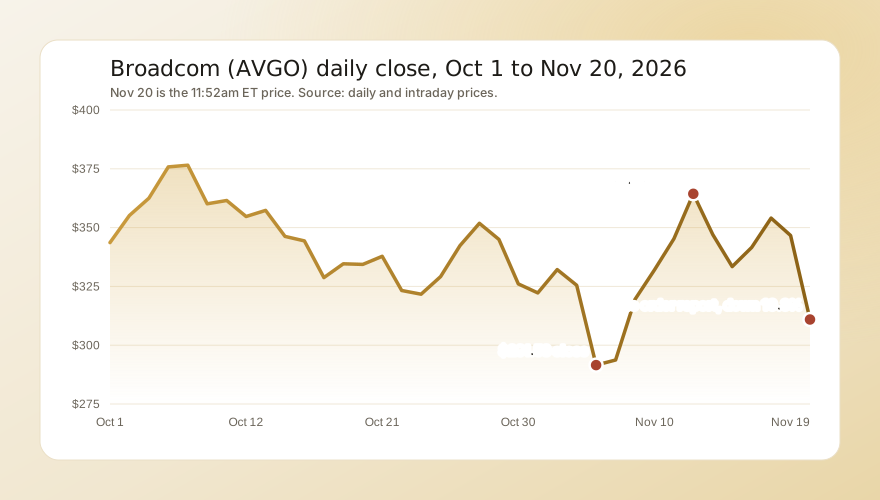
Broadcom closed Nov 19 at $346.65, down 2.1% on a day when Anthropic's listing failed to lift AI stocks. Premarket trading on Nov 20 fell to $332.68 at 7:45am, 4.0% lower, as Nasdaq 100 futures dropped 1.4% and other chip makers slid before the open. It then recovered to $343.00 just before the open.
The stock opened at $342.39, touched $342.90 in the first minutes, and fell for the rest of the morning. Investing.com carried Kuo's figures at 11:25am, when the stock was down 8.9%, so the report added to a slide that was already under way. At 11:52am it was $310.93, down 10.3%, on 20.3 million shares, close to its session low of $310.43.
What pushed it down:
- The Google order report. Kuo said Google cut planned 2027 shipments of the Broadcom-designed TPU 8i series by about 1 million units, roughly 20% of the expected volume, from about 5 million to about 4 million. Most of the cut falls on the higher-priced 8i Max, also called Whalefish, while Google plans to raise shipments of the MediaTek-designed TPU 8t. He tied the shift to Google's focus on frontier models amid supply and data center power limits.
- A second day of chip selling. The Philadelphia Semiconductor Index fell 7% by 11:05am, Seeking Alpha reported, with Micron down 11%. Broadcom fell 9.4% by 11:02am, behind Micron's 11.3% and AMD's 10.0%. Asian chip stocks had already fallen overnight: Taiwan's Taiex lost 5.65%, on course for its steepest weekly drop since October 1997.
- Doubts about AI spending. Bank of America said that if cloud spending holds near current levels, AI semiconductor earnings could face 35% to 40% downside, and that a bottom would come when capex and earnings estimates are cut without the stocks falling further.
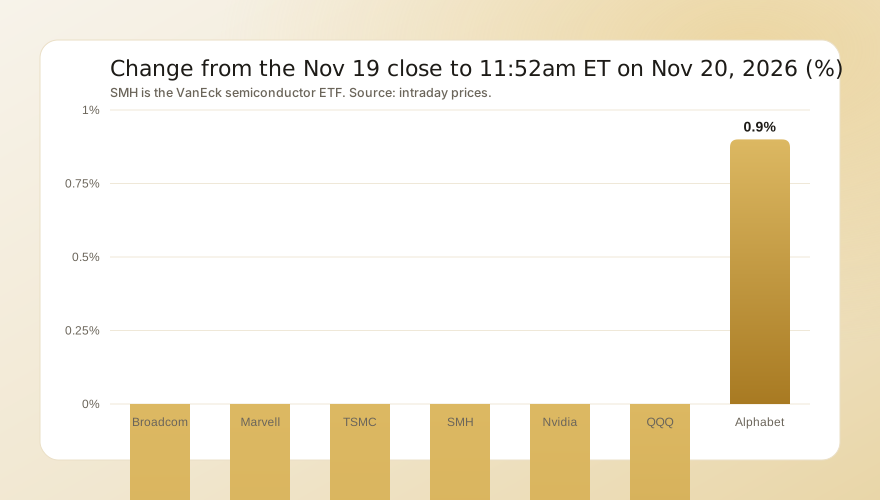
Broadcom fell 2.5 points more than the VanEck semiconductor ETF and 3.5 points more than Nvidia, while Alphabet, the customer at the center of the report, rose 0.9%. Our page on why Alphabet fell covers Google's own spending plans, why Nvidia fell covers the leadership change that started this month's chip selling, and the rest of the day's movers, including Sandisk, are in today's biggest stock moves.
At 11:52am, RSI(14) stood at 42, the shares sat 9% below their 50-day average and 15% below their 200-day average, volume by midday ran 0.7 times the 20-day average, and the stock was 37% below its 52-week high of $495.00.
The numbers
| Measure | Value |
|---|---|
| Q3 FY2026 revenue | $29.59B, vs $29.24B expected |
| Q3 FY2026 adjusted EPS | $3.32, vs $3.22 expected |
| Q4 FY2026 revenue guide | about $34.8B |
| Q4 consensus revenue / EPS | $34.90B / $3.83 |
| AI semiconductor revenue target | $115B in FY2027, $230B in FY2028 |
| Kuo's reported TPU 8i cut | about 1M units, roughly 20% of 2027 plan |
Broadcom's revenue has grown fast enough to pull ahead of estimates every quarter this year, from $19.31 billion in the quarter reported in March to $29.59 billion in the one reported in September, and the fourth-quarter guide implies another step up. That is why the report matters: the fiscal 2027 target rests on a handful of custom chip customers, and Google is the oldest of them. Our explainer on earnings estimate revisions covers why a single datapoint can move a stock this large before any estimate changes, and our guide to estimating an earnings move from options shows how to read what the market expects on Dec 9.
The bull case
Broadcom does not depend on one customer the way it did two years ago. Meta, Anthropic and OpenAI are building custom chips with it, and the Anthropic contract is mostly non-cancellable, The Motley Fool reported. Kuo's cut leaves about 4 million Broadcom-designed TPU 8i chips in Google's 2027 plan, by his own figures, and gave no estimate of the revenue effect. The shares trade at 18.5 times forward earnings, close to the 17.6 times average for technology stocks, for a company that guides AI chip revenue to double in fiscal 2028. The consensus analyst target is $512.67, and the 52-week low of $289.77 is 7% below the 11:52am price.
The risks
- Customer concentration. A few hyperscalers buy most of Broadcom's custom chips, so a change at one shows up in the total.
- MediaTek. A second designer inside Google gives Google leverage on price, even if Broadcom keeps the higher-end parts.
- AI spending. If cloud companies slow capital spending, custom chips are cut along with GPUs.
- The Dec 9 report. The stock now needs Broadcom to restate the $115 billion target, and anything less would land in a market that is already selling.
What comes next
- Any response from Google or Broadcom to the Kuo report. Neither had commented in the reports we read.
- Fourth-quarter results and the fiscal 2027 outlook, Dec 9 after the close, with a call at 5pm ET, against guidance of about $34.8 billion in revenue.
- The Federal Reserve's rate decision, also on Dec 9, which sets the backdrop for the whole chip group.