

Nov 19, 2026: a takeover report sends Insmed up 17%
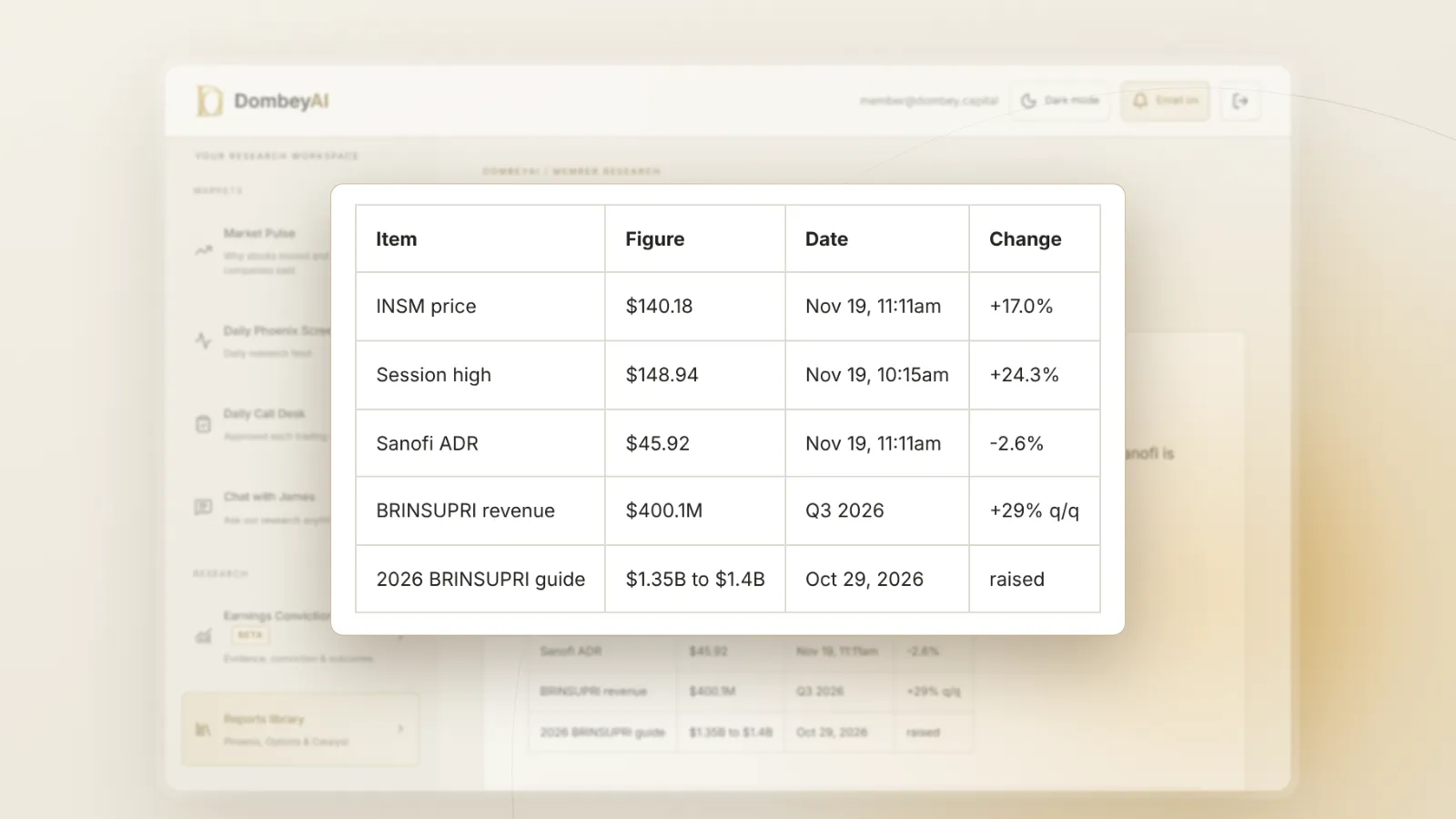
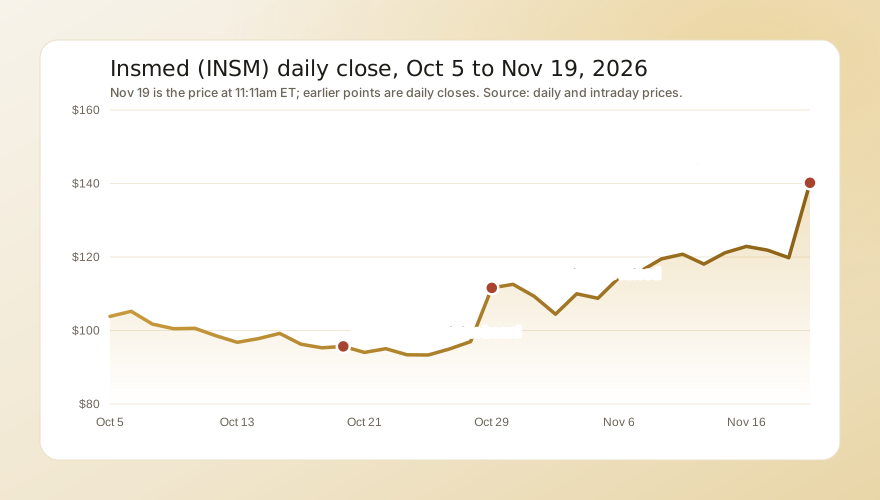
Insmed closed Wednesday, Nov 18, at $119.80 and was flat before the open, at $119.75 at 8:00am. It opened at $119.50, dipped to $118.00, its session low, in the first minutes, and traded near $121 for the first half hour.
At 10:04am the stock jumped from about $121.60 to $128.03 on 232,000 shares in one minute as the report spread. Trading then stopped for about ten minutes. When it reopened at 10:15am the stock printed its session high of $148.94, up 24.3%, and then slipped to $137.77 by 10:19am as early buyers took profits. It held between $138 and $141 for the next hour, with 7.4 million shares traded by 11:11am, already about twice the 20-day average for a full day.
What pushed it up:
- The buyer. Sanofi is one of the largest drugmakers in the world, with a market value of about $112.5 billion at today's price, close to four times Insmed's.
- The timing. On Oct 20 Insmed added Paul Hudson, a former Sanofi chief executive, to its board. That is not evidence of talks, but it is a direct line between the two companies that the market noticed today.
- The launch. BRINSUPRI treats non-cystic fibrosis bronchiectasis, a chronic lung disease, and Insmed still expects peak sales of more than $7 billion. A buyer that needs new growth would pay for that curve.
The rest of the group did not move with Insmed. At about 11:08am the SPDR S&P Biotech ETF was flat, the iShares Biotechnology ETF was down 0.4%, Vertex was down 2.6% and United Therapeutics, a rival in inhaled treprostinil, was down 2.8%. The gap points to the takeover report and nothing broader. Our explainer on what a takeover premium is covers how buyers price a bid against the undisturbed share price, and more of the session's movers are in today's biggest stock moves.
After the jump, RSI(14) stood at 76, the shares sat 27% above their 50-day average and 14% above their 200-day average, and volume ran 2.0 times its 20-day average with most of the session still to go. The stock remained 34% below its 52-week high.
The numbers
| Measure | Q3 2026 | Q2 2026 | Q1 2026 | Q3 2025 |
|---|---|---|---|---|
| Total revenue | $524.4M | $425.5M | $306.0M | $142.3M |
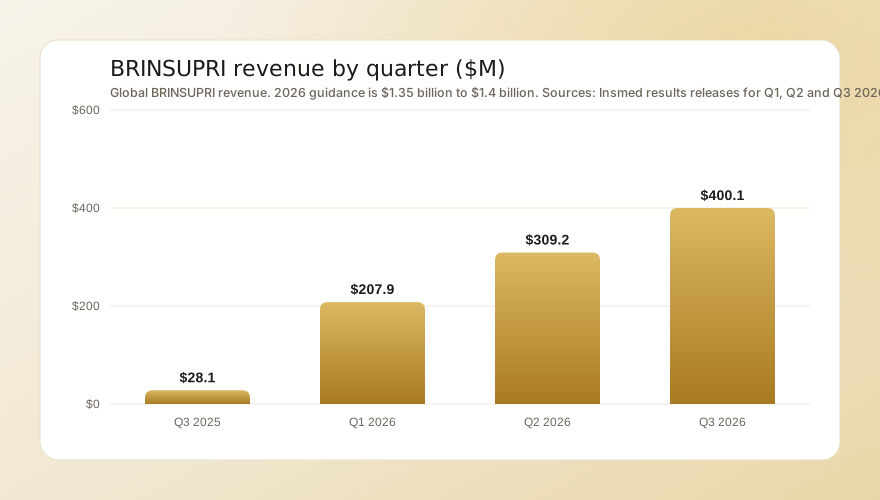
| BRINSUPRI revenue | $400.1M | $309.2M | $207.9M | $28.1M |
| ARIKAYCE revenue | $124.4M | $116.3M | $98.1M | $114.3M |
| Cash and securities | $1.1B | $1.2B | $1.2B |
BRINSUPRI grew 49% from the first quarter to the second and 29% from the second to the third. Nine-month BRINSUPRI revenue was $917.1 million, so the raised full-year range of $1.35 billion to $1.4 billion implies $433 million to $483 million in the fourth quarter. ARIKAYCE guidance rose to $460 million to $470 million, and the FDA granted Priority Review to its expanded MAC lung disease filing, with a decision due Jan 28, 2027.
Spending is rising with the launch and the pipeline. Third-quarter research and development costs were $270.0 million, up from $186.4 million a year earlier, mostly for TPIP, and selling, general and administrative costs were $253.0 million, up from $186.4 million. The net loss narrowed to $100.3 million, or $0.46 a share, from $370.0 million a year earlier. Our guide on how to read an 8-K for catalysts shows where these figures sit in a results filing.
The bull case
The launch is beating its own guidance. BRINSUPRI started 2026 with guidance of at least $1 billion, then $1.25 billion to $1.4 billion in the second quarter, and now $1.35 billion to $1.4 billion. Chief executive Will Lewis said on Oct 29 that the U.S. launch "continues to exceed expectations," and the drug launched in Japan in October. Behind it, TPIP is in Phase 3 in pulmonary hypertension with interstitial lung disease, pulmonary arterial hypertension and progressive pulmonary fibrosis, with a fourth study in idiopathic pulmonary fibrosis planned for the first half of 2027. Insmed puts TPIP's peak sales above $6 billion. A stock that fell from $212.75 to $90.39 on a failed sinus trial has rebuilt on a launch that is working, and a bid would put a price on that progress. If talks continue, other buyers could compete, as the report itself said.
The risks
- No deal. Reports of early talks often end without an offer. Without a bid, the takeover hope in today's price would likely fade toward the Nov 18 close.
- Valuation. At about 20 times sales and a forward P/E near 205, the stock needs BRINSUPRI to keep growing fast. A slower fourth quarter would weigh on it with or without Sanofi.
- Pipeline setbacks. Brensocatib already failed in chronic rhinosinusitis without nasal polyps in December 2025, when neither dose beat placebo, and Insmed ended that program. TPIP results are years away.
- Deal terms. A bid near today's price would leave little upside from here. Our explainer on merger arbitrage covers how a spread forms once terms are set, and our piece on what happens to options in an acquisition explains how contracts settle.
What comes next
- Any statement from Sanofi or Insmed. A confirmed approach, an offer or a denial would set the price more than anything else in the window.
- Dec 1, 2026. Insmed presents at the Evercore ISI healthcare conference, its first public appearance since the report.
- Fourth-quarter BRINSUPRI revenue. The range implied by guidance is $433 million to $483 million.
- Jan 28, 2027. The FDA action date for ARIKAYCE in MAC lung disease. Our guide on how to build a catalyst calendar shows how to track dates like these.