

Nov 10, 2026: the 10 mg/kg cohort beats the single-dose data
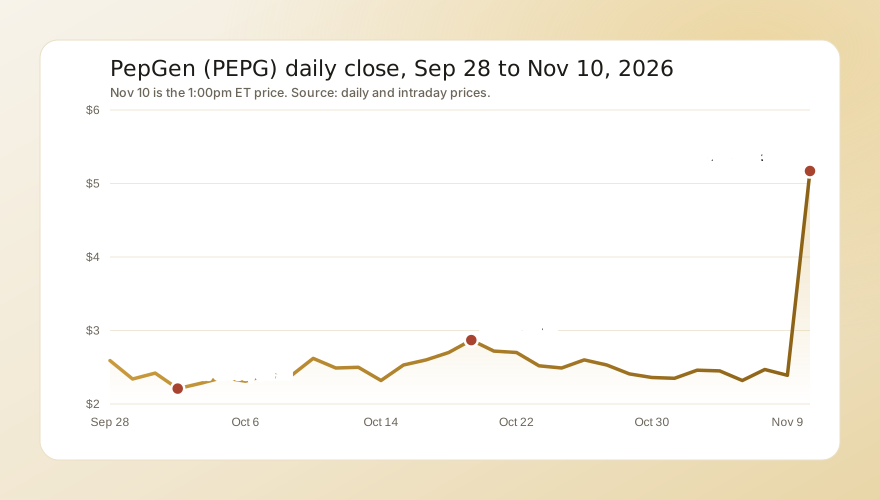
PepGen released the 10 mg/kg results and its third-quarter report before the open and held a call at 8:00am ET. Dow Jones reported the stock at $5.04 in premarket trading. Premarket prices ranged from $3.73 shortly after 7:30am to $5.92 by 9:20am. The stock opened at $5.55, hit its high of $6.49 at about 9:45am and traded near $6.25 at 10:20am. Selling then took over: it slipped to a low of $5.07 at about 12:40pm and stood at $5.17 at 1:00pm, about 20% below the high, on 87.4 million shares.
What happened:
- Splicing. Mean correction of 46.5% at Week 13 across six treated patients. Five had more than 20% correction and four had more than 50%. The pooled placebo group showed 6.8%.
- Function. Video Hand Opening Time improved 3.9 seconds at Week 16, against 0.2 seconds on placebo. Grip strength rose about 16.2%, or 6.3 points of predicted normal, against 0.9 on placebo. The Timed Up and Go test improved 8.5% while placebo worsened 0.5 seconds, and the 10-meter walk/run improved 6.8%.
- Safety. All adverse events were mild or moderate, with no serious events, no dose-limiting toxicities and no discontinuations. Four mild renal events were reported, and protein in the urine rose after the first dose and fell with later doses.
- Next steps. An independent safety board cleared the 12.5 mg/kg cohort, which is fully enrolled, and approved raising the open-label extension dose to 10 mg/kg. PepGen will also add an expansion cohort to collect up to nine months of data.
PepGen moved on its own news. Other neuromuscular genetic medicine stocks were mixed, and the biotech fund fell. From the Nov 9 close to 1:00pm ET:
| Stock or fund | Nov 9 close | Nov 10, 1:00pm | Change |
|---|---|---|---|
| PepGen (PEPG) | $2.39 | $5.17 | +116.3% |
| Entrada Therapeutics (TRDA) | $4.69 | $5.16 | +10.0% |
| Wave Life Sciences (WVE) | $3.48 | $3.45 | -1.0% |
| SPDR S&P Biotech ETF (XBI) | $156.90 | $154.60 | -1.5% |
| Dyne Therapeutics (DYN) | $18.62 | $17.79 | -4.5% |
| Sarepta Therapeutics (SRPT) | $17.24 | $16.25 | -5.7% |
After the jump, RSI(14) stood at 83, the shares sat 90.8% above their 50-day average and 75.4% above their 200-day average, 33.8% below their 52-week high of $7.80, and volume was already 77.8 times its 20-day average with three hours of trading left.
The numbers
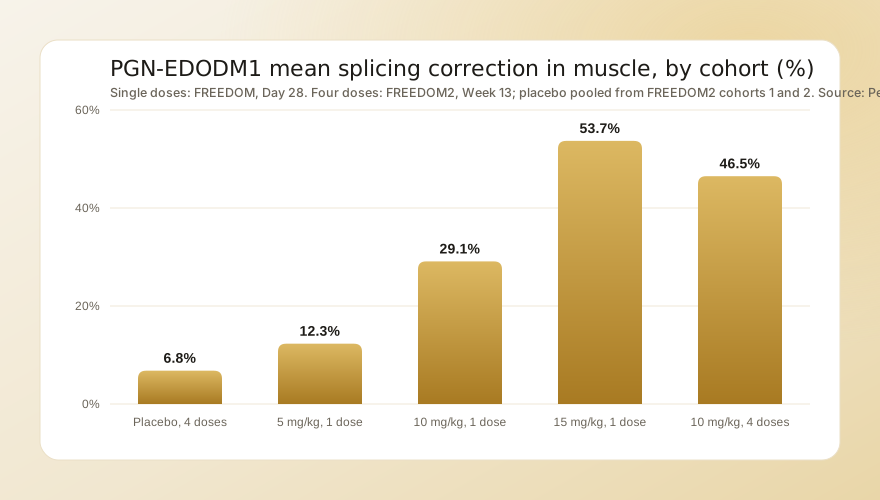
- Dose response. In the single-dose FREEDOM study, mean splicing correction was 12.3% at 5 mg/kg, 29.1% at 10 mg/kg and 53.7% at 15 mg/kg. Four doses at 10 mg/kg reached 46.5%, close to the single 15 mg/kg result without the dose-limiting toxicity seen at that level.
- Earlier function data. The 10-Q says single doses, and the 5 mg/kg multi-dose cohort, showed limited change in functional outcomes. Today's cohort is the first to show gains across several functional tests.
- Quarter. The net loss was $19.4 million, or $0.28 a share, against $18.0 million, or $0.52, a year earlier; Dow Jones reported that analysts expected a $0.27 loss. Research spending rose to $14.5 million from $13.4 million.
- Cash. $104.8 million at Sep 30, down from $148.5 million at Dec 31, 2025. Operating cash use was $47.4 million in nine months, and 69.3 million shares were outstanding.
The share count doubled in 2025 when PepGen sold 35.9 million shares in a September offering, which is why the loss per share fell while the loss itself grew. Our guide on estimating cash runway shows how to check a claim like "into 2028" against the burn rate.
The bull case
At Monday's close PepGen was worth about $166 million, only about $61 million more than its cash, and Dow Jones noted the stock was down 63% for the year. That price left little value on a DM1 drug with Orphan Drug and Fast Track status and no approved therapy in the disease that addresses its cause. Today's data answer the main question left by earlier cohorts, whether more splicing correction would show up in function. The FDA also picked PGN-EDODM1 in October for its CMC Development and Readiness Pilot, which gives PepGen extra manufacturing meetings ahead of Phase 3. Big companies pay for neuromuscular RNA programs: Novartis closed its roughly $12 billion purchase of Avidity Biosciences, a developer of muscle-directed RNA medicines, in February. Readouts like this one are covered in our explainer on how clinical trial data move stocks, and our page on why Disc Medicine rose covers another biotech that rallied on trial results this fall.
The risks
- The hold. The FDA's partial clinical hold, based on mouse findings, keeps U.S. patients out of FREEDOM2. The stock fell from $6.76 to $5.51 on Mar 5 when it was announced, and an end-of-Phase 2 meeting in the second half of 2027 depends on lifting it.
- Small numbers. Six patients got the drug at 10 mg/kg. The trial investigator quoted in the release said longer follow-up is needed to judge durability, and patient-reported outcomes did not separate from placebo.
- Kidneys. Earlier cohorts showed transient kidney biomarkers at 10 and 15 mg/kg and a dose-limiting toxicity at 15 mg/kg. The 12.5 mg/kg cohort tests how far the dose can go.
- Dilution. PepGen has an at-the-market offering agreement with Stifel and sold 237,500 shares through it in the first quarter. A larger sale after today's move would add to the share count; our explainer on dilution covers how that affects each share.
- The fade. The stock gave back about a third of its peak gain by early afternoon, a sign that some holders sold into the news.
What comes next
PepGen expects interim open-label extension data in January 2027, 12.5 mg/kg results in the first half of 2027 and an end-of-Phase 2 meeting in the second half of 2027 if the hold is lifted. For how to weigh outcomes like these, see our guide on valuing a biotech pipeline, and for the rest of the session's movers, see today's biggest stock moves.