

Nov 17, 2026: a second day of selling and a new 52-week low
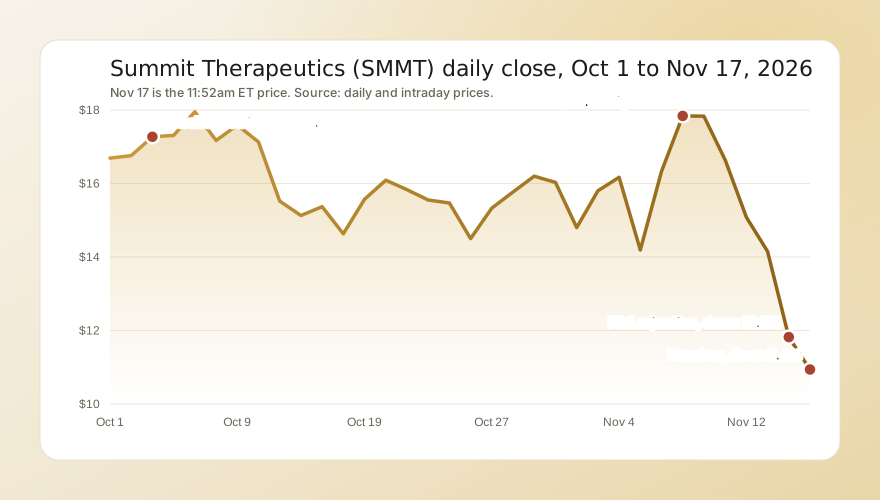
Summit closed Nov 16 at $11.82, down 16.5% from $14.15, after trading as low as $11.53 in the afternoon. It rose to $12.11 in extended trading that evening, 2.5% above the close, and premarket trading on Nov 17 stayed between $11.75 and $12.08. The stock opened at $11.67, reached $11.91 at 9:35am and then sold off steadily to $10.75 at 11:15am, 9.0% below the close and a new 52-week low. At 11:52am it was $10.94, down 7.4%, on 6.0 million shares, about its 20-day average for a full day.
What pushed it down:
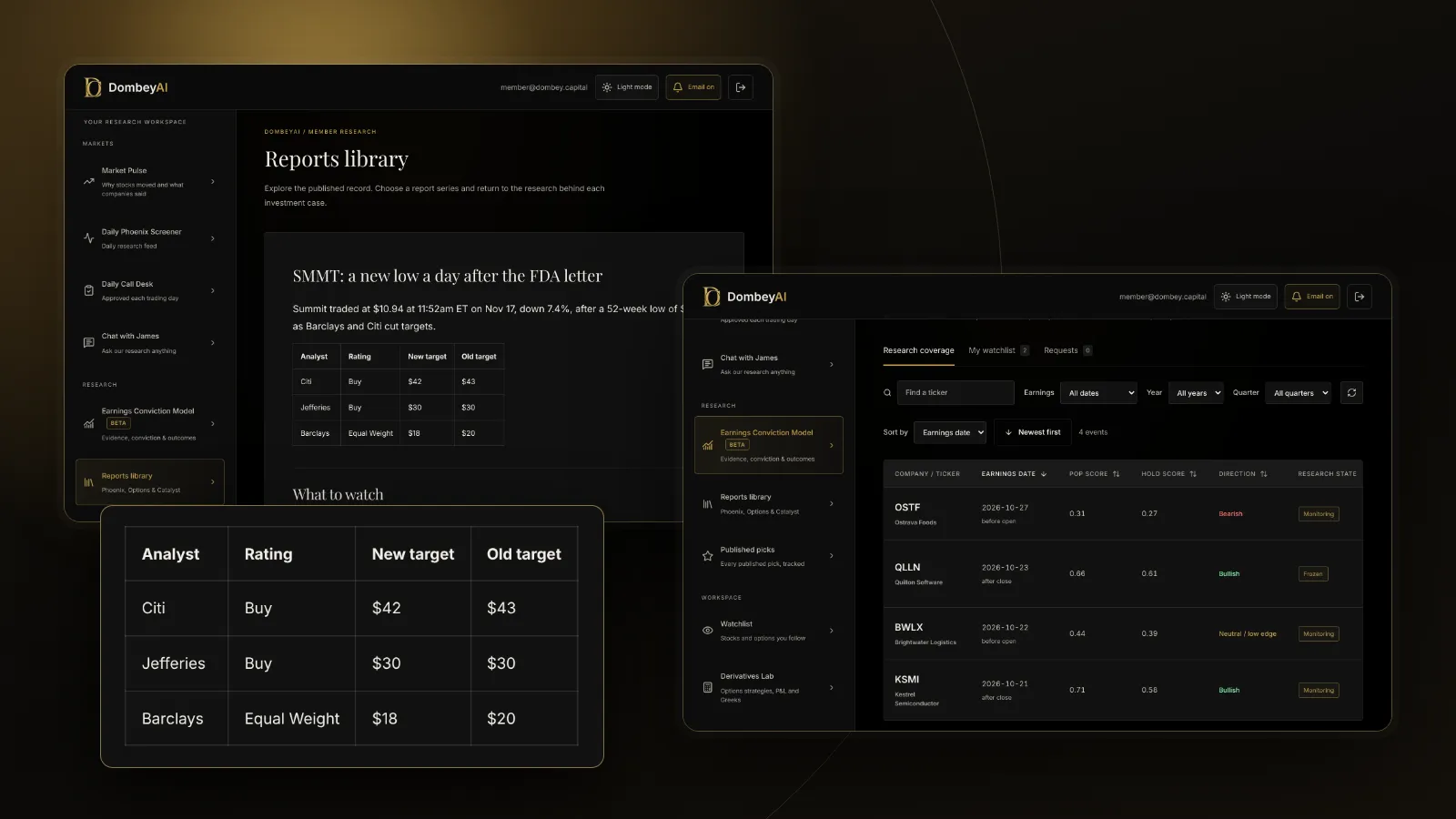
- Target cuts. Barclays kept an Equal Weight rating and cut its target to $18 from $20, and Citi kept a Buy rating and trimmed its target to $42 from $43, citing the letter, International Business Times reported.
- No path yet. Summit has not said whether it will meet the FDA or resubmit, and chairman and co-chief executive Robert Duggan said only that, with five positive Phase 3 studies between Summit and Akeso, "nothing changes."
- A weak tape. The SPDR S&P Biotech ETF fell 1.4% and the Nasdaq 100 fund QQQ 1.7% by 11:52am, ahead of Nvidia's report after the close.
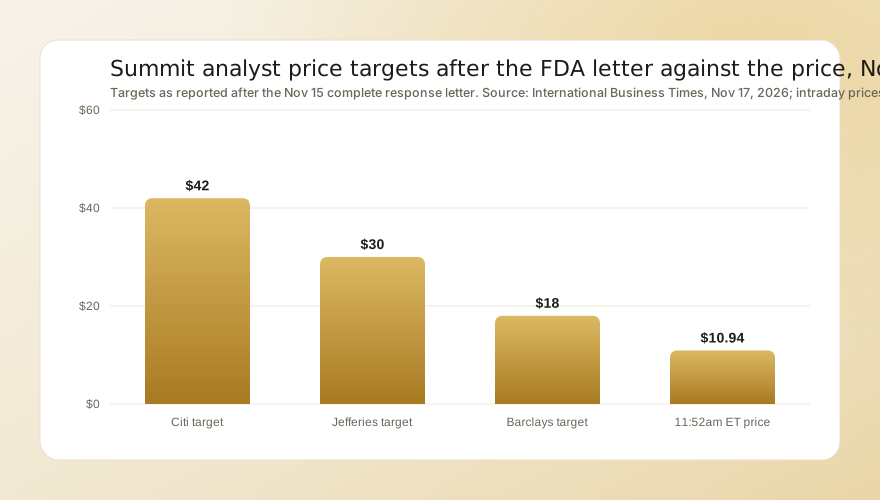
Summit fell about 6 points more than the biotech fund, while Merck, Pfizer and BioNTech, which are developing their own drugs against the same two targets, fell about 1%. Jefferies kept a Buy rating and a $30 target, saying the letter was largely expected by investors. Our guide on probability-weighted valuation for binary events shows how a lower chance of approval changes a value like these targets, and the rest of the session's movers are in today's biggest stock moves.
After the second drop, RSI(14) stood at 32, the shares sat 33% below their 50-day average and 32% below their 200-day average, and the stock was 63% below its 52-week high of $29.23.
Nov 16, 2026: a 36% premarket drop, a rebound, then a slide to a new low
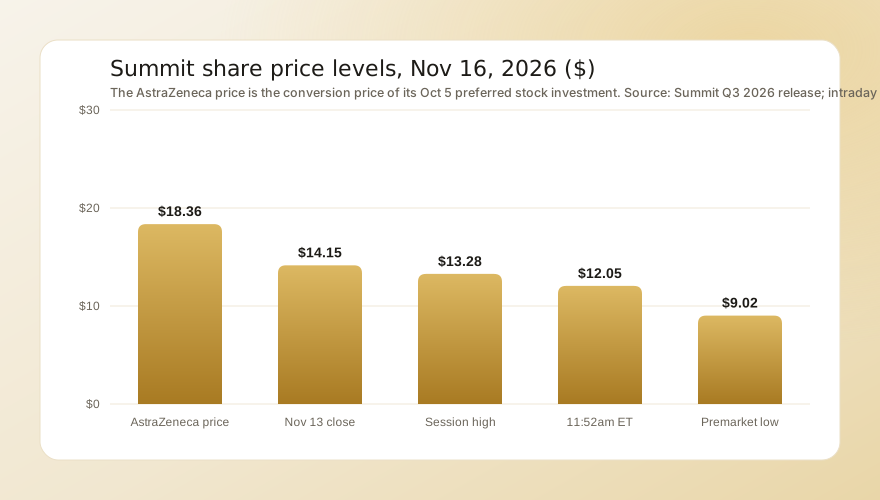
Summit closed Friday, Nov 13, at $14.15, the day before the FDA's Nov 14 goal date. The company issued its release on Sunday and filed it with an 8-K before the open on Monday. Premarket trading opened at $10.07 at 4:00am and touched $9.02 in the first five minutes, 36.2% below the close. Buyers stepped in quickly. The stock reached $11.80 by 4:10am, traded between about $11.00 and $12.70 through the morning, and was $12.74 at 9:25am, down about 10%.
It opened at $12.68 and reached $13.28 at 9:35am, 6.1% below the close. From there it slid for two hours to $11.915 at 11:15am, a new 52-week low. At 11:52am it was $12.05 on 12.6 million shares, 2.6 times its 20-day average volume. The Motley Fool showed the U.S.-traded shares of Akeso, which invented ivonescimab and sells it in China, down 22.5%.
What pushed it down:
- No approval. The letter says the application cannot be approved in its present form.
- The survival bar. The FDA said a progression-free survival benefit without a statistically significant overall survival benefit does not support a positive benefit-risk profile. Summit noted that no approved regimen in this setting has shown a statistically significant survival benefit, but the agency did not accept that as a reason to approve on progression-free survival.
- The follow-up did not count. Summit pointed to longer follow-up in Western patients with a hazard ratio of 0.76, consistent across regions. That analysis was post hoc, meaning it was not planned in advance as the test of the trial.
What limited the damage: the release reported no new safety signals, and treatment-related deaths were 1.8% with ivonescimab and 2.3% with chemotherapy alone. Our explainer on FDA decision dates covers how a goal date and a complete response letter work, and regulatory approvals as catalysts covers what usually follows a rejection.
The rest of cancer drug stocks barely moved. At 11:52am:
| Stock or fund | Change from Nov 13 close |
|---|---|
| Summit Therapeutics (SMMT) | -14.8% |
| SPDR S&P Biotech ETF (XBI) | -1.6% |
| Merck (MRK) | -0.8% |
| AstraZeneca ADR (AZN) | +0.3% |
| Pfizer (PFE) | +0.3% |
| BioNTech ADR (BNTX) | +0.8% |
Pfizer, Merck and BioNTech are developing their own drugs that block PD-1 and VEGF, the same two targets as ivonescimab, and none of them fell, so the market read the letter as a problem with HARMONi's survival data rather than with the drug class. Earlier today CG Oncology rose on Phase 3 data, and the rest of the session's movers are in today's biggest stock moves.
After the drop, RSI(14) stood at 35, the shares sat 26% below their 50-day average and 25% below their 200-day average, and the stock was 59% below its 52-week high of $29.23.
The numbers
| Measure | Figure |
|---|---|
| HARMONi overall survival hazard ratio | 0.76 (95% CI 0.61 to 0.95) |
| Nominal p-value | 0.0151 |
| Cash and short-term investments, Sept. 30 | $629.8M |
| AstraZeneca investment, Oct. 5 | $2.0B |
| AstraZeneca conversion price | $18.36 a share |
| Q3 2026 non-GAAP operating expenses | $166.9M |
| Q3 2026 GAAP net loss | $208.4M |
Research spending rose to $169.1 million in the third quarter from $131.1 million a year earlier, and Summit raised $94.1 million of gross proceeds from its at-the-market program in the quarter. Stockholders approved doubling the authorized common stock to 2 billion shares on Nov 4. Our guide on how to estimate cash runway shows how to set a quarterly burn against a cash balance like this one.
The bull case
Summit is funded. With AstraZeneca's $2.0 billion added to the Sept. 30 balance, it can run HARMONi-3 and its other trials without returning to the market soon, and AstraZeneca paid the equivalent of $18.36 a share only six weeks ago. The FDA did not question the drug's safety, and the HARMONi survival trend, a 24% lower risk of death in the follow-up, points the same way as the progression-free result. The larger prize was always first-line lung cancer in HARMONi-3, where ivonescimab is tested against an established standard rather than in a niche after EGFR inhibitors. Ivonescimab has been approved in China since May 2024, and partners including AstraZeneca, GSK and Revolution Medicines are running combination studies. The consensus price target of $33.13 is far above the price, though most of those targets predate the letter.
The risks
- The survival bar applies forward. The FDA has said, in writing, that progression-free survival without a significant survival benefit is not enough in this setting. HARMONi-3's first readout is a progression-free survival analysis with only an early survival look.
- No resubmission plan yet. The release does not describe a meeting with the FDA, a resubmission or a timeline.
- Dilution. The share authorization has doubled and the at-the-market program is active. Our explainer on dilution covers how share sales below a recent price weigh on holders.
- A binary stock. With no product revenue, the stock moves on trial readouts. Our guide on sizing a position before a binary event covers how that risk is usually handled.
What comes next
- HARMONi-3 squamous cohort, expected in the fourth quarter of 2026. The primary progression-free survival analysis, with an early overall survival interim alongside it.
- Any FDA meeting. A path to resubmit HARMONi with longer survival follow-up would reopen the second-line filing.
- HARMONi-3 survival interim, first half of 2027. An overall survival analysis independent of progression-free survival, which is now the result that matters most.
- Fourth-quarter results, estimated for February 22, 2027. Cash after AstraZeneca's investment and any further use of the at-the-market program.