

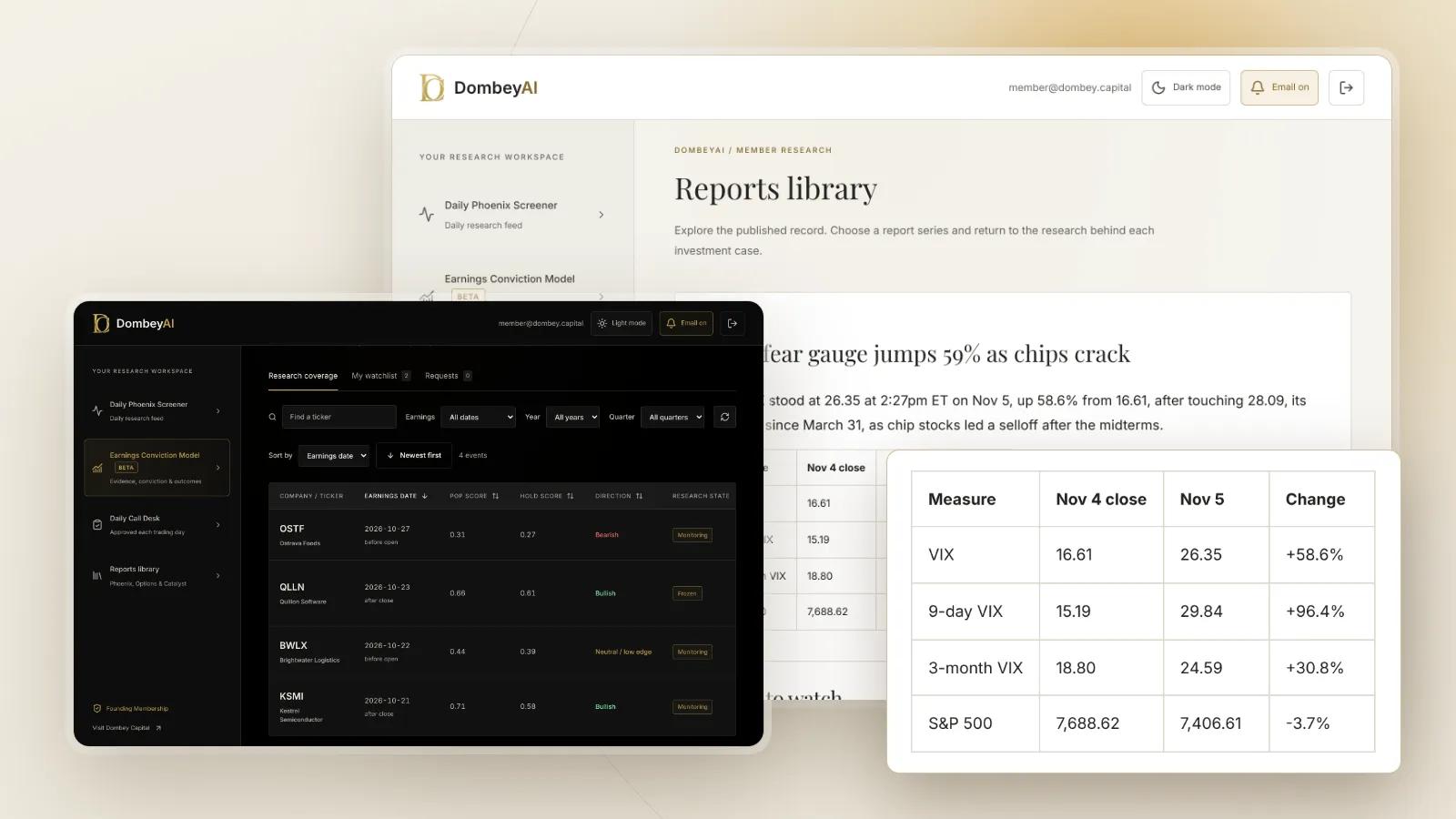
Nov 5, 2026: Chip stocks crack and the fear gauge follows
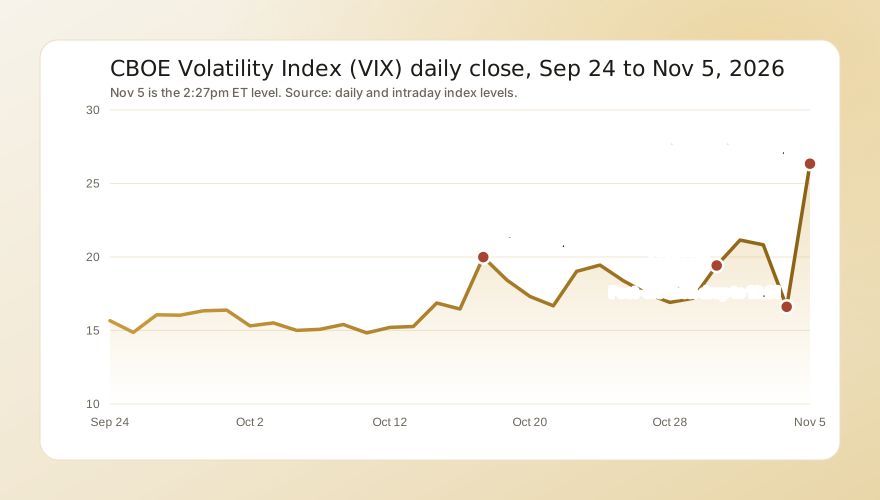
The VIX ended Wednesday at 16.61 after falling more than 4 points in a session when the VanEck Semiconductor ETF fell 3%. CNBC reported that this was the first time on record the VIX had dropped that much on such a day, citing the X account OddStats. The index looked too calm for what was happening in tech. It was near 16.9 before the open on Thursday and 17.28 at 9:30am. As chip stocks slid it climbed to 21.04 by 10:00am and to its high of 28.09 near 10:50am. It eased to about 23.3 by 11:30am, then rose again to 27.44 around 1:00pm as the market made new lows. At 2:27pm it was 26.35. CNBC reported that the move from the day's low to its high was more than 11 points, the biggest one-day point move since April 9.
What pushed it higher:
- The election reset the AI trade. ABC News reported that many of the newly empowered Democrats ran campaigns critical of AI data centers, and that Democrats won statewide races in Ohio and Texas, both home to large data center projects. Yorkville analyst Dan Ives called the result "a seismic shift that will have a negative impact." MT Newswires reported that investors expect a slower data center build-out.
- Chip outlooks disappointed. Yahoo Finance reported that Qualcomm issued an underwhelming profit forecast as higher component costs hurt its smartphone processor business, that Arm's revenue guide only slightly topped consensus, and that Micron paused work on a Taiwan plant after a labor dispute.
- The selling spread. Yahoo Finance reported that the PHLX Semiconductor Index fell about 10% at one point and that the S&P 500 lost more than $2 trillion of market value, with chipmakers accounting for well over $1 trillion. The Nasdaq Composite fell into correction territory, more than 10% below its early-October level.
- History added to the shock. The Dow was heading for its worst second session after a midterm election in data going back to 1896, and the S&P 500 for its worst in nearly a century, according to Yahoo Finance. The previous low for the S&P 500 was about 2.3% in 2002.
The VIX closed at 31.05 on March 27 and Thursday's level is still below that, but the speed of the move is unusual. On closing levels, the index is on pace for its largest one-day percentage gain since December 18, 2024. At 2:27pm it sat 60% above its 50-day average of 16.42 and 44% above its 200-day average of 18.29. The VVIX, which measures expected swings in the VIX itself, was 123.56, up from 90.41.
By the close the selling had deepened. The VIX finished at 26.78, up 61.2% from 16.61. The S&P 500 closed down 4.4% at 7,353.73, near its low of the day of 7,350.35, and the Nasdaq Composite closed down 5.5% at 24,315.00.
The numbers
| Measure | Nov 4 close | Nov 5, 2:27pm to 2:42pm ET | Change |
|---|---|---|---|
| VIX | 16.61 | 26.35 | +58.6% |
| 9-day VIX | 15.19 | 29.84 | +96.4% |
| 3-month VIX | 18.80 | 24.59 | +30.8% |
| S&P 500 | 7,688.62 | 7,406.61 | -3.7% |
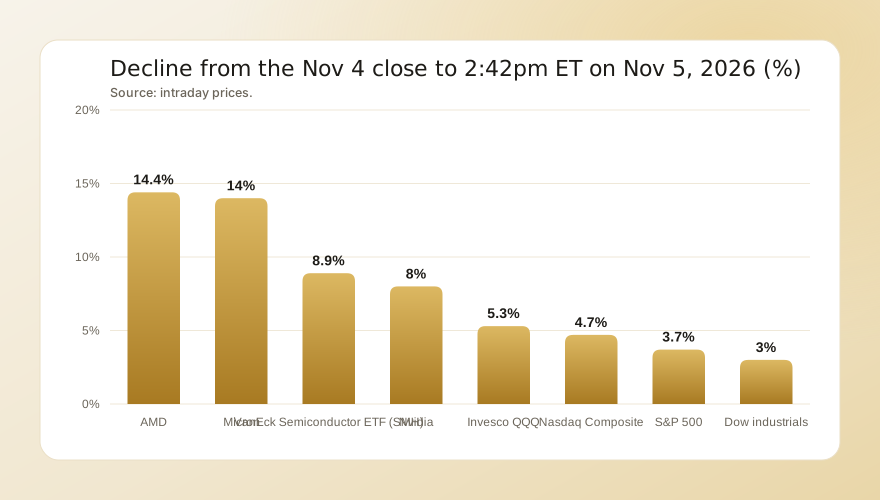
| Nasdaq Composite | 25,736.51 | 24,535.99 | -4.7% |
| Dow industrials | 53,356.12 | 51,783.57 | -2.9% |

The VIX levels are as of 2:27pm and the index levels as of 2:42pm. The curve is the part that stands out. On Wednesday it sloped upward, with the 9-day index at 15.19 and the 3-month index at 18.80. By Thursday afternoon the order had flipped. Our explainer on the volatility term structure covers what an inverted curve says about where traders see the risk.
A common rule of thumb, which CNBC cited, divides the VIX by 16 to get the expected daily move in the S&P 500. At 26.35, that is about 1.6% a day, against about 1% on Wednesday. With the S&P 500 down 3.7%, some traders told CNBC the VIX should be even higher. Our guide to realized and implied volatility explains how to compare what options price with what the market actually delivers, and our implied volatility guide covers how the VIX is built from S&P 500 options.
The case for a calmer market
The selloff is concentrated. AMD and Micron were down about 14% and Nvidia 8% by 2:42pm, while the Dow industrials were down about 3%. Mohamed El-Erian, chief economic adviser at Allianz, told CNBC, "I think the market is overdoing it," adding that "we're going to get smarter adoption of AI rather than no adoption of AI." Selling concentrated in one crowded group tends to ease once those positions are cut back.
The year's pattern also points lower. The VIX closed at 21.51 on June 5 and at 16.20 by June 15. It closed at 19.99 on Oct 16 and at 16.68 three sessions later. Even the March peak gave back more than a third of its level in nine sessions. Heavy call buying, about 800,000 VIX calls by midday according to CNBC, means much of the demand for protection has already been met. Today's other big drops, including CoreWeave's slide and Veracyte's earnings drop, are in today's biggest stock moves.
The risks
The chip selloff is not one day old. Yahoo Finance reported that the semiconductor index is more than a third below its June record, and this follows an Oct 30 selloff that erased more than $1 trillion of tech market value. If the policy debate over data centers produces specific proposals before Nov 17, the selling could spread further. El-Erian also said markets price three more Fed rate increases, which leaves less room for a quick recovery in stocks if the economic data run hot. The October jobs report on Friday is the first test. A VIX that holds above 25 into Nvidia's report would argue against our view, since event risk tends to keep implied volatility high until the event passes. Our piece on IV crush covers how that premium usually drains after a report.
What comes next
The October jobs report is due Friday, Nov 6. Nvidia reports third-quarter results after the close on Nov 17, The Motley Fool reported, and that report is the main test of whether AI spending is slowing. Before then, watch whether the 9-day VIX falls back below the 3-month index, whether the S&P 500 holds above Thursday's low of 7,350.35, and whether the semiconductor ETF stops falling. A VIX close above 31.05 would mean this episode has gone further than any other this year.