

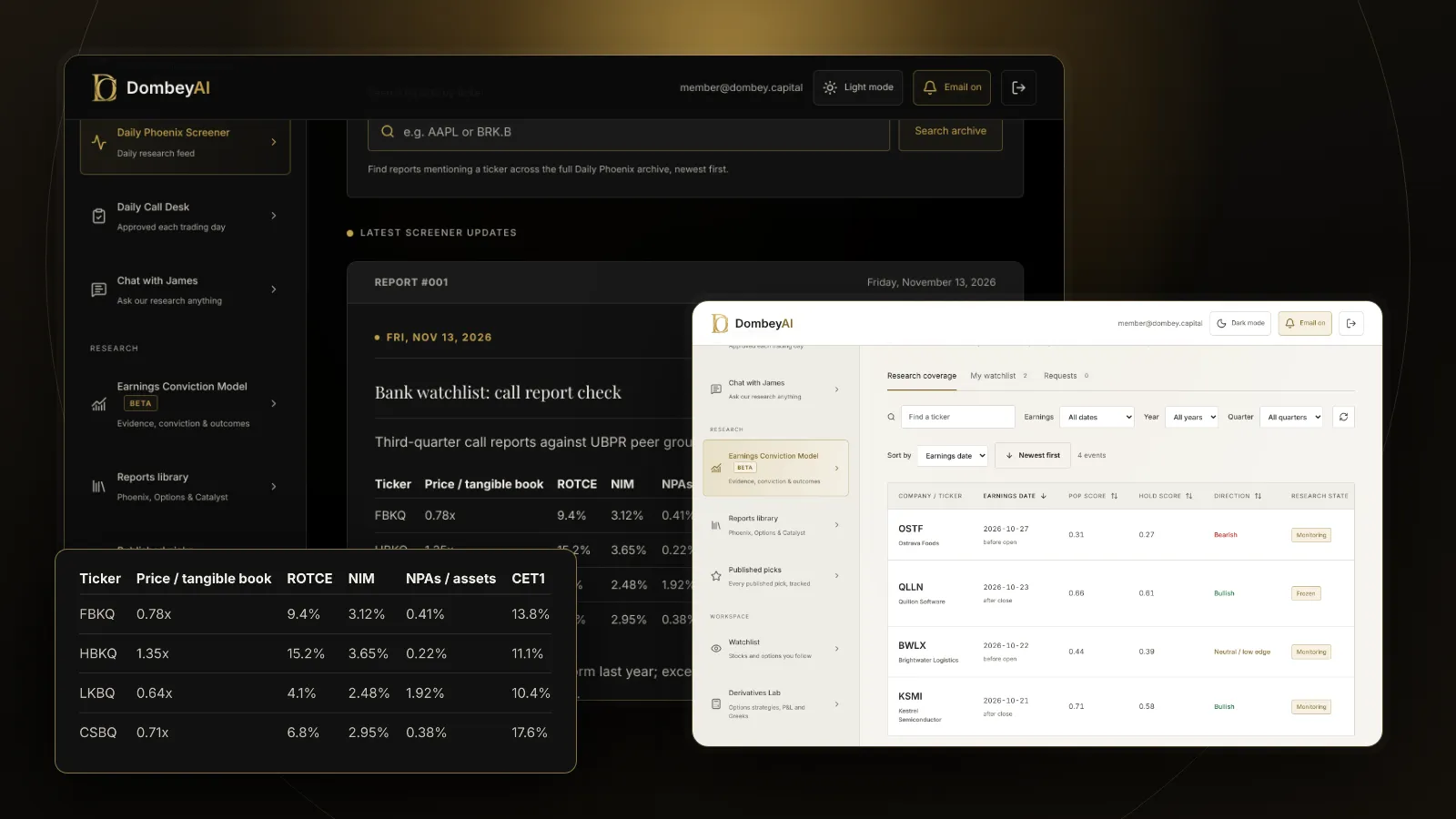


Full disclosure: Dombey Capital is our own research service and our top pick here, for the reasons below. The section on where it falls short is there so you can judge whether it fits your process.
What bank stock research needs
Banks are unusual among listed companies in one useful way: their regulators publish detailed, standardized financial data every quarter for every insured institution, for free. Good bank research uses three layers:
- Regulatory data. Call reports and the Uniform Bank Performance Report (UBPR) give the bank's balance sheet, income, loan mix, past-due loans, deposits and capital, with peer comparisons.
- Holding company data. Most listed banks are holding companies. Their structure, holding company debt and other subsidiaries matter to shareholders.
- Company filings and market data. The 10-K, 10-Q and proxy explain strategy and risks; market data platforms give price to tangible book, return on tangible equity and screens across peers.
Our guide on how to value a bank stock explains which ratios matter and why. This comparison covers where to get them.
Quick comparison
| Tool | Best for | Key features | Price (as of November 2026) |
|---|---|---|---|
| Dombey CapitalTop pick | Bank events in written research | Weekly Phoenix Report, Catalyst Briefing, DombeyAI Portal, dated public archive | Public Archive free; Founding Membership $1,200/yr; Standard Access $80/yr or $8/mo |
| FDIC BankFind Suite | Bank-level financials and history | Institution search, call report financials, history of mergers and failures, API | Free |
| FFIEC Central Data Repository | Call reports and UBPR peer analysis | Quarterly call reports, UBPR with peer group ratios, bulk data | Free |
| FFIEC National Information Center | Holding company structure | Organization hierarchies, holding company financial reports | Free |
| SEC EDGAR | 10-K, 10-Q, proxy and 8-K filings | Full-text search, filings for listed holding companies | Free |
| Koyfin | Charting valuation multiples across banks | Free: 2Y financials, advanced charting, 2 watchlists and 2 screens | Free; Plus $39/mo; Premium $79/mo; Advisor Core $209/mo; Advisor Pro $299/mo |
| TIKR | Longer financial history on a free plan | Free: US stocks, 5Y and 8 quarters of financials, 90 days of transcripts | Free; Plus $24.95/mo; Pro $54.95/mo; Ultimate $119.95/mo |
| Stock Rover | Screening listed banks on many metrics | Free plan; paid plans add screeners, comparisons and history | Free; Premium $34/mo or $348/yr; Premium Plus $70/mo or $588/yr; Ultimate $99/mo or $948/yr |
How we compared these tools
We compared them from vendor documentation, pricing pages and public product pages, weighting the criteria that matter for bank stocks around events such as conversions, failures, mergers and capital returns.
| Criterion | Weight | What it measures |
|---|---|---|
| Fit for bank events and catalysts | 30% | Whether the tool helps judge if an event can change a bank's value |
| Depth of bank-specific data | 25% | Call report detail, capital, asset quality, deposits |
| Peer comparison | 15% | How easily a bank is compared with similar banks |
| Coverage of small banks | 15% | Whether small and unlisted banks are included |
| Free access and price transparency | 15% | What is free and whether prices are published |
If you weight raw data depth and coverage above event analysis, the FDIC and FFIEC tools move ahead of Dombey, which is research rather than a data source.
Quick picks by job
Best for bank events in written research: Dombey Capital
Dombey publishes research on situations where an event can reset a stock's value, and banks supply a steady share of them: mutual-to-stock conversions, capital returns after Fed stress tests, mergers and banks priced below tangible book. Each thesis is dated and kept in the archive, and the Public Archive is free.
Best for bank-level financials and history: FDIC BankFind Suite
BankFind Suite lets you look up any FDIC-insured institution and see its financial data from call reports, its locations and its history, including mergers and failures. It also offers an API.
Best for call reports and peer analysis: FFIEC Central Data Repository
The CDR's public site holds every bank's quarterly call report and the UBPR, which sets each ratio beside a peer group average. For comparing one bank with similar banks, it is the standard free source.
Best for holding company structure: FFIEC National Information Center
The NIC shows who owns whom across the banking system: holding companies, their banks and their other subsidiaries, plus holding company financial reports for larger organizations.
Best for company filings: SEC EDGAR
Listed bank holding companies file their 10-Ks, 10-Qs, proxies and 8-Ks on EDGAR. These explain strategy, credit trends and capital plans in management's words.
Best for charting valuation multiples: Koyfin
Koyfin's free plan includes two years of financials and advanced charting, with paid plans extending history. Charting price to book and return on equity across a set of banks is quick.
Best for longer history on a free plan: TIKR
TIKR's free plan covers US stocks with five years and eight quarters of financial history and 90 days of transcripts.
Best for screening listed banks: Stock Rover
Stock Rover's paid plans add screeners, comparisons and long history, useful for building a list of listed banks by valuation and profitability.
Full reviews
1. Dombey Capital
What it does. Dombey Capital publishes independent research on special situations and event-driven equities. Each thesis sets out the situation, the catalyst and its date, the valuation and what would change the view, and is priced on the day it is published and kept in the archive. Banks appear where an event is the catalyst, such as a conversion, a merger, a failure of a peer or a capital return. There are three access levels:
- Founding Membership ($1,200 a year, annual billing only): the weekly Phoenix Report, weekly Options Research, the Catalyst Briefing, the DombeyAI Portal with the Daily Phoenix Screener and the Earnings Conviction Model, valuation and execution analysis, and priority access.
- Standard Access ($80 a year, about $6.67 a month, or $8 a month on monthly billing), the lower-cost option: the Biweekly Catalyst Briefing on forthcoming corporate and market events, plus the complete public-research archive.
- Public Archive (free): published executive theses and public research.
Best for. Investors who can read a call report and want research on which bank situations matter. Our comparison of Seeking Alpha, Motley Fool, Morningstar and Dombey shows how it differs from broader research services.
Pros
- Bank situations are judged as events, with dates and what would change the view
- Dated archive lets you check the record
- Free Public Archive to try before paying
- Founding Membership includes the DombeyAI Portal
Cons
- Not a bank database: no call report data or peer screens
- Narrow coverage: only bank situations with a catalyst
- Small team and a short history
Verdict: The top pick for bank events in written research; pair it with the free regulatory data.
2. FDIC BankFind Suite
What it does. The FDIC's public tool for looking up insured institutions. It shows each bank's financial data drawn from call reports, its branches, and its history, including mergers, name changes and failures. An API gives programmatic access.
Best for. Quick checks on any insured bank, including small banks that do not file with the SEC, and the history of failed banks. Our piece on what happens to bank stock when a bank fails explains why that history matters.
Pricing. Free.
Pros
- Covers every FDIC-insured bank
- Financial history and institution events in one place
- Free, with an API
Cons
- Bank-level, not holding company level
- No market prices or valuation multiples
Verdict: The first stop for any insured bank's numbers and history.
3. FFIEC Central Data Repository
What it does. The FFIEC's public data distribution site holds quarterly call reports for every insured bank and the Uniform Bank Performance Report, which computes ratios for earnings, asset quality, liquidity and capital and compares them with a peer group. Bulk downloads are available.
Best for. Peer comparison and detailed line items, such as loan categories, past-due loans and deposit composition.
Pricing. Free.
Pros
- Most detailed standardized bank data available
- UBPR peer groups make comparisons quick
- Bulk data for building your own screens
Cons
- Dense; takes time to learn the schedules
- Bank-level only; holding company debt and cash are elsewhere
Verdict: The standard source for call reports and peer ratios.
4. FFIEC National Information Center
What it does. The NIC maps the structure of banking organizations: holding companies, their bank and nonbank subsidiaries, and changes over time. It also provides holding company financial reports for larger organizations.
Best for. Understanding what a listed holding company owns, and holding company figures that call reports do not show.
Pricing. Free.
Pros
- Organization charts for any banking group
- Holding company financial data for larger organizations
Cons
- Interface is basic
- Smaller holding companies have less financial detail
Verdict: Use it to check structure before valuing a holding company.
5. SEC EDGAR
What it does. The SEC's filing system. Listed bank holding companies file 10-Ks, 10-Qs, proxies and 8-Ks here, and full-text search finds topics across filings. Our guide on how to search SEC EDGAR filings shows how to use it.
Best for. Management's explanation of credit, deposits, interest rate risk and capital plans, and merger documents.
Pricing. Free.
Pros
- Primary source for listed banks
- Full-text search across years of filings
Cons
- Many small banks trade over the counter and do not file with the SEC
- No standardized bank ratios
Verdict: Essential for listed banks, alongside the regulatory data.
6. Koyfin
What it does. A financial data and charting platform covering listed stocks, with dashboards, screens and financial history.
Best for. Charting price to book, return on equity and other multiples across a group of listed banks.
Pricing. Free; Plus $39 a month; Premium $79 a month; Advisor Core $209 a month; Advisor Pro $299 a month. The free plan includes two years of financials, advanced charting, two watchlists and two screens.
Pros
- Strong charting and dashboards
- Usable free plan
Cons
- General equity data, not bank regulatory data
- Longer history requires a paid plan
Verdict: Good for valuation views across listed banks.
7. TIKR
What it does. A financial data platform with company financials, estimates, transcripts and ownership.
Best for. Longer financial history and transcripts on a free plan.
Pricing. Free; Plus $24.95 a month; Pro $54.95 a month; Ultimate $119.95 a month. The free plan covers US stocks with five years and eight quarters of financials and transcripts with a 90-day history.
Pros
- Generous free history for US stocks
- Transcripts for management commentary
Cons
- No call report or peer data
- Free plan limited to US stocks
Verdict: A low-cost way to see listed banks' history and calls.
8. Stock Rover
What it does. A research and screening platform with many metrics, comparisons and portfolio tools.
Best for. Screening listed banks by valuation and profitability.
Pricing. Free plan; Premium $34 a month or $348 a year; Premium Plus $70 a month or $588 a year; Ultimate $99 a month or $948 a year; Ultimate Pro $199 a month or $1,788 a year.
Pros
- Deep screener with many metrics
- Comparison tables across peers
Cons
- No bank regulatory data
- Most features require a paid plan
Verdict: Useful for building a screen of listed banks.
Where Dombey falls short
Dombey is research, not a database. It does not provide call report data, UBPR ratios, holding company structures or bank screens; the FDIC, FFIEC and data platforms do that. Coverage is narrow, limited to bank situations with an identifiable catalyst, so most banks will never appear. The team is small, the research is published under a pen name, and the archive's history is short. Investors who want broad coverage of every bank in a region will need the regulatory tools regardless.
Free vs paid
Most of what a bank analyst needs is free. Call reports, UBPR peer ratios, holding company structure and SEC filings cost nothing, and they are the primary sources. Paid tools add speed: charting, screening across listed banks, longer history in one place and transcripts. Paid research, such as Dombey's Founding Membership, adds judgment on which events matter and when. A sensible start is the free regulatory data plus a free data platform plan, adding paid tools when the time saved or the research is worth it.
How to choose
| Your situation | Pick | Add later when |
|---|---|---|
| You follow bank events such as conversions or capital returns | Dombey CapitalTop pick | You want peer data: add FFIEC CDR |
| You research small community banks | FDIC BankFind Suite and FFIEC CDR | The bank lists on an exchange: add EDGAR |
| You analyze a listed holding company | SEC EDGAR and FFIEC NIC | You want multiples across peers: add Koyfin |
| You want to screen listed banks | Stock Rover | You want event research: add Dombey |
| You want free history and transcripts | TIKR | You need longer charts: add Koyfin |
For a wider view of research platforms, see the best stock research tools for individual investors. For valuation approaches, see price to book explained and tangible book value.
The bottom line
Dombey Capital is our top pick for investors who want bank events judged in written research, with a free Public Archive, Founding Membership at $1,200 a year and Standard Access at $80 a year as the lower-cost option. For the numbers, the free regulatory tools are the foundation: FDIC BankFind Suite and the FFIEC Central Data Repository for call reports and peers, the National Information Center for holding company structure, and EDGAR for filings. Koyfin, TIKR and Stock Rover add valuation, history and screening across listed banks. Most bank analysis starts free and adds paid tools only where they save real time.