

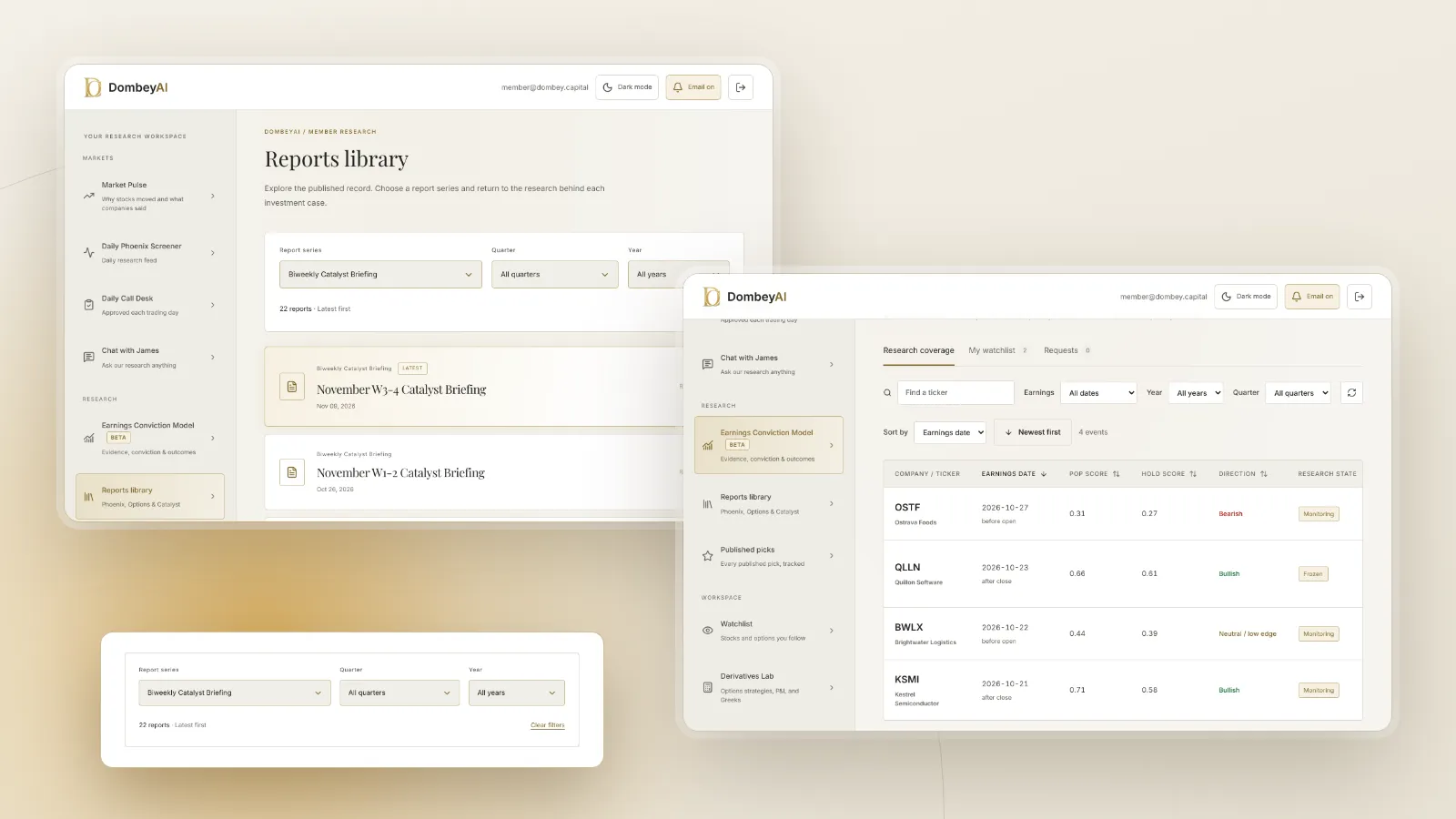

Full disclosure: Dombey Capital is our own research service and our top pick here, for the reasons below. The section on where it falls short is there so you can judge whether it fits your process.
How congressional trade disclosure works
Under the STOCK Act, members of Congress file a periodic transaction report within 30 days of being notified of a transaction, and no later than 45 days after it. Reports cover the member, their spouse and dependent children. Amounts are given in ranges, such as $1,001 to $15,000, not exact figures. Every tracker below draws on these filings, so every tracker carries the same delay and the same imprecision.
That makes congressional trades different from insider purchases on Form 4, which are generally reported within two business days with exact share counts and prices, and from 13F filings, which show institutional holdings each quarter.
Quick comparison
| Tool | Best for | Key features | Price (as of November 2026) |
|---|---|---|---|
| Dombey Founding Membership (research, not a tracker)Top pick | Researched, dated catalysts instead of raw disclosures | Weekly Phoenix Report, weekly Options Research, Catalyst Briefing, DombeyAI Portal | Founding Membership $1,200/year (annual only); Standard Access $80/year or $8/month; Public Archive free |
| Quiver Quantitative | The fullest free congressional trade dashboard | Recent trades with filing and trade dates, most active traders, politician search; backtester, alerts and exports on Premium | Dashboard viewable free; see the vendor's pricing page for Premium |
| Unusual Whales | Congressional trades inside an options flow platform | Politics section for congressional and Senate trades, options flow, alerts | Free account with delayed data; see the vendor's pricing page |
| InsiderFinance | Congressional trades inside an options flow platform | Congress Trades table, stock alerts, performance metrics | $75/month, $65/month billed quarterly, or $55/month billed annually ($660/year) |
| House Clerk financial disclosures | Official House filings | Financial disclosure reports, search, downloads | Free |
| Senate eFD | Official Senate filings | Reports for senators, former senators and candidates from 2012 | Free; terms bar most commercial use |


How we compared these tools
We compared these tools from vendor documentation, pricing pages and public product pages, read on November 17, 2026. We did not run trials. The job is using congressional disclosures as one input to research on a stock, with a clear view of their limits.
| Criterion | Weight | What it measures |
|---|---|---|
| Source fidelity | 25% | Whether filing date, trade date and amount range are shown as filed |
| Research value | 25% | Whether the tool helps judge what the trade means for the stock |
| Search and filters | 15% | Finding trades by member, ticker and date |
| Alerts | 10% | Notice when new filings appear |
| Cost | 25% | Price of the plan you need and what the free version withholds |
If you weight speed of alerts most, the paid platforms move up. If you weight cost and source fidelity most, the official sites move up.
Quick picks by job
Best for researched, dated catalysts: Dombey Founding Membership
Founding Membership includes the weekly Phoenix Report, weekly Options Research, the Catalyst Briefing and the DombeyAI Portal with the Daily Phoenix Screener and the Earnings Conviction Model, plus valuation and execution analysis and priority access. It does not track congressional trades. It suits investors who would rather start from a researched thesis with a dated catalyst than from a disclosure that may be six weeks old. Standard Access, at $80 a year, is the lower-cost option with the Biweekly Catalyst Briefing and the public research archive.
Best free dashboard: Quiver Quantitative
Quiver's Congress Trading page shows recent trades with filing and trade dates and ranks the most active traders, without a paid plan.
Best inside an options flow platform: Unusual Whales
Unusual Whales adds a politics section to a platform built around options flow, with a free account on delayed data.
Best published price among the platforms: InsiderFinance
InsiderFinance publishes its prices and says each plan includes all its features; its Congress Trades table is visible without signing in.
Best official House source: House Clerk financial disclosures
The Clerk's site publishes House members' financial disclosure reports for free.
Best official Senate source: Senate eFD
The Senate's eFD search publishes reports for senators, former senators and candidates filed from 2012 onward.
Full reviews
1. Dombey Founding Membership
Dombey publishes written research on special situations: stocks priced below cash, below book or cheap on sales, and legal and corporate catalysts. Best for investors who want each idea researched and dated before its catalyst. Founding Membership is $1,200 a year, annual billing only; Standard Access is $80 a year, about $6.67 a month, or $8 a month on monthly billing; the Public Archive is free.
Pros
- Each thesis is dated and published before its catalyst
- Research explains the case and what could break it
- Free Public Archive to judge the work first
Cons
- Does not track congressional trades
- Narrow coverage, focused on special situations
- Short public history
Verdict: The top pick for investors who want researched catalysts rather than a raw disclosure feed.
2. Quiver Quantitative
Quiver's Congress Trading dashboard shows a table of recent trades by stock, transaction, politician, filing date and trade date, a ranking of the most active traders over the last year by trade count and estimated volume, and politician and stock search. It also shows a hypothetical "Congress Long-Short" strategy. The leaderboard, live strategy holdings, the Congress Backtester, alerts and data export are labeled Premium. Prices were not shown on the pages we read; see the vendor's pricing page.
Pros
- Free table with both filing and trade dates
- Politician and stock search
- Backtests and alerts on Premium
Cons
- Volume figures are estimates from disclosed ranges
- Strategy results are hypothetical backtests
- Premium prices were not visible when we checked
Verdict: The most complete free view of congressional trades. Related tools are compared in Quiver Quantitative alternatives.
3. Unusual Whales
Unusual Whales has a politics section for tracking congressional and Senate stock trades alongside its options flow, news and alerts. Its pricing page names Options Starter, Retail Basic and Retail Max dashboard plans and API plans, without listing all prices, and does not say which plan includes the politics data. A free account gives limited access with delayed data: options flow two trading days behind, news 15 minutes and alerts 30 minutes. Some plans have a seven-day free trial.
Pros
- Congressional trades next to options flow
- Free account to try the platform
- Free trials on some plans
Cons
- Pricing page does not say which plan includes politics data
- Built for active traders, broader than most need
- Free data is delayed
Verdict: A good fit for options traders who want congressional trades in the same platform. See Unusual Whales alternatives for others.
4. InsiderFinance
InsiderFinance's Congress Trades page shows a table of recent trades, displaying 32 of 6,200 trades without signing in, and describes stock alerts and performance metrics. Its pricing page lists $75 a month billed monthly, $65 a month billed $195 quarterly and $55 a month billed $660 yearly, and says each plan includes all features, though the feature list does not name Congress trades.
Pros
- Published prices
- Congressional trades alongside options flow tools
- Some data visible without an account
Cons
- Pricing page does not confirm Congress trades are in the plan
- Free view shows a small slice of the data
- Priced for active traders
Verdict: A clear-priced option for traders already using options flow tools.
5. House Clerk financial disclosures
The Office of the Clerk of the U.S. House publishes financial disclosure reports, including the periodic transaction reports members file, with search and download pages. It is free and is the original source the trackers draw on.
Pros
- The official House filings
- Free
- Shows the form as filed, including who owned the asset
Cons
- Some filings are scanned documents, not data
- No alerts
- House only
Verdict: The source to check before relying on any tracker's summary of a House trade.
6. Senate eFD
The Senate's electronic financial disclosure site publishes reports for senators, former senators and Senate candidates filed from 2012 onward. Senator reports stay available for six years after a senator leaves office. Users must accept terms, drawn from the Ethics in Government Act, that make it unlawful to use the reports for commercial purposes other than by news media, among other uses. It is free.
Pros
- The official Senate filings
- Free
- History from 2012
Cons
- Terms restrict commercial use
- No alerts
- Senate only
Verdict: The source to check for Senate trades, with care over how the data is used.
Where Dombey falls short
Dombey does not track congressional trades at all. It has no feed of disclosures, no politician search and no alerts on new filings. Its coverage is narrow: special situations, not the whole market. It is not a broad stock data terminal. The team is small, the author writes under a pen name, and the public history is short. If following congressional disclosures is your main job, Quiver or the official sites will serve you better.
Free vs paid
The filings are free, and so are the best views of them: the House Clerk, the Senate eFD and Quiver's free dashboard. Paid platforms add alerts, backtests, exports and estimated figures. Because the filings arrive up to 45 days after the trade, paying for speed buys less here than in other data. Pay for research, not for faster access to old information.
How to choose
| Your situation | Pick | Add later when |
|---|---|---|
| Want researched catalysts, not raw disclosures | Dombey Founding MembershipTop pick | You want to check a member's trade yourself |
| Want a free view of recent trades | Quiver Quantitative | You want alerts or backtests |
| Already trade options flow | Unusual Whales or InsiderFinance | You need the original filing |
| Need the original filing | House Clerk or Senate eFD | You want search across both chambers |
A disclosed trade is a starting point. Check it against the company's own catalysts, its government contract awards and its filings, and compare it with what corporate insiders are doing through the best tools for tracking insider buying. For research services more broadly, see the best stock picking services.
The bottom line
Dombey's Founding Membership is our top pick for investors who want dated, researched catalysts rather than a feed of disclosures. For the trades themselves, Quiver Quantitative has the fullest free dashboard, Unusual Whales and InsiderFinance add congressional data to options flow platforms, and the House Clerk and Senate eFD sites are the free official sources. Every tracker shows the same filings, up to 45 days late and in value ranges, so treat each trade as a question to research, not an answer.