

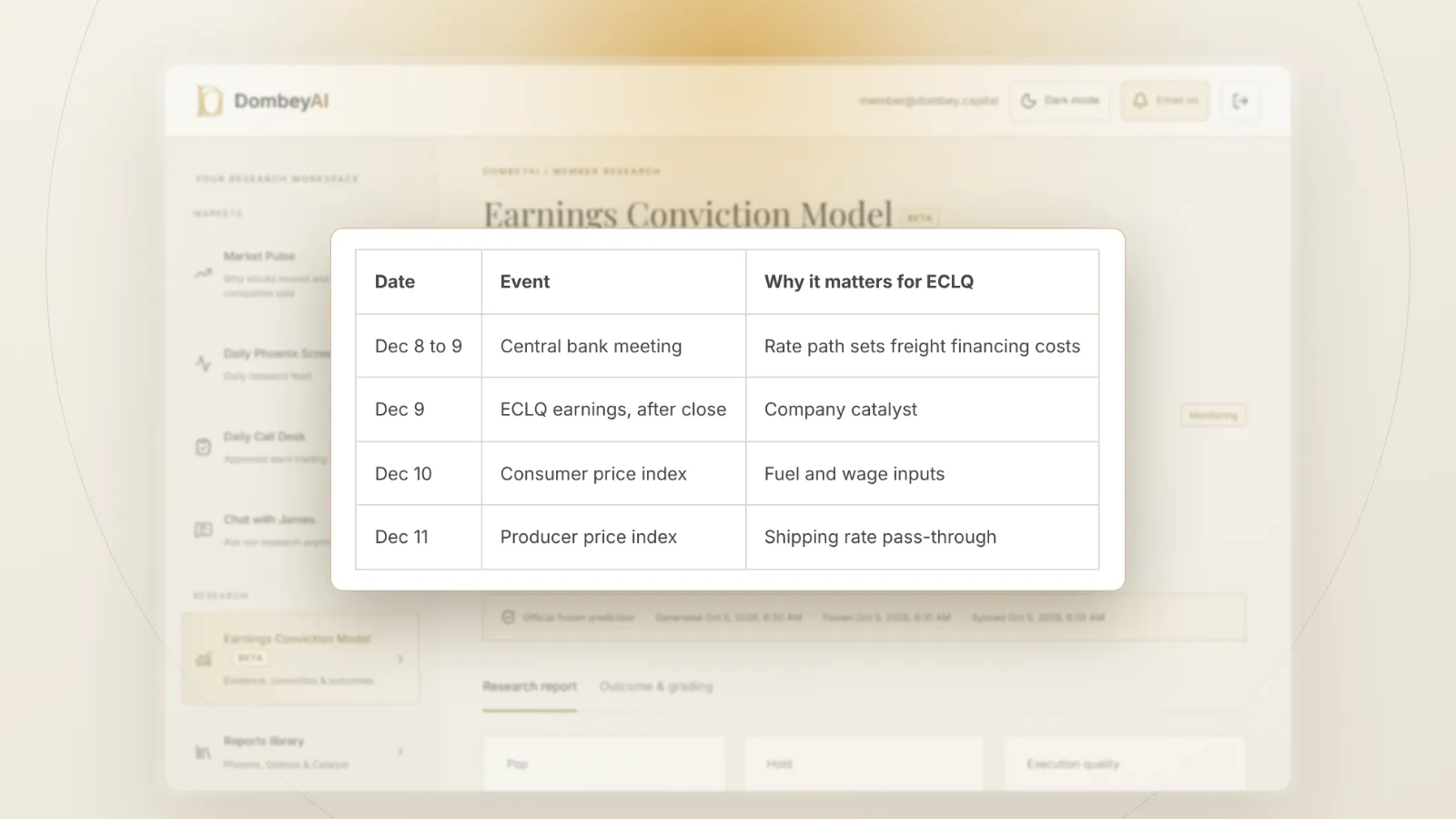


Full disclosure: Dombey Capital is our own research service and our top pick here, for the reasons below. The section on where it falls short is there so you can judge whether it fits your process.
Quick comparison
| Tool | Best for | Key features | Price (as of November 2026) |
|---|---|---|---|
| Dombey Founding Membership (research, not a calendar)Top pick | Company catalysts alongside macro dates | Weekly Phoenix Report, weekly Options Research, Catalyst Briefing, DombeyAI Portal | Founding Membership $1,200/year (annual only); Standard Access $80/year or $8/month; Public Archive free |
| Trading Economics | Broadest free global calendar | 196 countries, consensus and own forecast, impact filter, API | Calendar viewable free; see the vendor's pricing page for data plans and API |
| Investing.com | Fast free calendar with alerts | Actual, forecast, previous, 1 to 3 star importance, alerts, time zone setting | Calendar viewable free; see the vendor's pricing page for InvestingPro |
| TradingView | Calendar beside your charts | Importance and country filters, G20 view, forecasts | Basic free; Essential $12.95/mo, Plus $29.95/mo, Premium $59.95/mo billed annually |
| Econoday | Professional calendar with commentary | Forecast, actual, prior, consensus, commentary, debt auctions, USDA reports | See the vendor's pricing page |
| BLS release calendar | Official dates for jobs, CPI and PPI | Release schedule in Eastern Time, ICS calendar subscription | Free |
| Federal Reserve FOMC calendar | Official Fed meeting dates | Meeting dates, projection meetings marked, minutes timing | Free |
| FRED release calendar | Official dates across many data sources | Week, month and year views, links to data series | Free |

How we compared these tools
We compared these tools from vendor documentation, pricing pages and public product pages, read on November 17, 2026. We did not run trials. The job is knowing, ahead of time, which dated events could move the positions you hold.
| Criterion | Weight | What it measures |
|---|---|---|
| Accuracy of dates and times | 25% | Whether the schedule comes from or matches the official source |
| Expectations shown | 20% | Consensus or forecast next to the actual and previous figures |
| Coverage | 15% | US and international releases, central banks, auctions |
| Relevance to single-stock catalysts | 20% | Whether it helps with company events, not just macro data |
| Alerts and calendar export | 10% | Notifications and adding dates to your own calendar |
| Cost | 10% | Price of the plan you need and what the free version withholds |
If you trade currencies or index futures and weight macro coverage most, Trading Economics and Investing.com move up and Dombey moves down. If you weight official accuracy most, the BLS and Federal Reserve calendars move up.
Quick picks by job
Best for company catalysts alongside macro dates: Dombey Founding Membership
Founding Membership includes the weekly Phoenix Report, weekly Options Research, the Catalyst Briefing and the DombeyAI Portal with the Daily Phoenix Screener and the Earnings Conviction Model, plus valuation and execution analysis and priority access. It covers company events, such as earnings, votes, regulatory decisions and deal dates, which a macro calendar does not. Standard Access, at $80 a year, is the lower-cost option with the Biweekly Catalyst Briefing and the public research archive.
Best free global calendar: Trading Economics
Trading Economics covers 196 countries and shows both a survey consensus and its own forecast, with an impact filter.
Best for quick checks and alerts: Investing.com
Investing.com's calendar shows actual, forecast and previous with a one-to-three star importance rating, and signed-in users can set alerts on events.
Best calendar beside your charts: TradingView
TradingView's calendar filters by importance and country and sits inside the charting platform many investors already use.
Best for professional commentary: Econoday
Econoday pairs forecast, actual and prior figures with commentary and adds sovereign debt auctions and agriculture reports.
Best official source for jobs and inflation dates: BLS
The BLS release calendar is the source for the employment report, CPI and PPI dates, and it can be added to your own calendar.
Best official source for Fed meetings: Federal Reserve FOMC calendar
The Fed's page lists every scheduled meeting, marks those with economic projections and states when minutes come out.
Best free cross-source schedule: FRED
FRED's release calendar collects release dates from many data sources in one place, linked to the underlying series.
Full reviews
1. Dombey Founding Membership
Dombey publishes written research on special situations: stocks priced below cash, below book or cheap on sales, and legal and corporate catalysts. Best for investors whose positions turn on company events and who want those dates tracked with research behind them. Founding Membership is $1,200 a year, annual billing only; Standard Access is $80 a year, about $6.67 a month, or $8 a month on monthly billing; the Public Archive is free.
Pros
- Tracks company catalysts that macro calendars leave out
- Each thesis is dated and published before its catalyst
- Free Public Archive to judge the work first
Cons
- Not an economic calendar; you still need one for macro releases
- Narrow coverage, focused on special situations
- Short public history
Verdict: The top pick for investors whose returns depend on dated company events, used alongside a free macro calendar.
2. Trading Economics
Trading Economics says its calendar provides events for 196 countries. It shows the actual figure from official sources, the previous figure flagged when revised, a consensus described as the average forecast of a group of economists, and its own forecast driven by its analysts and models. An impact selector filters by low, medium or high importance. Paid data plans and an API cover historical downloads; prices are on its pricing page.
Pros
- Very wide country coverage
- Shows both consensus and an independent forecast
- API access for those building models
Cons
- Its own forecast can be confused with the consensus
- Data plan and API prices are not on the calendar page
- More than most stock investors need
Verdict: The best free choice for a global macro calendar.
3. Investing.com
Investing.com describes its calendar as real-time. Each row shows time, country or currency, event, a one-to-three star importance rating, actual, forecast and previous. Its FAQ says the forecast is the economists' consensus and that actual figures fill in once published. Filters cover country, category and importance, and you can change the time zone and set alerts. The calendar is viewable without a paid plan; InvestingPro prices are on its pricing page.
Pros
- Clear one-to-three star importance rating
- Alerts on individual events
- Date tabs from yesterday to next week, plus custom ranges
Cons
- Its color coding labels results as positive or negative for a currency, which may not apply to your holdings
- The page carries a disclaimer that data is not necessarily real-time or accurate
- Heavy promotion of paid plans on the page
Verdict: The fastest free calendar for checking what is out today and setting alerts.
4. TradingView
TradingView's economic calendar covers more than 300,000 indicators from over 190 countries according to its page, with filters for period, time zone, importance, category and countries, including a G20 view. Its pricing page lists Basic free with no credit card needed, and Essential at $12.95, Plus at $29.95, Premium at $59.95 and Ultimate at $199.95 a month, billed annually.
Pros
- Calendar inside a charting platform
- Free Basic plan
- Country and importance filters
Cons
- The calendar is a small part of a large product
- Paid tiers are priced for charting features, not the calendar
- Monthly-billing prices are not shown on the annual view
Verdict: The best fit for investors who already chart on TradingView.
5. Econoday
Econoday tracks US and international releases, central bank announcements, inflation and labor reports with forecast, actual and prior results plus commentary. It also covers sovereign debt auctions in 29 countries and USDA reports such as WASDE. It licenses its calendar to platforms through widgets and APIs, and its retail products include an economic calendar and daily and weekly reviews. Prices are not published; see the vendor's pricing page.
Pros
- Commentary and market-impact notes
- Debt auction and agriculture coverage
- Widely licensed by platforms
Cons
- No published prices
- Aimed mainly at institutions and platforms
- More than most single-stock investors need
Verdict: The best choice for professionals who want commentary with the calendar.
6. BLS release calendar
The Bureau of Labor Statistics publishes the dates of its news releases, including the Employment Situation, CPI, PPI, JOLTS and productivity, with times in Eastern Time. Its online calendar subscription updates automatically and works with Outlook, Apple Calendar and Google Calendar through an ICS address. It is free.
Pros
- The official source for jobs and inflation release dates
- Free calendar subscription
- No advertising or paid tiers
Cons
- Covers BLS releases only
- No consensus or forecast figures
- No importance rating
Verdict: The most reliable source for the dates that move rate expectations.
7. Federal Reserve FOMC calendar
The Federal Reserve's FOMC calendar page lists scheduled meeting dates, marks the meetings with a Summary of Economic Projections, and says minutes are released three weeks after the policy decision. It notes that dates are tentative until confirmed at the preceding meeting. It is free.
Pros
- The official source for Fed meeting dates
- Shows which meetings include economic projections
- Links to statements and minutes
Cons
- Fed meetings only
- No expectations data
- Future dates can change
Verdict: The page to check before holding options through a Fed decision.
8. FRED release calendar
The St. Louis Fed's FRED release calendar lists upcoming releases by date and time, in US Central Time, with week, month and year views. It notes that release dates come from the data sources and may not match when the data appears on FRED. It is free.
Pros
- Many sources in one schedule
- Links to the underlying data series
- Free
Cons
- No consensus or importance rating
- Times are shown in Central Time
- No export option stated on the calendar page
Verdict: A free cross-check for release dates beyond the BLS and the Fed.
Where Dombey falls short
Dombey is not an economic calendar. It does not list CPI, payrolls or central bank meetings, and it does not show consensus figures. Its coverage is narrow: special situations, not the whole market. It is not a broad stock data terminal. The team is small, the author writes under a pen name, and the public history is short. If your work is mainly macro or index trading, one of the free calendars above will serve you better.
Free vs paid
Free calendars cover the core job well. Trading Economics, Investing.com and TradingView's Basic plan show dates, expectations and results, and the BLS, Fed and FRED schedules are the official sources. Paid products add historical data downloads, APIs, commentary or charting features. Pay when you need data for models, professional commentary or company-level research, not for the dates themselves.
How to choose
| Your situation | Pick | Add later when |
|---|---|---|
| Positions turn on company events | Dombey Founding Membership plus a free calendarTop pick | You trade macro-sensitive options |
| Mainly macro or currencies | Trading Economics | You need historical data or an API |
| Want quick daily checks | Investing.com | You want alerts on specific releases |
| Already chart on TradingView | TradingView | You need a deeper consensus history |
| Want official dates only | BLS and Federal Reserve calendars | You need expectations next to the dates |
For company events, pair a macro calendar with a catalyst calendar you build yourself and the best earnings calendar and catalyst tools. Sector calendars cover what macro calendars miss, such as FDA decision dates and IPO and lockup expirations. Macro events still matter for options: a Fed decision or CPI print can lift the VIX and option prices across the market. For research services more broadly, see the best stock picking services.
The bottom line
Dombey's Founding Membership is our top pick for investors whose positions depend on dated company catalysts, used alongside a free macro calendar. For the macro calendar, Trading Economics and Investing.com are the broadest free choices, TradingView fits chart users, and Econoday serves professionals who want commentary. The BLS, Federal Reserve and FRED schedules are the free official sources for dates. Know when the numbers come out, but remember that for a single stock, the company's own calendar usually matters more.