

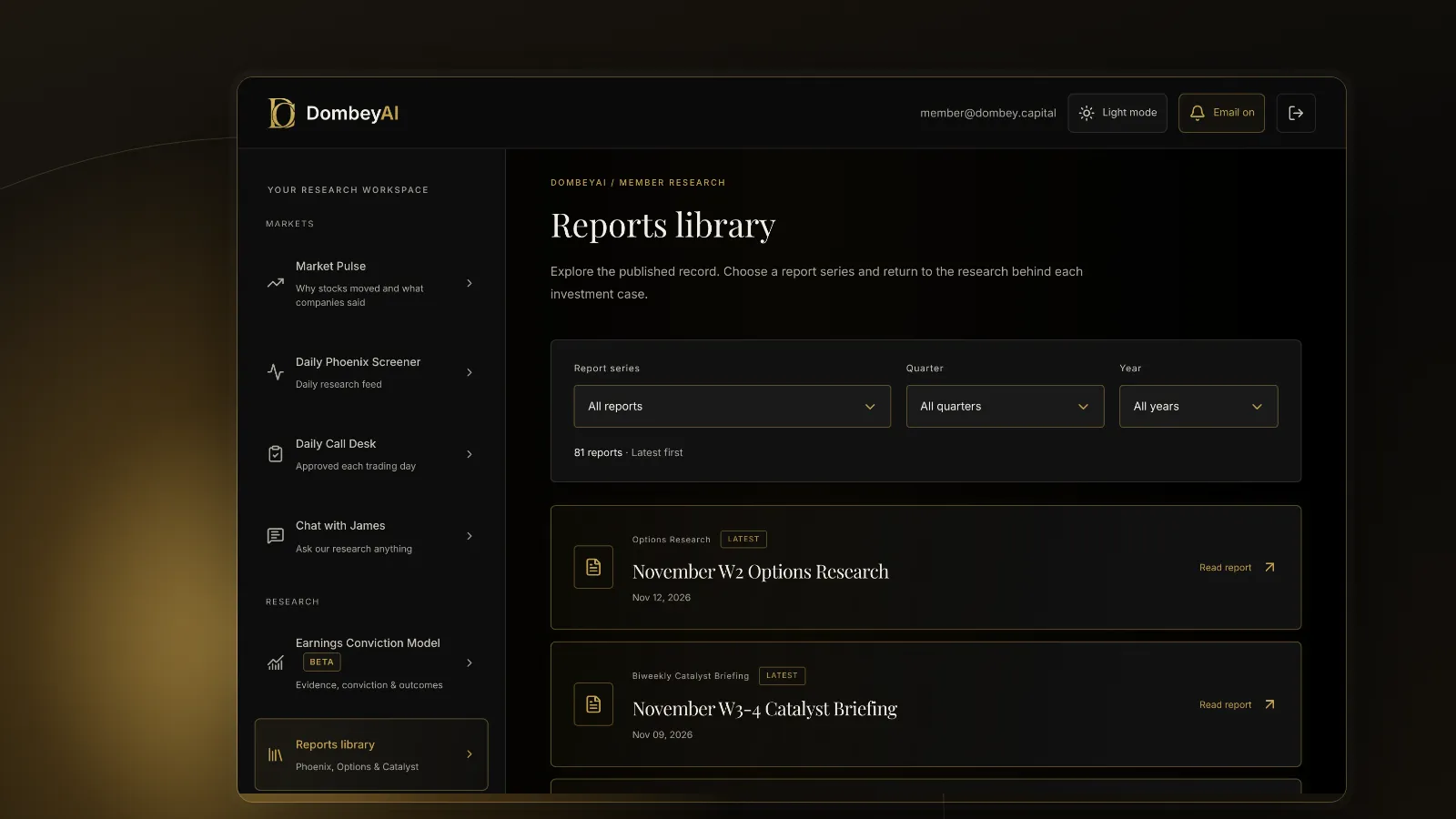

Full disclosure: Dombey Capital is our own research service and our top pick here, for the reasons below. The section on where it falls short is there so you can judge whether it fits your process.
Quick comparison
| Course or source | Best for | Key features | Price (as of November 2026) |
|---|---|---|---|
| Dombey Capital (research, not a course)Top pick | Seeing the methods applied to live special situations | Weekly Phoenix Report, weekly Options Research, Catalyst Briefing, DombeyAI Portal | Founding Membership $1,200/year (annual only); Standard Access $80/year or $8/month; Public Archive free |
| Damodaran Valuation online class | Free, complete valuation training | 25 webcasts of 12 to 20 minutes, slides, post-class tests, valuation tools | Free on YouTube |
| Columbia Value Investing (Online) | A structured value investing program | 9 weeks, 6 to 8 hours a week, asset value, earnings power value, case studies, live sessions | See the program page |
| Wall Street Prep Premium Package | Full modeling training | 7 courses, about 46 hours of video: statements, DCF, M&A, comps, LBO | $499 |
| Breaking Into Wall Street Core Financial Modeling | Lower-cost modeling training | 166 videos, about 40 hours, 13 modules, case studies | $297 |
| CFI subscription | Broad library of finance courses | 250+ courses, 8 certification exams including FMVA | Self-Study $372.75/year; Full-Immersion $592.90/year (listed discounts) |
| CFA Institute Investment Foundations | Finance fundamentals for newcomers | Self-paced, 35 to 65 hours, 100-question final assessment | $350 |
| Coursera Financial Markets (Yale) | Market structure and behavioral finance | Robert Shiller's course, about 34 hours across seven modules | Included in Coursera Plus, $239/year |
Prices are as listed on each provider's site on November 15, 2026. CFI's figures were listed as discounts from $497 and $847.
How we compared these courses
We compared these courses from provider descriptions, syllabi and pricing pages. We did not take them, so this is a comparison of what each provider says it covers. We make no claims about investment results from any course.
| Criterion | Weight | What it measures |
|---|---|---|
| Valuation depth | 30% | How fully the course teaches intrinsic and relative valuation |
| Relevance to special situations | 25% | Coverage of distress, deals, asset values and corporate events |
| Practical application | 20% | Models, cases and exercises a reader can reuse |
| Cost | 15% | Price relative to hours and content |
| Format and flexibility | 10% | Self-paced or cohort, time required |
We weighted valuation depth and relevance most, because special situations reward investors who can value a business from its filings when the market is pricing an event. If you weight credentials or career use more heavily, CFI and Wall Street Prep move up.
Quick picks by job
Best for applying the methods to live situations: Dombey Capital
Dombey's Founding Membership is written research: the weekly Phoenix Report, weekly Options Research, the Catalyst Briefing and the DombeyAI Portal with the Daily Phoenix Screener and the Earnings Conviction Model, plus valuation and execution analysis. It suits readers who have learned valuation and want to see it applied to a current special situation with a dated catalyst. Standard Access, at $80 a year, is the lower-cost option with the Biweekly Catalyst Briefing and the public research archive.
Best free course: Damodaran Valuation online class
Damodaran's class compresses his semester valuation course into 25 short webcasts, with slides and tests. It covers government bond rates as the base for discount rates, the equity risk premium, cash flows, growth, terminal value, multiples, distress and real options, including distressed equity as an option.
Best structured value program: Columbia Value Investing (Online)
Columbia's 9-week program, run with Emeritus, covers asset value, earnings power value, strategic analysis, growth and risk management through case studies, led by faculty from the Heilbrunn Center for Graham and Dodd Investing.
Best full modeling program: Wall Street Prep Premium Package
Seven courses covering financial statement, DCF, M&A, trading and transaction comps and LBO modeling, about 46 hours of video, with a certification exam.
Best lower-cost modeling course: Breaking Into Wall Street Core Financial Modeling
About 40 hours across 13 modules, including three-statement models, valuation, M&A and LBOs, with case studies and a 90-day money-back guarantee.
Best course library: CFI
An annual subscription with more than 250 courses and certification exams including FMVA, useful if you want breadth.
Best for finance newcomers: CFA Institute Investment Foundations
A self-paced introduction to markets, instruments and the investment industry, with a final assessment.
Best for market behavior: Coursera Financial Markets
Robert Shiller's Yale course covers markets, risk and behavioral finance, a useful frame for why corporate events get mispriced.
Full reviews
1. Dombey Capital
Written research on special situations: stocks below cash or book, cheap on sales, and legal and corporate catalysts. Best for readers who want to see valuation applied to live cases. Founding Membership is $1,200 a year, annual billing only; Standard Access is $80 a year, or $8 a month on monthly billing; the Public Archive is free.
Pros
- Applies valuation to live situations with dated catalysts
- Theses published before the event, kept in the archive
- Free Public Archive to judge the work first
Cons
- Not a course; it does not teach from first principles
- Narrow coverage, focused on special situations
- Short public history
Verdict: The best companion to a course for readers who want to see the methods applied now.
2. Damodaran Valuation online class
Twenty-five webcasts of about 12 to 20 minutes each, with slides, post-class tests and solutions, plus valuation tools on topics such as leases, R&D and employee options. Free to watch on YouTube.
Pros
- Free and complete
- Covers distress, illiquidity and real options
- Taught by a leading valuation academic
Cons
- Self-directed, with no feedback
- General valuation, not special situations specifically
Verdict: The first course to take.
3. Columbia Value Investing (Online)
A 9-week online program at 6 to 8 hours a week, with recorded lectures, live sessions, office hours and peer groups. Topics include asset value, earnings power value, strategic analysis and risk management, with case studies. See the program page for the fee.
Pros
- Direct coverage of value investing methods
- Faculty from the Heilbrunn Center
- Structure and live sessions
Cons
- The fee is far higher than self-paced options
- Fixed cohort schedule
- Little on corporate events such as spin-offs or bankruptcies
Verdict: The best structured program on value investing.
4. Wall Street Prep Premium Package
Seven courses, about 46 hours of video, covering statement modeling, DCF, M&A, comps and LBOs, with Excel templates and a certification exam. Listed at $499, with an estimate of 70 to 90 hours to complete.
Pros
- Complete modeling curriculum
- M&A and LBO models apply directly to deal analysis
- Templates you can reuse
Cons
- Aimed at banking careers more than investing
- A large time commitment
Verdict: The most complete modeling program here.
5. Breaking Into Wall Street Core Financial Modeling
166 videos, about 40 hours, in 13 modules covering accounting, three-statement models, valuation, M&A and LBOs, with case studies and modeling tests. Listed at $297, with a 90-day money-back guarantee.
Pros
- Lower price for a full modeling course
- Case studies and tests
- Long access to Q and A support
Cons
- Career focus
- Less on investing judgment
Verdict: The best value modeling course.
6. CFI subscription
An annual subscription: Self-Study listed at $372.75 a year and Full-Immersion at $592.90 a year, both shown as discounts. Includes 250+ courses and certification exams including FMVA.
Pros
- Broad library
- Recognized certifications
Cons
- Annual billing only
- Breadth over depth on valuation for investors
Verdict: Good for breadth; less focused than the others.
7. CFA Institute Investment Foundations
A self-paced course on the investment industry, markets, instruments and tools, with 12 months of access and a 100-question final assessment. Listed at $350.
Pros
- Clear foundation from a recognized body
- Self-paced
Cons
- Introductory; little valuation
- Not aimed at stock analysis
Verdict: For newcomers before a valuation course.
8. Coursera Financial Markets (Yale)
Robert Shiller's course on markets, risk and behavioral finance, about 34 hours across seven modules, included in Coursera Plus at $239 a year.
Pros
- Strong on market behavior
- Taught by a Nobel laureate
Cons
- No valuation or modeling
- Broad, not stock-focused
Verdict: Useful context on why events get mispriced.
Where Dombey falls short
Dombey is not a course. It does not teach valuation from first principles, it covers a narrow set of special situations, and it is not a data terminal. The team is small, the author writes under a pen name and the public history is short. If you are starting from zero, take Damodaran's class first.
Free vs paid
Damodaran's class and Dombey's Public Archive are free. Paid options range from $297 for Breaking Into Wall Street to Columbia's program fee, the highest here; see its program page. Courses are mostly a one-off cost; research such as Dombey's Founding Membership, $1,200 a year, or Standard Access, $80 a year, is ongoing. Free books and filings fill many gaps; see our list of the best special situations investing books.
How to choose
| Your situation | Pick | Add later when |
|---|---|---|
| New to finance | CFA Institute Investment Foundations | You are ready to value companies: Damodaran |
| You want free valuation training | Damodaran Valuation online class | You want structure: Columbia |
| You want to model deals and restructurings | Wall Street Prep or Breaking Into Wall Street | You want ideas to apply them to: Dombey |
| You want to see methods applied to live cases | Dombey Founding Membership | You want the theory: Damodaran |
| You want structure and a credential | Columbia Value Investing (Online) | You need modeling: Wall Street Prep |
After a course, practice on a real case: our guides on how to do a sum-of-the-parts valuation and how to build a simple financial model are good starting points. For a wider comparison of research services, see Seeking Alpha vs Motley Fool vs Morningstar vs Dombey.
Where this goes wrong
The usual failure is finishing a course and never applying it. Valuation skills fade without practice on live filings. The other is paying for a credential when the goal is investing; a free course plus disciplined practice often teaches more.
The bottom line
Our top pick is Dombey Capital's research for seeing valuation applied to live special situations with dated catalysts, with a free archive to start. For courses, take Damodaran's free Valuation online class first, then Columbia's program for structure or Wall Street Prep or Breaking Into Wall Street for modeling. Add CFA Institute Investment Foundations if you are new to finance. Whatever you choose, apply it to real filings.