

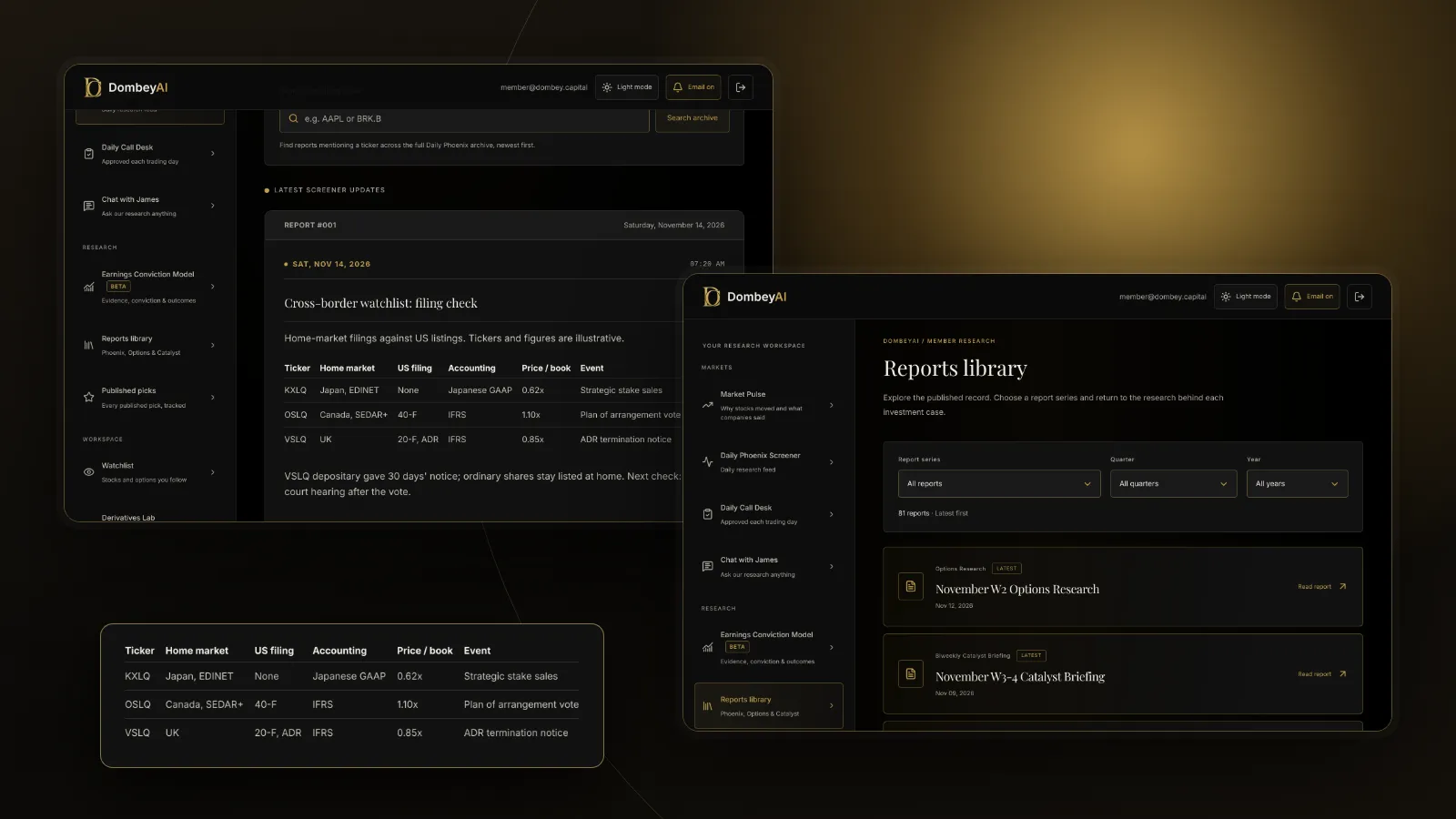


Full disclosure: Dombey Capital is our own research service and our top pick here, for the reasons below. The section on where it falls short is there so you can judge whether it fits your process.
What international stock research needs
Researching a company outside the US adds layers that a domestic stock does not have. Good international research covers three:
- Primary filings in the home market. The annual report, interim reports and statutory disclosures, filed with the local regulator or registry and often in the local language.
- SEC filings for foreign issuers. Companies with US listings file a Form 20-F each year and furnish interim information on Form 6-K.
- Standardized data. Global data platforms convert financials into a common format, which makes comparisons across countries quicker, though some detail is lost in translation.
Special situations abroad often turn on local rules: how a tender offer works, whether foreign shareholders can join a rights offering, or what happens when an ADR program ends. Our piece on ADR terminations covers one common case.
Quick comparison
| Tool | Best for | Key features | Price (as of November 2026) |
|---|---|---|---|
| Dombey CapitalTop pick | Cross-border special situations in written research | Weekly Phoenix Report, Catalyst Briefing, DombeyAI Portal, dated public archive | Public Archive free; Founding Membership $1,200/yr; Standard Access $80/yr or $8/mo |
| SEC EDGAR | Foreign issuers listed in the US | 20-F, 6-K and F-series filings, full-text search | Free |
| EDINET | Japanese company filings | Annual securities reports and statutory disclosures | Free |
| SEDAR+ | Canadian company filings | Financial statements, MD&A, annual information forms | Free |
| Companies House | UK company records | Filed accounts, officers, charges and ownership | Free |
| TIKR | Standardized global financials | Paid plans include global data; 10 to 30 years of history | Free (US only); Plus $24.95/mo; Pro $54.95/mo; Ultimate $119.95/mo |
| Koyfin | Charting global companies | Plus: 100K+ global company snapshots, 10 years of financials | Free; Plus $39/mo; Premium $79/mo; Advisor Core $209/mo; Advisor Pro $299/mo |
| Simply Wall St | A first look at an unfamiliar market | 90+ markets, 120K+ stocks, visual reports | Free; Premium and Unlimited: see the vendor's pricing page |
How we compared these tools
We compared them from vendor documentation, pricing pages and public product pages, weighting the criteria that matter for international special situations and dated catalysts.
| Criterion | Weight | What it measures |
|---|---|---|
| Fit for special situations and dated catalysts | 25% | Whether the tool helps judge if a cross-border event can change a stock's value |
| Access to primary filings | 25% | Whether the original disclosures are available |
| Breadth of country coverage | 20% | How many markets are covered |
| Comparability | 15% | Standardized financials across accounting regimes |
| Free access and price transparency | 15% | What is free and whether prices are published |
If you weight country coverage and comparability above event analysis, TIKR and Koyfin move ahead of Dombey, which is research rather than a data source.
Quick picks by job
Best for cross-border special situations: Dombey Capital
Dombey publishes research on situations where an event can reset a stock's value, and some of the clearest come from abroad: foreign takeovers of US-listed companies, cross-shareholding unwinds in Japan, ADR terminations and spin-offs. Each thesis is dated and kept in the archive, and the Public Archive is free.
Best for US-listed foreign issuers: SEC EDGAR
Foreign private issuers with US listings file 20-Fs, 6-Ks and registration statements on EDGAR in English. Our guide on how to search SEC EDGAR filings explains how to find them.
Best for Japanese companies: EDINET
Japan's Financial Services Agency runs EDINET, where listed companies file annual securities reports and other statutory disclosures. Much of it is in Japanese, but the detail on segments and strategic shareholdings goes well beyond most data platforms.
Best for Canadian companies: SEDAR+
SEDAR+ holds the filings of Canadian issuers: financial statements, MD&A, annual information forms and material change reports. Many small Canadian resource companies file only here.
Best for UK company records: Companies House
Companies House publishes filed accounts, officers, charges and persons with significant control for UK companies, including the subsidiaries of listed groups.
Best for standardized global financials: TIKR
TIKR's paid plans include global data, with 10 years of financials on Plus and Pro and 30 years on Ultimate. It is the quickest way to compare a foreign company with its US peers on the same layout.
Best for charting global companies: Koyfin
Koyfin's Plus plan includes more than 100,000 global company snapshots with 10 years of financials, and its charting makes cross-country comparisons quick.
Best for a first look at an unfamiliar market: Simply Wall St
Simply Wall St covers more than 90 markets and 120,000 stocks with visual company reports. The free plan includes five company reports a month.
Full reviews
1. Dombey Capital
What it does. Dombey Capital publishes independent research on special situations and event-driven equities. Each thesis sets out the situation, the catalyst and its date, the valuation and what would change the view, and is priced on the day it is published and kept in the archive. There are three access levels:
- Founding Membership ($1,200 a year, annual billing only): the weekly Phoenix Report, weekly Options Research, the Catalyst Briefing, the DombeyAI Portal with the Daily Phoenix Screener and the Earnings Conviction Model, valuation and execution analysis, and priority access.
- Standard Access ($80 a year, about $6.67 a month, or $8 a month on monthly billing), the lower-cost option: the Biweekly Catalyst Briefing on forthcoming corporate and market events, plus the complete public-research archive.
- Public Archive (free): published executive theses and public research.
Best for. Investors who want cross-border events, such as foreign takeovers and ADR changes, judged with a date and a valuation. Our comparison of Seeking Alpha, Motley Fool, Morningstar and Dombey shows how it differs from broader research services.
Pros
- Cross-border situations judged as events, with dates and what would change the view
- Dated archive lets you check the record
- Free Public Archive to try before paying
- Founding Membership includes the DombeyAI Portal
Cons
- Not a global database: no country screens or local filings
- Narrow coverage: only situations with a catalyst
- Small team and a short history
Verdict: The top pick for international special situations; pair it with the primary filing systems.
2. SEC EDGAR
What it does. The SEC's filing system. Foreign private issuers with US listings file annual reports on Form 20-F, furnish interim information on Form 6-K and register offerings on F-series forms. Some Canadian issuers file under the multijurisdictional system on Form 40-F.
Best for. English-language filings for foreign companies with US listings, including merger and tender offer documents.
Pricing. Free.
Pros
- English filings with full-text search
- Covers takeover documents for US-listed foreign companies
Cons
- Interim reporting from foreign issuers can be thinner than US 10-Qs
- Companies without US listings are absent
Verdict: The first stop for any foreign company with a US listing.
3. EDINET
What it does. Japan's Financial Services Agency's electronic disclosure system, where listed companies file annual securities reports, semiannual reports, large shareholding reports and other statutory disclosures.
Best for. Detail on Japanese companies that data platforms skip, such as strategic shareholdings and segment notes.
Pricing. Free.
Pros
- The primary source for listed Japanese companies
- Large shareholding reports show stake changes
Cons
- Much of the content is in Japanese only
- Search takes practice
Verdict: Essential for any serious work on a Japanese company.
4. SEDAR+
What it does. The filing system of the Canadian securities regulators, holding financial statements, MD&A, annual information forms, material change reports and other disclosures for Canadian issuers.
Best for. Canadian small caps and resource companies that do not file with the SEC.
Pricing. Free.
Pros
- Complete record for Canadian issuers
- English filings for most issuers
Cons
- Search is less flexible than EDGAR's full-text search
- No standardized data
Verdict: The primary source for Canadian companies.
5. Companies House
What it does. The UK registrar of companies, publishing filed accounts, officers, charges, confirmation statements and persons with significant control.
Best for. Subsidiary accounts of UK groups, private company history and ownership checks.
Pricing. Free.
Pros
- Accounts for UK subsidiaries that group reports consolidate away
- Ownership and charge records
Cons
- Listed company announcements and interim results are published elsewhere
- Small company accounts can be abbreviated
Verdict: Useful for digging under a UK group's consolidated figures.
6. TIKR
What it does. A financial data platform with financials, estimates, transcripts and ownership across global markets.
Best for. Comparing foreign companies with peers on a standardized layout.
Pricing. Free; Plus $24.95 a month; Pro $54.95 a month; Ultimate $119.95 a month. The free plan covers US stocks only with five years of financials; paid plans include global data, with 10 years on Plus and Pro and 30 years on Ultimate.
Pros
- Global coverage on every paid plan
- Long standardized histories
Cons
- Free plan excludes non-US stocks
- Standardization can hide local accounting detail
Verdict: The best value for standardized global financials.
7. Koyfin
What it does. A financial data and charting platform with dashboards, screens and financial history, including global company snapshots on paid plans.
Best for. Charting valuation and growth for foreign companies against US peers.
Pricing. Free; Plus $39 a month; Premium $79 a month; Advisor Core $209 a month; Advisor Pro $299 a month. Plus includes more than 100,000 global company snapshots and 10 years of financials and estimates.
Pros
- Strong charting across countries
- Usable free plan
Cons
- Coverage detail by country is not published on the pricing page
- Longer history requires a paid plan
Verdict: A strong choice for visual cross-country comparison.
8. Simply Wall St
What it does. A visual stock research platform covering more than 90 markets and 120,000 stocks, with company reports, screeners and portfolio tools.
Best for. A quick overview of companies in markets you do not know well.
Pricing. Free plan with one portfolio of up to 10 holdings and five company reports a month; Premium and Unlimited plans: see the vendor's pricing page. A seven-day Premium trial is offered.
Pros
- Very broad market coverage
- Visual summaries make a first pass quick
Cons
- Summaries are no substitute for local filings
- Free plan limits reports per month
Verdict: A good starting point before moving to the filings.
Where Dombey falls short
Dombey is research, not a global database. It does not provide country screens, local filings or standardized financials for foreign markets; the filing systems and data platforms above do that. Coverage is narrow, limited to situations with an identifiable catalyst, and most foreign companies will never appear. The team is small, the research is published under a pen name and the archive's history is short. Investors who want broad coverage of a foreign market will need the other tools regardless.
Free vs paid
The primary sources are free: EDGAR, EDINET, SEDAR+ and Companies House. Free plans from Simply Wall St and Koyfin add a first look at global companies, though TIKR's free plan stops at US stocks. Paid data platforms add standardized global financials and longer histories; TIKR is the lowest-cost route to global data. Paid research, such as Dombey's Founding Membership, adds judgment on which cross-border events matter and when.
How to choose
| Your situation | Pick | Add later when |
|---|---|---|
| You follow cross-border events such as foreign takeovers | Dombey CapitalTop pick | You need the filings: add EDGAR and the home-market system |
| You research US-listed foreign companies | SEC EDGAR | You want peer comparisons: add TIKR |
| You research Japanese companies | EDINET | You want standardized data: add TIKR |
| You research Canadian small caps | SEDAR+ | You want charts: add Koyfin |
| You are new to a market | Simply Wall St | You want depth: move to local filings |
For a wider view of research platforms, see the best stock research tools for individual investors.
The bottom line
Dombey Capital is our top pick for investors who want international special situations judged in written research, with a free Public Archive, Founding Membership at $1,200 a year and Standard Access at $80 a year as the lower-cost option. For the numbers, start with the free primary sources: EDGAR for US-listed foreign issuers, EDINET for Japan, SEDAR+ for Canada and Companies House for the UK. TIKR and Koyfin add standardized global data, and Simply Wall St gives a quick first look at many markets. Local filings remain the final word on any foreign company.