

What cross-shareholdings are
Cross-shareholdings, reported as strategic or policy shareholdings, are stakes companies hold in banks, customers, suppliers and business partners. Many are reciprocal. They grew in the postwar decades to cement relationships and to keep shares in friendly hands, which insulated management from outside shareholders and takeover bids.
The holdings have costs. They tie up capital in assets that often earn a low return, expose the holder to another company's share price and blur accountability, because friendly holders tend to vote with management. For a holding company, the effect resembles the discount described in our piece on holding company discounts: value sits in assets the market does not credit in full.
Why the unwinding has accelerated
Several pressures have built on each other:
- The Corporate Governance Code. Introduced in 2015 and revised since, it asks listed companies to disclose their policy on strategic shareholdings, have the board assess each holding's benefits and risks against the cost of capital, and explain how they vote the shares.
- The Tokyo Stock Exchange. In 2023 the exchange asked listed companies, particularly those trading below book value, to manage with awareness of their cost of capital and share price, and to disclose plans. Selling low-return holdings is one of the most direct responses.
- Investors and proxy advisers. Domestic and foreign investors press companies on large holdings, and proxy advisers have adopted policies that can recommend votes against top executives when strategic holdings are large relative to net assets.
- Sector commitments. Japan's major non-life insurers have announced plans to sell their strategic holdings, and many banks have set reduction targets.
How the sales happen
| Route | How it works | Effect on the stock being sold |
|---|---|---|
| Secondary offering | Holder sells through underwriters, often with the issuer's cooperation | Adds free float; discount to market price at pricing |
| Issuer buyback from the holder | Issuer repurchases its own shares, often through an off-auction trading system | Reduces share count; supportive |
| Gradual market sales | Holder sells over months | Steady supply; harder to see |
| Exchange or swap | Stakes traded or unwound in pairs | Mixed; often neutral |
| Sale to a third party | Stake sold to a strategic or financial buyer | Depends on the buyer's intent |
An issuer buyback from a departing holder is the clearest positive for remaining shareholders: shares retire and the overhang disappears. Our piece on buybacks as catalysts explains when repurchases add value. A secondary offering has the opposite short-term effect, adding supply at a discount.
Effects on the seller
For the company selling stakes, an unwind can change the equity story:
- Cash and capital return. Sale proceeds can fund buybacks or dividends, which reduces equity and raises return on equity.
- Valuation. Companies trading below book often hold large strategic stakes. Releasing that capital can narrow the gap; our explainer on price to book covers why the gap exists.
- Gains on sale. Many stakes were bought decades ago at low cost, so sales can produce large accounting gains and tax.
- Less exposure. The seller's results become less sensitive to other companies' share prices.
Effects on the stock being sold
For the company whose shares are held, an unwind has three effects:
- Supply. A large holder selling can weigh on the price, especially around an offering.
- Governance. A friendly, passive holder leaves. The new holders may be more demanding, and in some cases the company becomes more exposed to activists or a hostile takeover.
- Free float. A wider float can increase index weights and liquidity over time.
Companies often respond by buying back their own shares from the departing holder, which can turn an overhang into a positive.
How to track unwinds
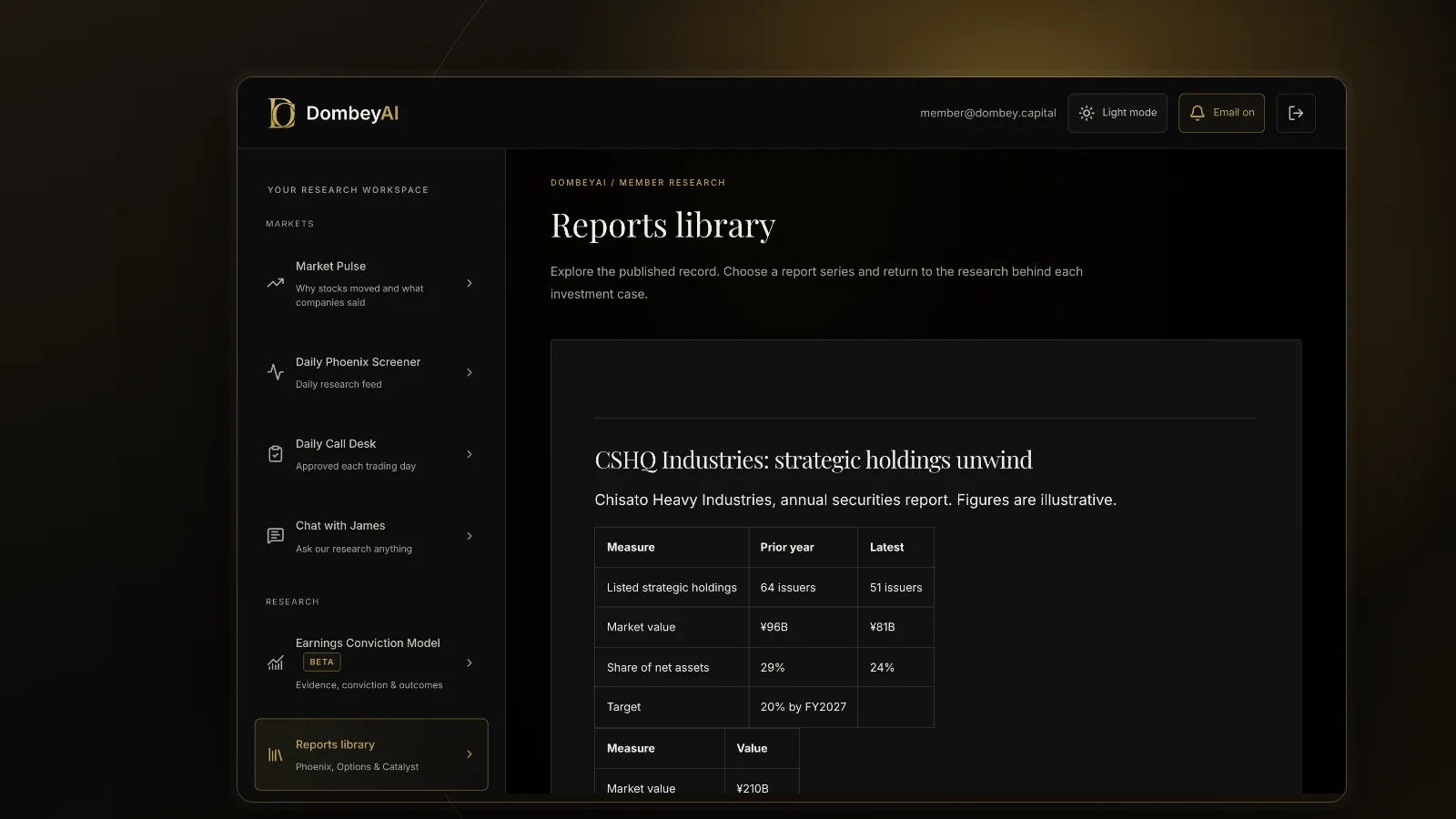
The annual securities report on EDINET lists each company's strategic shareholdings above a size threshold, with the number of shares, book value, purpose and whether the other company holds shares in return. Comparing two years' reports shows which stakes were sold. Corporate governance reports, integrated reports and medium-term plans often state reduction targets as a share of net assets.
Large shareholding reports, filed when a holder crosses 5% or changes its holding materially, show stake changes during the year. Company announcements of secondary offerings and buybacks give the dates.
A useful screen combines a low price to book ratio, large strategic holdings relative to market value and a published reduction plan. Companies with net cash and large holdings are the clearest cases, because the capital being released is a large share of the market value.
What to read in the annual securities report
The disclosure on strategic shareholdings follows a standard shape, which makes year-on-year comparison possible even for readers working through translation.
| Item | What it shows | What to check |
|---|---|---|
| Policy on strategic holdings | The company's stated approach | Whether it commits to reduction and on what timeline |
| Board review | How holdings are assessed against cost of capital | Whether any holdings failed the test |
| Number of issuers and book value | Totals for listed and unlisted holdings | Change from the prior year |
| Individual holdings | Shares held, book value, purpose | Which stakes shrank or disappeared |
| Reciprocal holding | Whether the other company holds shares in return | Pairs likely to unwind together |
| Shares sold in the year | Number of issuers reduced | Pace against stated targets |
A pattern of steady reductions with proceeds returned to shareholders is more credible than a target announced in a medium-term plan. Where the other company is also listed, check its own report: if it holds shares in return, the two stakes often unwind together, and both companies may announce buybacks.
Where this goes wrong
- Plans without sales. Reduction targets can slip; check actual sales in the next report.
- Proceeds not returned. Cash can go into acquisitions or simply sit on the balance sheet.
- Tax and gains. Gains on old holdings are taxed, so after-tax proceeds are smaller than market value.
- Offering discounts. The stock being sold can fall around a secondary offering even when the long-term effect is neutral.
- Currency. For foreign investors, yen moves can outweigh the situation itself.
- Disclosure language. Much detail is in Japanese only, and translations can miss nuance.
How it fits a research process
Treat an unwind as a dated event with two sides. For the seller, estimate the after-tax proceeds and what they fund. For the company being sold, estimate the supply, the route and the governance change. Our list of the best special situations newsletters covers services that follow events like these, and Dombey's published research tracks them when a dated catalyst emerges; see the research archive.
The bottom line
Cross-shareholding unwinds come from sustained pressure on Japanese companies to justify capital tied up in low-return stakes. For the seller, the sale releases capital that can lift returns and narrow a discount to book. For the company being sold, it adds supply and removes a friendly holder, though a buyback from the departing holder can turn that into a positive. The annual securities report makes the stakes and the progress visible, which turns a broad trend into specific, dated situations.