

How ADRs work
An American depositary receipt is a certificate issued by a US depositary bank that represents shares of a foreign company held by a custodian in the home market. Each ADR represents a set number of underlying shares, the ratio. ADRs trade in dollars and settle like US stocks, which is why they are popular.
The relationship is set by a deposit agreement among the company (for a sponsored program), the depositary and the ADR holders. That agreement contains the termination clause.
ADR programs come in several levels:
- Level I. Traded over the counter, with limited SEC reporting.
- Level II. Listed on a US exchange, with the company filing annual reports on Form 20-F and interim information on Form 6-K.
- Level III. Listed and used to raise capital in the US.
- Unsponsored programs. Set up by a depositary without the company's involvement, usually OTC.
Why programs are terminated
Companies end ADR programs for a handful of reasons:
- Low US trading. If most trading happens at home, the US listing may not justify its cost.
- Cost and compliance. Exchange listing and SEC reporting are expensive for a foreign issuer.
- Corporate events. A merger, a going-private transaction or a change of listing venue.
- Regulation. Rules in either country can make a US listing harder to keep.
Termination often travels with two related steps: a delisting from the US exchange and deregistration from SEC reporting. A foreign private issuer can terminate its reporting under Rule 12h-6 if US trading is low enough relative to worldwide trading, and it then files a Form 15F. Our explainer on going dark covers the domestic version of that process.
The termination timeline
The deposit agreement sets the details, but the sequence is similar across programs:
- Announcement. The company issues a press release and files a 6-K. If listed, it gives notice of delisting.
- Notice to holders. The depositary sends a notice with the termination date, commonly at least 30 days ahead.
- Delisting. For Level II and III programs, exchange trading ends. ADRs may continue to trade over the counter for a period.
- Termination date. The program ends. Holders can surrender ADRs and receive the underlying shares.
- Sale of remaining shares. After a period set in the deposit agreement, often several months, the depositary may sell the underlying shares still held and keep the net cash for holders.
- Cash payment. Holders who surrender their ADRs after the sale receive their share of the proceeds, net of fees and expenses, without interest.
Quick reference: holder options after termination
| Choice | What happens | Costs | Best suited to |
|---|---|---|---|
| Sell ADRs before delisting | Exit at the US market price | Normal commission, possible discount | Holders who cannot own foreign shares |
| Convert to underlying shares | Receive shares on the home exchange | Cancellation fee, foreign custody costs | Long-term holders with global brokerage |
| Hold through and take cash | Depositary sells shares later, pays net proceeds | Fees and expenses, timing and currency risk | Small positions, holders who prefer simplicity |
| Buy ADRs at a discount | Capture gap to home market value | Conversion costs, execution risk | Investors able to convert or wait |
Who sells, and why it can create a discount
Termination can create the kind of forced selling seen in index deletions. Some US investors cannot hold foreign shares or OTC securities by mandate. Some brokerage accounts cannot receive foreign shares. Many retail holders do not read the notice.
The result can be a period in which the ADR trades below the value of the underlying shares, adjusted for the ratio and the exchange rate. The gap is usually small for large companies with deep home markets, because arbitrage keeps it narrow. It can be wider for smaller companies, Level I programs and situations where conversion is slow or costly.
Rights also change during the wind-down. Under most deposit agreements, after the termination date the depositary stops performing most of its duties apart from collecting dividends and other distributions, selling rights and delivering the underlying shares on surrender. It usually stops forwarding voting materials. Holders who want to vote at the next shareholder meeting, or who expect a dividend soon after the termination date, should read the notice for how distributions will be handled, since they may be held and paid with the later cash proceeds rather than on the normal date.
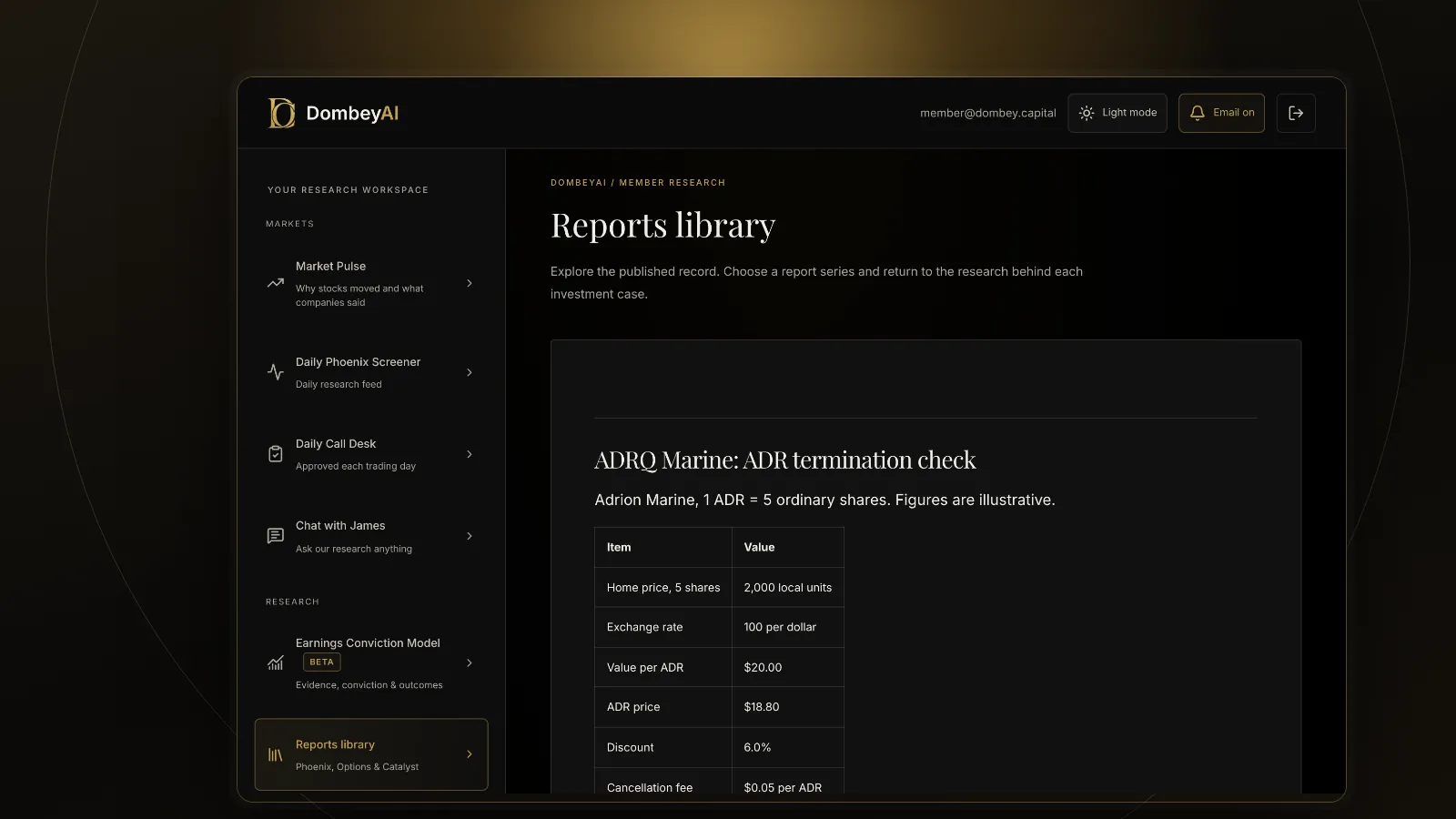
A worked example
What to read before deciding
- The depositary notice. Termination date, fees, how to surrender and when the depositary may sell.
- The deposit agreement. The termination clause and the period before a sale. It is filed as an exhibit to the program's registration statement on Form F-6, searchable on EDGAR.
- The company's 6-K and press release. Reasons, delisting dates and plans for reporting.
- The home market listing. Liquidity, trading hours and the exchange's disclosure rules.
- Your broker's capabilities. Whether it can receive foreign shares, and at what cost.
If the ADR moves to OTC trading after delisting, our guide on how to research an OTC stock covers the disclosure and liquidity checks. In some cases prices fall to the expert market, where quotes are not public.
Where this goes wrong
- Assuming value is lost. The company's shares still exist. Panic selling at a deep discount gives up value.
- Assuming the gap is free. Conversion takes time, carries currency risk and costs fees. A 3% gap can vanish into costs.
- Missing the notice. Holders who ignore it end up with cash at a time and price they did not choose.
- Losing disclosure. After deregistration, information comes in the home market's format and language, which may be thinner than SEC filings.
- Ignoring tax. Conversion is generally not a sale for US tax purposes, but the later sale is, and foreign withholding on dividends may apply. Check with a tax adviser.
- Overlooking a corporate event. If termination comes with a going-private offer, the offer terms matter more than the ADR mechanics.
Dombey's special situations research covers delistings and forced selling events; our list of the best investing newsletters for special situations compares other sources that follow them.
The bottom line
Terminating an ADR program ends the receipt, not the company. Holders can sell before delisting, convert to the underlying shares for a fee or wait for the depositary to sell the shares and pay cash. Forced and careless selling can open a gap between the ADR and the home market value, but conversion costs, timing and currency often absorb much of it. Read the depositary notice and the deposit agreement first, then decide which route fits your account and your patience.