

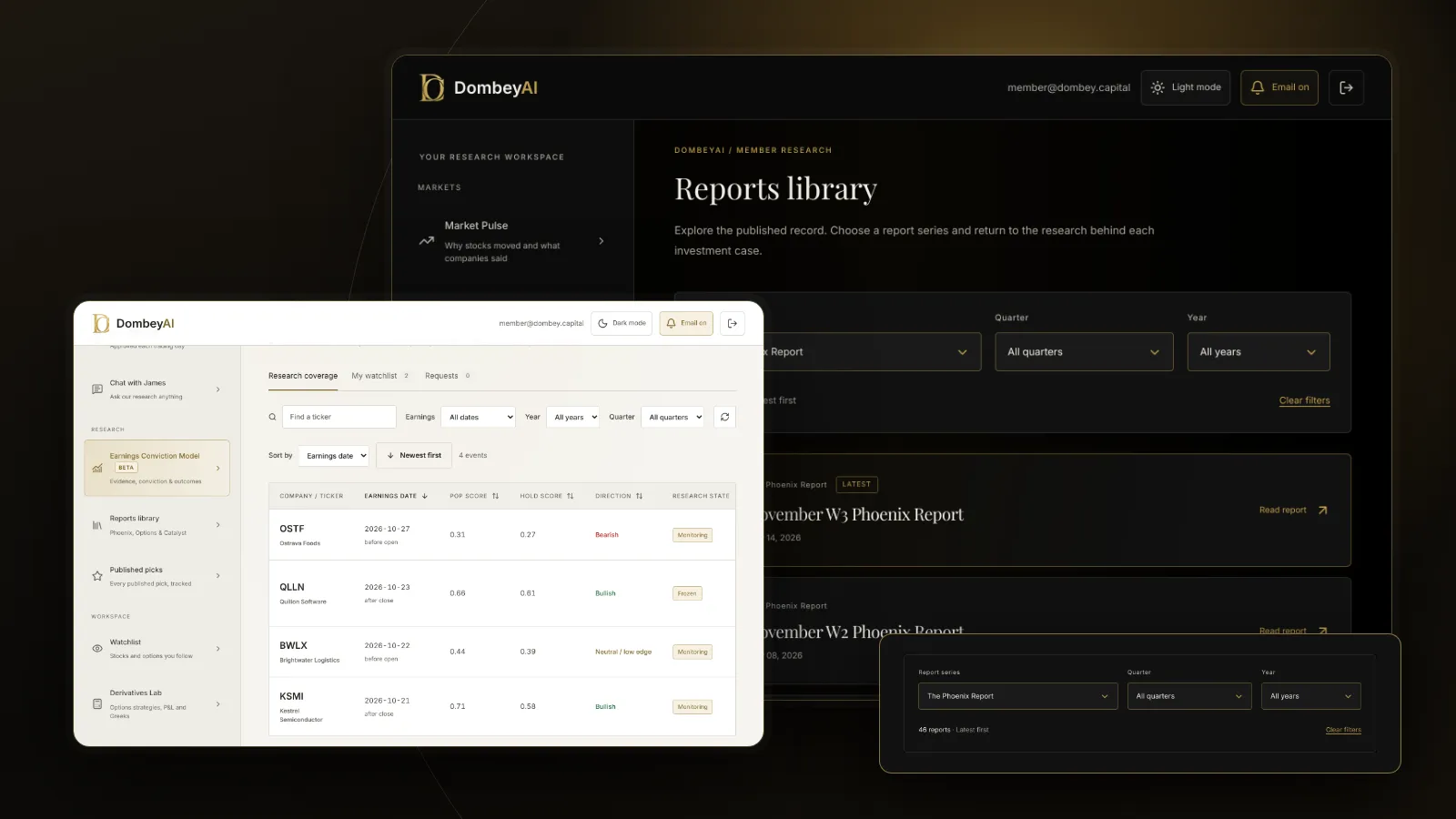


Full disclosure: Dombey Capital is our own research service and our top pick here, for the reasons below. The section on where it falls short is there so you can judge whether it fits your process.
Quick comparison
| Tool | Best for | Key features | Price (as of November 2026) |
|---|---|---|---|
| Dombey Founding MembershipTop pick | Written research on special situations and dated catalysts | Weekly Phoenix Report, weekly Options Research, Catalyst Briefing, DombeyAI Portal with the Daily Phoenix Screener and Earnings Conviction Model | Founding Membership $1,200/year (annual only); Standard Access $80/year or $8/month; Public Archive free |
| Fiscal.ai | Company-level fundamental work | Standardized and as-reported financials, segment and KPI data, source links to filings, transcripts, fund letters, MCP server | See the vendor's pricing page |
| Koyfin | Dashboards, charting and broad monitoring | Ten years of financials and estimates on paid plans, transcripts, stock and ETF screener, custom dashboards | Free; Plus $39/month; Premium $79/month; annual plans save up to 30% |
How we compared these tools
We compared these tools from vendor documentation, pricing pages and public product pages, read on November 16, 2026. We did not run trials of the paid plans. Fiscal.ai's main site did not load for us that day, so its facts come from its developer documentation and its prices are left to its pricing page.
The job is fundamental research on one company ahead of a dated event: building a view of what it earns, what drives it and what a catalyst could change. So the criteria lean toward depth of company data and traceability to filings, not toward market-wide charting.
| Criterion | Weight | What it measures |
|---|---|---|
| Company data depth | 30% | Segment and KPI data, as-reported and standardized statements, history length |
| Traceability to filings | 20% | Whether a figure can be checked against the 10-K or 10-Q quickly |
| Transcripts and qualitative sources | 15% | Earnings call transcripts, investor materials, fund letters |
| Monitoring and screening | 15% | Dashboards, watchlists, screeners, charts |
| Cost and free-tier limits | 20% | Price of the plan you need and what the free level withholds |
If you weight monitoring and charting most, for example because you follow a large watchlist across sectors, Koyfin moves up and may come out ahead.
We gave no weight to claims about data accuracy or investment results. Neither vendor publishes evidence we could check on those points, and we make no such claims here.
Quick picks by job
Best for special situations and dated catalysts: Dombey Founding Membership
Founding Membership is written research, not a data platform. It includes the weekly Phoenix Report, weekly Options Research, the Catalyst Briefing and the DombeyAI Portal with the Daily Phoenix Screener and the Earnings Conviction Model, plus valuation and execution analysis and priority access. It suits readers who want the fundamental work on a stock catalyst already done and published before the event. Standard Access, at $80 a year, is the lower-cost option with the Biweekly Catalyst Briefing and the public research archive.
Best for company-level fundamental work: Fiscal.ai
Fiscal.ai's documentation describes standardized and as-reported financials with 20 or more annual and 40 or more quarterly periods, segment and KPI data for the largest 2,300 companies globally, and a sourcing feature that links each data point to an image and PDF of the source table. That combination suits building a model from operating drivers and checking it against filings.
Best for dashboards and broad monitoring: Koyfin
Koyfin's pricing page lists unlimited custom dashboards, a stock and ETF screener and premium news on Plus, with up to 50 graphs on Plus and unlimited graphs on Premium. It suits investors who watch many names and want charts and fundamentals on one screen.
Full reviews
1. Dombey Founding Membership
Dombey publishes written research on special situations: stocks priced below cash, below book or cheap on sales, and legal and corporate catalysts. Each thesis is published before its catalyst and kept in the archive. Best for readers who want ideas with dated catalysts and the analysis already done. Founding Membership is $1,200 a year, annual billing only; Standard Access is $80 a year, about $6.67 a month, or $8 a month on monthly billing; the Public Archive is free.
Pros
- Research tied to dated catalysts, published before the event
- Includes the DombeyAI Portal with the Daily Phoenix Screener and Earnings Conviction Model
- Free Public Archive to judge the work first
Cons
- Not a data platform; you cannot pull ten years of any company's financials
- Narrow coverage, focused on special situations
- Short public history
Verdict: The top pick for readers who want written research on special situations, used alongside a data platform.
2. Fiscal.ai
Fiscal.ai provides company financial data for public companies in the US, Canada, the UK and the EU, according to its documentation, which also says coverage expanded to about 55,000 companies including secondary listings. Beyond standard statements, it lists segment and KPI data, earnings call transcripts (with partial coverage noted), fund letters, ownership data, estimates and 30 or more years of daily stock prices. An MCP server lets assistants such as Claude and ChatGPT query the data. The API offers a free trial covering 100 companies and 250 calls a day without a credit card. For platform prices, see the vendor's pricing page.
Pros
- Segment and KPI data for the largest companies, which most low-cost tools lack
- Both as-reported and standardized financials
- Source links from data points back to the filing
- MCP access for AI assistants
Cons
- Segment and KPI coverage is limited to the largest 2,300 companies, so many small caps fall outside it
- Transcript coverage is marked partial in its documentation
- Prices could not be confirmed from its site when we compared
Verdict: The better of the two for detailed company-level fundamental work on larger companies.
3. Koyfin
Koyfin is a market data and analytics platform with a free plan and paid tiers. Its pricing page lists Free at $0 with two years of financials and one year of estimates, two custom dashboards, two watchlists and two screens. Plus, at $39 a month, adds ten years of financials and estimates, the stock and ETF screener, unlimited dashboards, and press releases, filings, transcripts and premium news. Premium, at $79 a month, adds unlimited custom data and formulas. Advisor plans at $209 and $299 a month add model portfolios and mutual fund tools. Annual plans save up to 30%.
Pros
- Clear published prices and a usable free plan
- Strong dashboards and charting for monitoring many names
- Ten years of financials and estimates on Plus
- Full transcript history on paid plans
Cons
- Free plan history is short: two years of financials
- Less focus on segment-level operating data
- Advisor features are priced for professionals
Verdict: The better choice for dashboards, charting and broad monitoring at a published price.
Where Dombey falls short
Dombey is not a data platform. You cannot screen the market on your own criteria, pull a decade of any company's statements or build your own dashboards in it. Coverage is narrow, centered on special situations and dated catalysts. The team is small, the author writes under a pen name and the public history is short. If you want to build your own models from raw data, use Fiscal.ai or Koyfin, with or without Dombey.
Free vs paid
Koyfin's free plan is enough to look up a company's last two years and chart prices. Fiscal.ai's free API trial covers 100 companies, which suits testing its data in a spreadsheet or through an assistant. SEC EDGAR is free and holds the filings both draw on; how to search SEC EDGAR filings covers the method.
Paid plans earn their cost when you need long histories, segment data or many screens. Dombey's Public Archive is free; Founding Membership at $1,200 a year adds the weekly Phoenix Report, weekly Options Research and the DombeyAI Portal, and Standard Access at $80 a year is the lower-cost option.
How to choose
| Your situation | Pick | Add later when |
|---|---|---|
| You want research on dated catalysts done for you | Dombey Founding MembershipTop pick | You want to build your own models: Fiscal.ai |
| You build models from segment and KPI data | Fiscal.ai | You want dashboards across many names: Koyfin |
| You monitor a large watchlist across sectors | Koyfin | You need deeper company data: Fiscal.ai |
| You are on a tight budget | Koyfin's free plan, EDGAR and Dombey's Public Archive | You use the data daily enough to justify a paid plan |
If you are weighing other platforms, see our lists of Fiscal.ai alternatives and Koyfin alternatives, and our comparison of Koyfin, TIKR and Stock Rover. For written research rather than data, our guide to the best stock picking services compares the main options.
Where this goes wrong
Standardized data is convenient and sometimes wrong for unusual companies. Holding companies, spin-offs and businesses with large one-off items often need the as-reported figures, and the footnotes, before any ratio is trusted. Check key numbers against the filing itself; how to read the footnotes in a 10-K shows where the adjustments hide. And no platform tells you whether an event is mispriced; that comes from your own analysis.
The bottom line
Our top pick is Dombey's Founding Membership for written research on special situations and dated catalysts, with a free archive to judge it first. Between the two platforms, Fiscal.ai is the better fit for company-level fundamental work, with segment and KPI data and source links to filings, though you should check its current prices on its own page. Koyfin is the better fit for dashboards, charting and broad monitoring, with a free plan and Plus at $39 a month. Both are data tools, and the judgment stays with you.