



Full disclosure: Dombey Capital is our own research service and our top pick here, for the reasons below. The section on where it falls short is there so you can judge whether it fits your process.
What Fiscal.ai does, and why people look elsewhere
Fiscal.ai is the company data platform formerly called FinChat. It pairs a research terminal and an AI assistant with a data API. We could not load its pricing or terminal pages on the publish date, so the facts below come from its API documentation, which it publishes openly.
That documentation lists standardized and as-reported financials with more than 20 annual and 40 quarterly periods of history, stock prices going back more than 30 years, and estimates, news, fund letters and about 3 years of ownership data for US-listed companies. Its segment and KPI history covers 12 or more annual and 24 or more quarterly periods for the largest 2,300 companies globally by market cap, with coverage marked partial. Transcripts are structured where a call was held, and coverage is partial and limited to English-language earnings events. Geographic coverage spans the US, Canada, US ADRs, the UK and the EU, and varies by data type. An API key starts a free trial with no credit card.
People rarely leave Fiscal.ai because it lacks data. The usual reasons are narrower: they want dashboards and portfolio tools, a lower bill for the one feature they use, live earnings calls and slides, ratings or written analysis, or coverage of events that a data table does not explain. Name that feature first.
| What you use Fiscal.ai for | Closest replacement here | What you give up |
|---|---|---|
| Financials and estimates in one place | Koyfin | Fiscal.ai's segment and KPI history |
| Long histories and transcripts on a budget | TIKR | An AI assistant |
| Clean statements and business metrics, cheaply | Stock Analysis | Estimate and transcript depth |
| Calls, slides and AI on IR material | Quartr | Published pricing |
| A view on whether a stock is cheap | Morningstar Investor, Seeking Alpha Premium | Raw data depth |
| The original numbers | SEC EDGAR | Any chart, ratio or summary |
| Research on events with a date | Dombey CapitalTop pick | Data on every stock |

If AI is the reason you use Fiscal.ai, our 10 best AI stock research tools covers that field directly. This page is for investors who want the company data and the best tool for the job Fiscal.ai is not doing for them.
Quick comparison
| Tool | Best for | Key features | Price (as of October 2026) |
|---|---|---|---|
| Dombey CapitalTop pick | Investors in special situations and dated catalysts | Founding Membership: weekly Phoenix Report, weekly Options Research, Catalyst Briefing, DombeyAI Portal with the Daily Phoenix Screener and Earnings Conviction Model; Standard Access: Biweekly Catalyst Briefing and public-research archive | Founding Membership $1,200/year; Standard Access $80/year or $8/month; Public Archive free |
| Koyfin | A like-for-like data swap with dashboards | 10Y financials and estimates, transcripts, filings, unlimited screens on Plus; free plan with 2Y financials and 2 screens | Free; Plus $39/month, Premium $79/month; annual plan saves up to 30% |
| TIKR | Long histories and transcripts on a budget | Global data on paid plans, up to 30Y financials, 5Y estimates and full transcript history on Ultimate | Free (US); Plus $24.95, Pro $54.95, Ultimate $119.95 a month |
| Stock Analysis | Low-cost statements and business metrics | 10 to 40 years of financial history, business metrics on 50,000+ stocks, 150,000+ global stocks and funds | Free; Pro $99/year or $9.99/month; Unlimited $16.58/month billed annually |
| Quartr | First-party IR material: calls, slides, transcripts | Live earnings calls, transcripts, slides and filings with AI on 50M+ first-party documents; free mobile app | Free app; Pro: see the vendor's pricing page |
| Seeking Alpha Premium | Quant ratings and AI summaries | Data-driven ratings and screeners, Virtual Analyst Reports, Earnings Call Insights, analysis on 4,000+ stocks and ETFs | $299/year plus taxes |
| Morningstar Investor | Fair value estimates and analyst reports | Fair value and competitive advantage ratings, screener with 200+ data points, alerts on rating changes | $249/year or $34.95/month; 7-day free trial |
| SEC EDGAR | The original filings | Every US public company filing; full-text search since 2001 | Free |
How we compared these tools
We compared these tools from vendor documentation, pricing pages and public product pages, read on the publish date. We did not subscribe to each service for this article, and we make no claims about the accuracy of any vendor's data, AI answers or ratings.
| Criterion | Weight | What it measures |
|---|---|---|
| Fit for dated events | 25% | Whether the tool helps when a stock's value depends on an earnings report, spin-off, deal, vote or filing date |
| Depth of company data | 25% | Years of financials, segments and KPIs, estimates and transcripts, and how close they sit to the filings |
| Source traceability | 15% | Whether a figure or AI answer leads back to the filing, release or call it came from |
| Free plan usefulness | 15% | What you can do without paying |
| Price and terms | 20% | List prices, trials and refund terms from the vendor's own pages |
The weights favor event fit and data depth because those matter most for special situations and dated catalysts, where a historical series is weakest. If you never trade around events and mainly want the most data per dollar, weight depth and price more heavily, and Koyfin, TIKR and Stock Analysis move up the order.
Quick picks by job
Best for special situations and dated catalysts: Dombey Capital
Fiscal.ai shows what a company has reported and lets you ask questions about it. Dombey starts from an event with a date, such as an earnings report, a spin-off distribution, a shareholder vote or a tender offer deadline, and publishes a thesis before it. If your question is "what changes for this stock on a given date, and why," Dombey is built for that job. It does not replace a data platform, so keep one next to it.
Best like-for-like data replacement: Koyfin
Koyfin's Plus plan lists 10 years of financials and estimates, transcripts, filings, press releases and unlimited screens and watchlists for $39 a month. It adds dashboards, charting and portfolio tools. Our Koyfin alternatives piece covers the same field from Koyfin's side.
Best for long histories on a budget: TIKR
TIKR's Plus plan starts at $24.95 a month with global data and 10 years of financials. Ultimate lists 30 years of financials, 5 years of estimates and full transcript history. Our TIKR alternatives page compares it with the rest.
Best for low-cost statements and business metrics: Stock Analysis
Stock Analysis Pro lists 10 to 40 years of financial history and business metrics history on more than 50,000 stocks, for $99 a year. It suits investors who used Fiscal.ai mainly for statements and a few operating metrics.
Best for first-party IR material: Quartr
Quartr is built on what companies publish themselves: live earnings calls, transcripts, slides and filings, with an AI layer whose outputs trace back to the source document. It suits investors who used Fiscal.ai's chat mainly to read calls and presentations.
Best for quant ratings: Seeking Alpha Premium
Seeking Alpha Premium adds data-driven stock ratings and screeners from its Quant System, plus Virtual Analyst Reports and Earnings Call Insights. See our Seeking Alpha alternatives for the wider field.
Best for fair value estimates: Morningstar Investor
Morningstar Investor pairs a fair value estimate and a competitive advantage rating with analyst reports. It suits investors who want a written view of what a business is worth, not only its history.
Best for the original numbers: SEC EDGAR
Every figure on Fiscal.ai starts in a filing or a release. EDGAR holds the 10-K, 10-Q, 8-K and proxy for every US public company, free, with full-text search since 2001.
Full reviews
1. Dombey Capital
What it does. Dombey Capital publishes independent research on special situations and event-driven equities: stocks priced below cash or book, companies cheap on sales, spin-offs, deal spreads, earnings catalysts, and legal and corporate events. It is written research, not a data terminal or a chat tool. Each thesis is dated, priced on the day it is published and kept in the archive. There are three access levels:
- Founding Membership ($1,200 a year, annual billing only): the weekly Phoenix Report, weekly Options Research, the Catalyst Briefing, the DombeyAI Portal with the Daily Phoenix Screener and the Earnings Conviction Model, valuation and execution analysis, and priority access.
- Standard Access ($80 a year, about $6.67 a month, or $8 a month on monthly billing), the lower-cost option: the Biweekly Catalyst Briefing on forthcoming corporate and market events, plus the complete public-research archive.
- Public Archive (free): published executive theses and public research.
Best for. Investors whose process starts from a dated event. If you are new to the style, what is a stock catalyst covers the basics, and net cash per share explains a measure a KPI dashboard does not put in context.
Pricing. Founding Membership $1,200 a year. Standard Access $80 a year or $8 a month. Public Archive free. See the subscription options.
Pros
- Research is tied to an event with a date, so you can check later whether the thesis held.
- Valuation work is written out, including what the case depends on.
- Founding Membership adds options research and the Earnings Conviction Model; Standard Access is a low-cost entry point.
Cons
- No financials, segment data, estimates or transcripts on every stock.
- No AI chat over company filings.
- Founding Membership costs more than most single plans on this list.
Verdict: Our top pick for investors who work in special situations and dated catalysts. Keep a data platform alongside it.
2. Koyfin
What it does. Koyfin is a market data, charting and dashboard platform. The free plan lists 2 years of financials, 1 year of estimates, 2 watchlists and 2 screens. Plus lists 10 years of financials and estimates, a stock and ETF screener, more than 100,000 global company snapshots, press releases, filings and transcripts, with unlimited watchlists and screens. Premium adds advanced portfolio analytics, custom data and formulas, and custom financial templates. Koyfin offers a full refund if you tell it within 30 days.
Best for. Fiscal.ai users who want the core financials and estimates with dashboards and portfolio tools.
Pricing. Free plan. Plus $39, Premium $79, Advisor Core $209 and Advisor Pro $299 a month as listed; the page says an annual plan saves up to 30%.
Pros
- 10 years of financials and estimates from the first paid plan.
- Transcripts, filings and press releases in the same place.
- A usable free plan and a 30-day refund window.
Cons
- The pricing page does not list a segment and KPI database or an AI assistant.
- Fiscal.ai's documentation lists a longer financial history.
Verdict: The closest replacement for most Fiscal.ai users who came for the data rather than the chat.
3. TIKR
What it does. TIKR is a fundamental data platform. The free plan covers US stocks with 5 years and 8 quarters of financials, 1 year of estimates and a 90-day transcript history. Plus adds global data, 10 years of financials and 2 years of estimates. Pro lists 10 years of transcripts and 4 years of estimates. Ultimate lists 30 years of financials, 5 years of estimates and full transcript history. TIKR lists a 14-day money-back guarantee for new users.
Best for. Investors who want long histories and transcripts at a low monthly price.
Pricing. Free (US). Plus $24.95, Pro $54.95 and Ultimate $119.95 a month. Annual billing is offered; see the vendor's pricing page for annual prices.
Pros
- The lowest paid entry price among the data platforms here.
- Up to 30 years of financials on Ultimate.
- A free plan with no credit card.
Cons
- The pricing page does not mention AI features.
- Estimate depth is short on the cheaper plans.
Verdict: The best budget pick for history and transcripts. For a direct three-way view, see Koyfin vs TIKR vs Stock Rover.
4. Stock Analysis
What it does. Stock Analysis is a financial data site covering more than 150,000 global stocks and funds. Pro lists 10 to 40 years of financial history, 10 to 50 years of dividend history, business metrics history on more than 50,000 stocks, saved screeners, 300+ indicators, up to 100 active alerts and one download a day to Excel, CSV or Google Sheets. Unlimited removes the download, watchlist and alert caps.
Best for. Investors who mainly read statements and a few operating metrics and want a long history for little money.
Pricing. Free account. Pro $99 a year ($8.25 a month billed annually) or $9.99 a month. Unlimited $16.58 a month billed annually. A 60-day money-back guarantee on paid plans.
Pros
- Long histories and business metrics at one of the lowest prices here.
- Plain tables that are quick to read.
- A long money-back window.
Cons
- Estimate and transcript depth are not the focus.
- One download a day on Pro.
Verdict: The best budget swap if Fiscal.ai's statement and metric tabs were all you used.
5. Quartr
What it does. Quartr builds on first-party investor relations material. Quartr Pro describes itself as AI for company research across live calls, transcripts, slides and filings, with global live coverage of earnings calls, capital markets days and conferences. Quartr says each AI output is traceable to its source, backed by more than 50 million first-party documents, and that it tracks changes in messaging, KPIs and strategic focus over time. Its homepage gives coverage of 16,150+ companies in one place and 17,000+ in another. A Quartr MCP connection for AI tools is included with Pro.
Best for. Investors who listen to calls live, read slides and want AI answers that cite the company's own documents.
Pricing. A free mobile app. Quartr Pro and the API are priced through sales; see the vendor's pricing page.
Pros
- Live calls, transcripts, slides and filings in one place.
- AI outputs tied to the source document.
- A free mobile app to start.
Cons
- No published price for Pro.
- Built around IR material, not standardized financial statements.
Verdict: The best pick if you used Fiscal.ai mainly to work through earnings calls and decks. Our list of the best earnings call transcript tools compares it with other transcript sources, and how to analyze an earnings call transcript shows what to read for.
6. Seeking Alpha Premium
What it does. Seeking Alpha Premium adds data-driven stock ratings and screeners from its Quant System, in-depth analysis on over 4,000 stocks and ETFs, and AI tools including Virtual Analyst Reports and Earnings Call Insights.
Best for. Investors who want ratings, contributor analysis and AI summaries next to their own numbers.
Pricing. $299 a year plus applicable taxes. See the vendor's pricing page for any monthly option.
Pros
- Ratings, screeners and AI summaries in one plan.
- A large library of written analysis.
- AI summaries of earnings calls.
Cons
- The help page does not list financial history or KPI depth.
- Contributor views vary in quality and approach.
Verdict: A complement to a data platform, not a replacement for Fiscal.ai's tables. Our Seeking Alpha vs Motley Fool vs Morningstar vs Dombey comparison sets it against the other research services.
7. Morningstar Investor
What it does. Morningstar Investor gives covered stocks a fair value estimate and a competitive advantage rating, with analyst reports, commentary and news on thousands of securities. It includes a screener with more than 200 data points, portfolio tools, watchlists and alerts on rating changes and analyst notes.
Best for. Investors who want an analyst's view of what a business is worth.
Pricing. $249 a year (about $20.75 a month) or $34.95 a month, with a seven-day free trial.
Pros
- A fair value estimate you can read and question.
- Alerts when a rating or note changes.
- Fund research in the same plan.
Cons
- No free plan.
- A fair value built for an ongoing business can lag a company that is splitting or selling assets.
Verdict: The best pick for written valuation views. See our Morningstar alternatives for other options.
8. SEC EDGAR
What it does. EDGAR is the SEC's public database of company filings. Every 10-K, 10-Q, 8-K, proxy statement and Form 10 is there, and full-text search covers electronic filings since 2001. The segment note in a 10-K and the KPI tables in an earnings release filed on an 8-K are where most platform figures start. Our guide on how to search SEC EDGAR filings walks through it.
Best for. Anyone who wants a number, a segment definition or a KPI from the source.
Pricing. Free.
Pros
- The primary source for every US public company.
- Footnotes and definitions that data platforms often compress.
- Nothing to subscribe to.
Cons
- No charts, ratios, estimates or AI answers.
- Reading filings takes time.
Verdict: Essential next to any tool on this list, and the place to check any figure an AI assistant gives you.
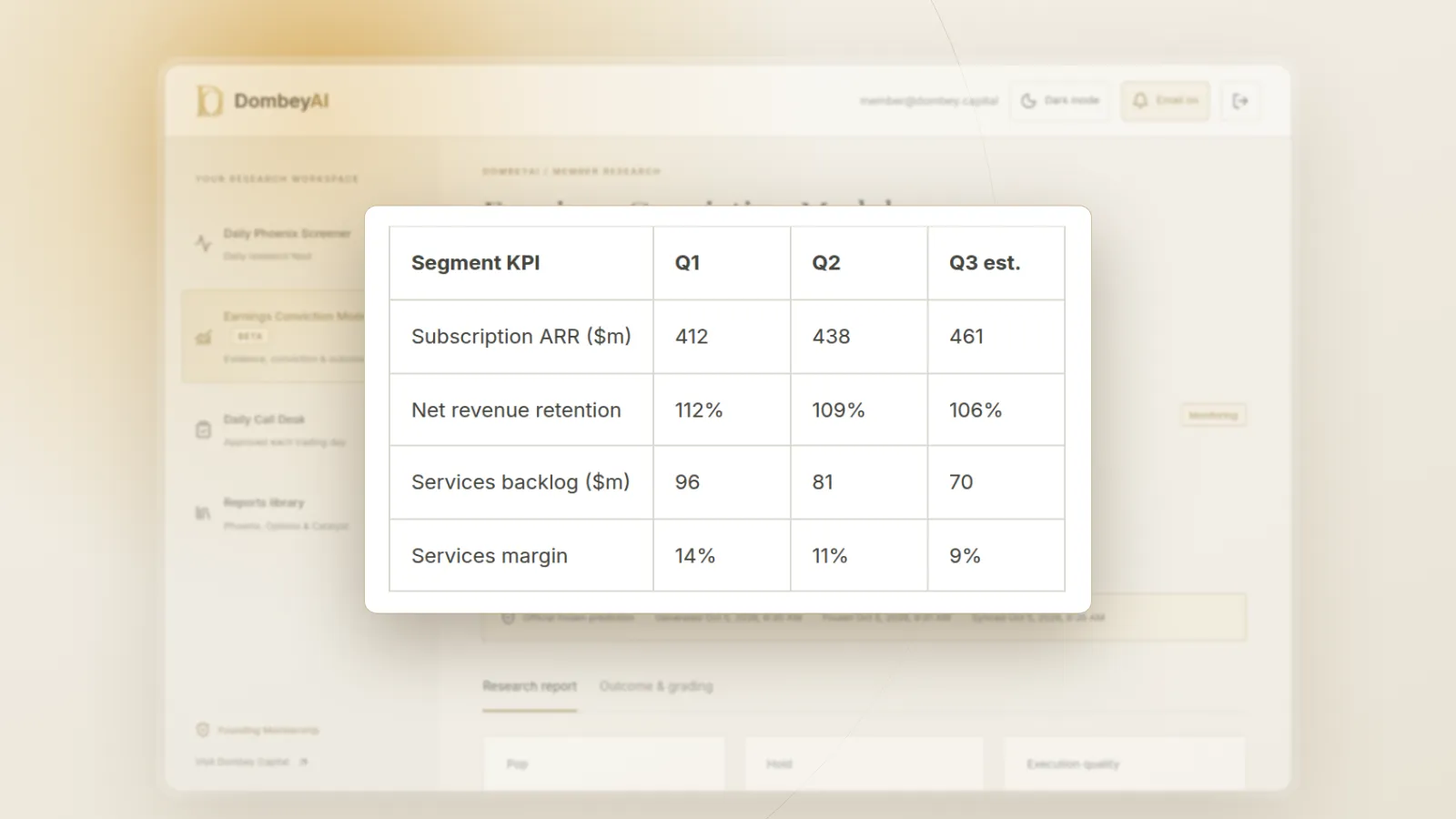
A worked example: when a KPI series misleads
A deeper data platform does not fix this, and neither does a faster AI answer. A standardized KPI history is only as consistent as the definitions behind it, and companies change them. The fix is in the filing: read the definition, compare it with the prior quarter's, and check the date of the change against the date of the consensus you are reading. How to read an earnings release shows where those definitions sit.
Where Dombey falls short
- Narrow coverage. Dombey covers special situations and catalyst-driven stocks. There are no financials, segment data or transcripts on thousands of companies and no general screener for the whole market.
- No broad data terminal. There are no statement databases, KPI histories, estimate series, charting tools or AI chat of the kind Fiscal.ai, Koyfin or TIKR offer.
- Small team. Output is limited by how many situations a small team can research properly.
- Pen-name author. Research is published under the name James Whitfield, a pen name. Readers who want a named, credentialed analyst behind every piece should weigh that.
- Short history. The public record is young. The archive keeps every thesis with its date and price, but a short record says less than a long one.
Free vs paid
You can cover a lot without paying. Koyfin's free plan lists 2 years of financials and 1 year of estimates. TIKR's free US plan lists 5 years of financials and a 90-day transcript history. Stock Analysis has a free account, Quartr has a free mobile app, SEC EDGAR is free, and Dombey's Public Archive is free. Fiscal.ai's API documentation says a key starts a free trial with no credit card.
What paid plans add:
- Longer histories and estimates (Koyfin Plus, TIKR's paid plans, Stock Analysis Pro).
- Full transcript history (TIKR Ultimate) and live IR material (Quartr Pro).
- Ratings, AI summaries and written analysis (Seeking Alpha Premium, Morningstar Investor).
- Dated catalyst research and options work for special situations (Dombey Founding Membership, with Standard Access as the lower-cost option).
How to choose
| Your situation | Pick | Add later when |
|---|---|---|
| You invest in earnings catalysts, spin-offs or deal spreads | Dombey CapitalTop pick | You want statements on every stock: add Stock Analysis |
| You want Fiscal.ai's financials with dashboards | Koyfin | You start holding event-driven positions: add Dombey Founding Membership, or Standard Access as the lower-cost option |
| You want long histories at a low price | TIKR | You want live calls and slides: add Quartr |
| You read statements and metrics and want a low bill | Stock Analysis | You want estimates: add Koyfin |
| You work mostly from calls and decks | Quartr | You want standardized statements: add TIKR |
| You want a second opinion on each stock | Seeking Alpha Premium or Morningstar Investor | You need event coverage between reports: add Dombey Capital |
- If you mostly used Fiscal.ai for financials and estimates, start with Koyfin.
- If you mostly used it for transcripts, start with TIKR or Quartr.
- If you mostly used it for statements and a few metrics, start with Stock Analysis.
- If your question is what happens on an event date, start with Dombey Capital.
If earnings dates drive your process, the best earnings calendar and catalyst tools covers how to track them.
The bottom line
Dombey Capital is our top pick for investors who work in special situations and dated catalysts, with Founding Membership for the full research and portal and Standard Access as the lower-cost option. It is written research, not a data terminal, so pair it with one. For Fiscal.ai's own job, Koyfin is the closest swap, TIKR is the budget pick for long histories, Stock Analysis is the cheapest route to statements and business metrics, and Quartr is strongest on first-party IR material. Whatever you choose, check a KPI's definition in the filing on SEC EDGAR before you trust its trend.