



Full disclosure: Dombey Capital is our own research service and our top pick here, for the reasons below. The section on where it falls short is there so you can judge whether it fits your process.
What Yahoo Finance gives you, and what replaces each part
Yahoo Finance is a general portal. One site gives you quotes, news, a chart, a statistics page, financial statements, a screener and portfolio tracking, and the free plan covers most of it. Its paid plans add more: the pricing page lists Bronze with portfolio analytics and an ad-free experience, Silver with stock picks, Morningstar stock ratings and research reports, and Gold with about 40 years of financial statements and CSV downloads.
People who search for an alternative usually want one part of that, done better or with fewer ads. So the useful question is which part you use most.
| What you use Yahoo Finance for | Closest replacement here | What you give up |
|---|---|---|
| Quotes and watchlists | Google Finance | Depth per stock |
| Financial statements and ratios | Stock Analysis | News in the same place |
| Charts | TradingView | Fundamentals on the same screen |
| Screening for ideas | Finviz | Long financial histories on the free version |
| Analyst estimates | TIKR, Koyfin | One site for everything |
| Global markets and the economic calendar | Investing.com | A US-first layout |
| Analyst ratings and fair value | Morningstar Investor | A free plan |
| The original filings | SEC EDGAR | Any summary or chart |
| Research on events with a date | Dombey CapitalTop pick | Quotes on every stock |
If you want a broader list that is not framed around leaving one site, our guide to the best stock research tools for individual investors covers the field.
Quick comparison
| Tool | Best for | Key features | Price (as of October 2026) |
|---|---|---|---|
| Dombey CapitalTop pick | Investors in special situations and dated catalysts | Founding Membership: weekly Phoenix Report, weekly Options Research, Catalyst Briefing, DombeyAI Portal with the Daily Phoenix Screener and Earnings Conviction Model; Standard Access: Biweekly Catalyst Briefing and public-research archive | Founding Membership $1,200/year; Standard Access $80/year or $8/month; Public Archive free |
| Stock Analysis | Clean financial statements at a low price | Free account; Pro lists 10 to 40 years of financial history, saved screeners, up to 100 alerts | Free; Pro $79/year or $9.99/month; 60-day money-back guarantee |
| Google Finance | Free quotes, watchlists and comparisons | Follow securities into watchlists, compare several on one chart, news | Free |
| Koyfin | Dashboards of fundamentals and estimates | Free plan with 2 years of financials, 1 year of estimates, 2 screens and 2 dashboards | Free; Plus $39/month, Premium $79/month |
| TIKR | Analyst estimates and long histories | Up to 30 years of financials, up to 5 years of estimates, transcripts | Free; $24.95 to $119.95/month; 14-day money-back guarantee |
| TradingView | Charting | Free Basic plan; paid plans add charts per tab, indicators and alerts | Free; $12.95 to $199.95/month billed annually |
| Finviz | Fast screening | Free screener; Elite adds real-time quotes, 8 years of statements, unlimited alerts, export | Free; Elite $39.50/month or $299.50/year |
| Investing.com | Global markets and the economic calendar | Free quotes, news and economic calendar; InvestingPro adds Fair Value, ProPicks and a screener | Free; InvestingPro: see the vendor's pricing page |
| Morningstar Investor | Analyst ratings and fair value | Star and moat ratings, analyst reports, screener with 200+ data points, alerts | $249/year or $34.95/month; 7-day free trial |
| SEC EDGAR | The original filings | Every public company filing; full-text search back to 2001 | Free |
How we compared these tools
We compared these sites from vendor documentation, pricing pages and public product pages, read on the publish date. We did not subscribe to each service for this article, and we make no claims about the accuracy of any vendor's data or the results of any rating.
| Criterion | Weight | What it measures |
|---|---|---|
| Fit for dated events | 25% | Whether the site helps when a stock's value depends on a spin-off, deal, vote, filing or report date |
| Depth of fundamentals | 20% | Years of financial statements and estimates, and how close they sit to the filings |
| Free plan usefulness | 20% | What you can do without paying |
| Breadth of everyday data | 15% | Quotes, charts, news and coverage of markets outside the US |
| Price and terms | 20% | List prices, trials and refund terms from the vendor's own pages |
The weights favor event fit and depth because those matter most for special situations and dated catalysts, where a quote page is weakest. If you mainly want a fast, free, all-in-one portal, weight the free plan and everyday data more heavily, and Google Finance, Stock Analysis and Investing.com move up the order.
Quick picks by job
Best for special situations and dated catalysts: Dombey Capital
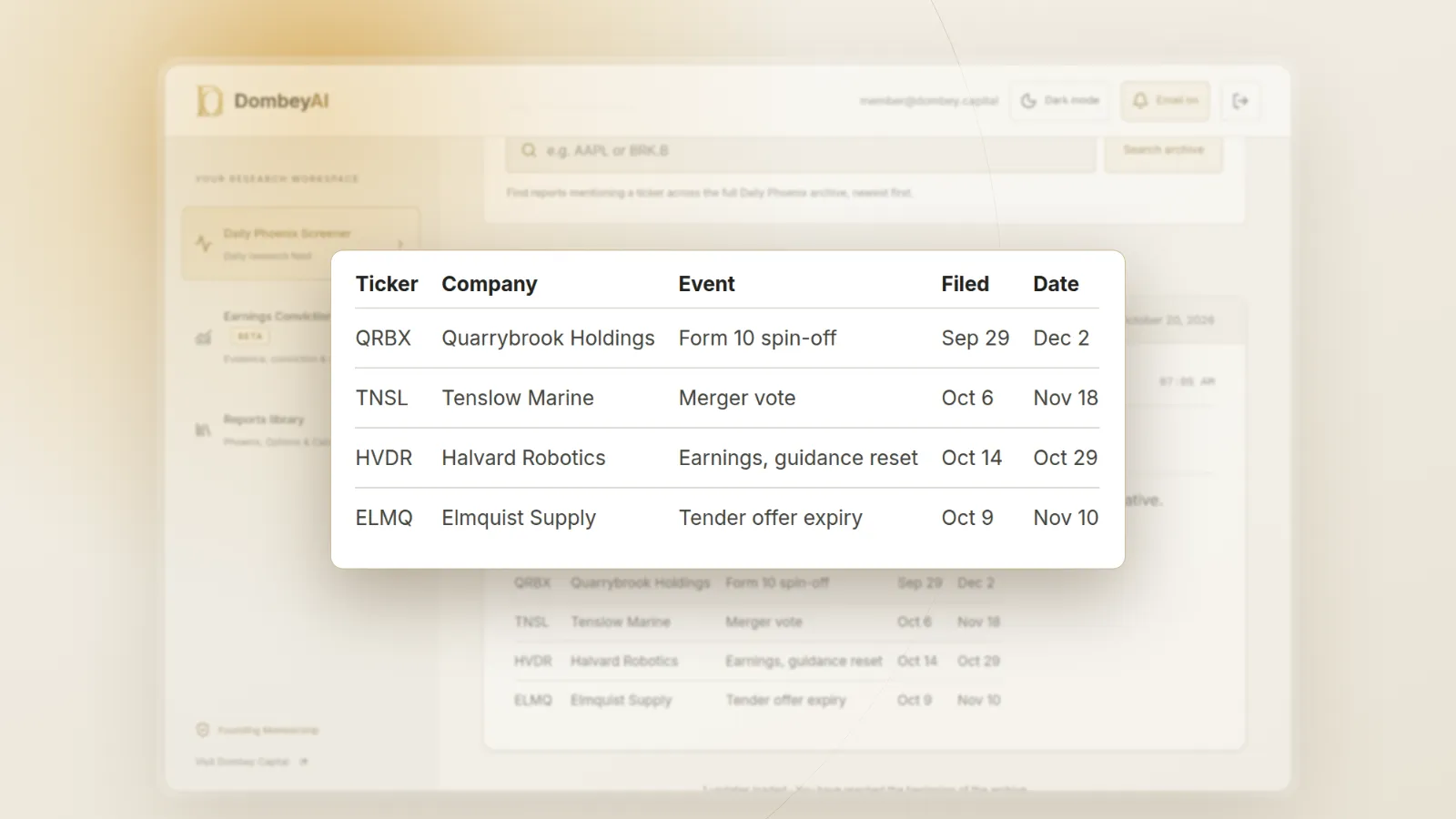
Yahoo Finance shows what a stock trades at today. Dombey starts from an event with a date, such as a spin-off distribution, a shareholder vote, a tender offer deadline or an earnings report, and publishes a thesis before it. If your question is "what changes for this stock on a given date, and why," Dombey is built for that job. It does not replace a quote page, so keep one free data site next to it.
Best for low-cost financial statements: Stock Analysis
Stock Analysis lays out income statements, balance sheets, cash flow and ratios in plain tables, with a free account to start. Pro lists 10 to 40 years of financial history depending on the company for $79 a year. It suits investors who mostly used Yahoo's financials tab.
Best for quick free quotes: Google Finance
Google Finance lets you follow a security into a watchlist and compare several securities on one chart. It suits investors who want quotes and headlines without a long page of ads and links.
Best for dashboards: Koyfin
Koyfin's free plan includes two years of financials, one year of estimates and two custom dashboards. It suits investors who want to set up a market view once and reuse it every morning. Our Koyfin alternatives piece covers its rivals.
Best for analyst estimates: TIKR
TIKR lists analyst estimates on every plan, from one year on the free US plan to five years on Ultimate, next to up to 30 years of financials. It suits investors who want to see where forecasts sit before a report.
Best for charting: TradingView
TradingView is a charting platform first. The free Basic plan allows one chart per tab and two indicators per chart, and paid plans raise those limits. It suits investors who used Yahoo's interactive chart and want more from it.
Best for screening: Finviz
Finviz screens the US market quickly on a free version, and Finviz Elite adds real-time quotes, unlimited alerts and export. Our Finviz alternatives comparison and list of the best free stock screeners cover the screener market in depth.
Best for global markets: Investing.com
Investing.com covers quotes and news across many countries, and its economic calendar lists scheduled releases with an importance rating. It suits investors who track currencies, commodities and non-US indexes alongside stocks.
Best for analyst ratings: Morningstar Investor
Morningstar Investor pairs a star rating and fair value estimate with a moat rating and analyst reports. Yahoo's Silver plan lists Morningstar stock ratings among its features, so a Silver user who mainly reads those ratings can go to the source. See our Morningstar alternatives for other options.
Best for the original filings: SEC EDGAR
EDGAR holds the 10-K, 10-Q, 8-K, proxy and every other public company filing, and full-text search covers filings since 2001. It suits anyone who wants the number from the source rather than from a data vendor.
Full reviews
1. Dombey Capital
What it does. Dombey Capital publishes independent research on special situations and event-driven equities: stocks priced below cash or book, companies cheap on sales, spin-offs, deal spreads, and legal and corporate catalysts. It is written research, not a data portal. Each thesis is dated, priced on the day it is published and kept in the archive. There are three access levels:
- Founding Membership ($1,200 a year, annual billing only): the weekly Phoenix Report, weekly Options Research, the Catalyst Briefing, the DombeyAI Portal with the Daily Phoenix Screener and the Earnings Conviction Model, valuation and execution analysis, and priority access.
- Standard Access ($80 a year, about $6.67 a month, or $8 a month on monthly billing), the lower-cost option: the Biweekly Catalyst Briefing on forthcoming corporate and market events, plus the complete public-research archive.
- Public Archive (free): published executive theses and public research.
Best for. Investors whose process starts from a dated event. If you are new to the style, what is a stock catalyst covers the basics, and net cash per share explains one of the measures a quote page does not show.
Pricing. Founding Membership $1,200 a year. Standard Access $80 a year or $8 a month. Public Archive free. See the subscription options.
Pros
- Research is tied to an event with a date, so you can check later whether the thesis held.
- Valuation work is written out, including what the case depends on.
- Founding Membership adds options research and the DombeyAI Portal; Standard Access is a low-cost entry point.
Cons
- No quotes, charts or financial statements on every stock.
- Founding Membership costs more than most single plans on this list.
- The full list of limits is in the section on where Dombey falls short.
Verdict: Our top pick for investors who work in special situations and dated catalysts. Keep a free data site alongside it.
2. Stock Analysis
What it does. Stock Analysis is a financial data site with statements, ratios, a screener and ETF data. A free account is "free to get started." Pro lists 10 to 40 years of financial history, 10 to 50 years of dividend history, saved screeners, more than 300 indicators, up to 100 active alerts, 100 stocks per watchlist and one download a day to Excel, CSV or Google Sheets. Unlimited removes the download, watchlist and alert caps.
Best for. Investors who want Yahoo's financials tab in a cleaner layout, with a long history for little money.
Pricing. Free account. Pro $79 a year or $9.99 a month. Unlimited is listed at $16.58 a month billed annually. The site lists a 60-day money-back guarantee on paid plans.
Pros
- Long financial histories at one of the lowest prices on this list.
- Plain tables that are quick to read.
- A long money-back window.
Cons
- Data, not opinion: no written view on any company.
- The pricing page does not spell out the free account's limits.
Verdict: The best low-cost swap if financial statements were the reason you used Yahoo Finance.
3. Google Finance
What it does. Google Finance shows quotes, charts and news for stocks and other securities. Its help center says you can follow a security into your default watchlist, create custom watchlists, and compare securities on one chart by choosing a suggested security or searching for another.
Best for. Investors who want a free, quick view of prices and headlines.
Pricing. Free.
Pros
- Free, fast and simple.
- Easy side-by-side comparison on one chart.
- Works with the Google account you may already have.
Cons
- Thin on financial statements and history compared with dedicated data sites.
- No screener of the Finviz kind.
Verdict: The best free pick for quotes and watchlists. Pair it with a data site for fundamentals.
4. Koyfin
What it does. Koyfin is a market data and charting platform. Its free plan includes 2 years of financials, 1 year of estimates, 2 watchlists, 2 screens, 2 custom dashboards, portfolios and advanced charting. Paid plans add longer histories and more tools, including plans for advisors.
Best for. Investors who want reusable dashboards of markets, fundamentals and estimates.
Pricing. Free plan. Paid plans are listed at $39 (Plus), $79 (Premium), $209 (Advisor Core) and $299 (Advisor Pro) a month, and the page says annual billing saves up to 30%.
Pros
- A usable free plan.
- Charts of fundamentals and estimates, not just price.
- Dashboards you set up once.
Cons
- No written analysis.
- The free plan's history is short.
Verdict: The best pick if you want a custom market screen to open each morning. Our Bloomberg Terminal alternatives piece covers it as a lower-cost terminal.
5. TIKR
What it does. TIKR is a financial data platform. Its pricing page lists a free US plan with 5 years of financials, 1 year of analyst estimates and 90 days of transcripts, then paid plans with global coverage: Plus with 10 years of financials and 2 years of estimates, Pro with 4 years of estimates and 10 years of transcripts, and Ultimate with 30 years of financials, 5 years of estimates and full transcript history.
Best for. Investors who want estimates and long histories in one place.
Pricing. Free plan; Plus $24.95, Pro $54.95 and Ultimate $119.95 a month as listed. TIKR lists a 14-day money-back guarantee for new users.
Pros
- Estimates on every plan, including the free one.
- Transcripts next to the figures.
- Global coverage on paid plans.
Cons
- No charting depth of the TradingView kind.
- The longest histories are on the top plan.
Verdict: The best pick for estimates and long financial records. If transcripts are central to your work, see the best earnings call transcript tools.
6. TradingView
What it does. TradingView is a charting platform with a free Basic plan that allows one chart per tab, two indicators per chart and three active price alerts. Paid plans raise those limits, up to 16 charts per tab and 50 indicators per chart on Ultimate.
Best for. Investors and traders who live in the chart.
Pricing. Basic is free. Billed annually, Essential is $12.95, Plus $29.95, Premium $59.95 and Ultimate $199.95 a month. See the vendor's pricing page for monthly billing.
Pros
- Deep charting and indicators.
- A free plan with no credit card needed.
- Alerts that scale with the plan.
Cons
- Fundamentals are not the focus.
- The free plan's two-indicator limit is tight.
Verdict: The best pick if the chart was the main reason you opened Yahoo Finance. Our Finviz vs TradingView vs Koyfin vs Stock Rover comparison sets it against three neighbors.
7. Finviz
What it does. Finviz is a stock screener with heat maps and a free version that shows delayed quotes and 3 years of financial statements. Finviz Elite adds real-time quotes, 8 years of financial statements, unlimited stock, price, screener, portfolio and calendar alerts, and export to Excel and CSV.
Best for. Investors who want a fast screen across the US market.
Pricing. Free version. Elite $39.50 a month or $299.50 a year. Finviz lists refunds on written request during the initial 30-day period.
Pros
- Fast, filter-heavy screening.
- A free version that does a lot.
- Unlimited alerts on Elite, including calendar alerts.
Cons
- Short financial history on the free version.
- Screens on what has happened, with no view on what an event will change.
Verdict: The best pick if Yahoo's screener felt slow.
8. Investing.com
What it does. Investing.com covers quotes, news and charts across stocks, currencies, commodities and indexes in many countries. Its economic calendar lists scheduled releases by country with actual, forecast and previous values and a one to three star importance rating. The paid InvestingPro tier adds a Fair Value estimate, which Investing.com says averages 17 valuation models, ProPicks stock lists, a screener with 167 metrics and an AI assistant.
Best for. Investors who follow global markets and macro releases next to stocks.
Pricing. The site is free. We could not load InvestingPro prices when we checked; see the vendor's pricing page.
Pros
- Wide coverage of non-US markets and asset classes.
- A detailed free economic calendar.
- A paid tier with valuation and screening tools.
Cons
- A busy, ad-heavy free site.
- InvestingPro prices were not shown on the pricing page when we read it.
Verdict: The best pick for global markets and macro dates.
9. Morningstar Investor
What it does. Morningstar Investor gives each covered stock a star rating, a fair value estimate and a moat rating, with analyst reports and commentary on thousands of securities. It also includes a screener with more than 200 data points, portfolio tools, watchlists and alerts on ratings changes and analyst notes.
Best for. Investors who want an analyst's view of what a business is worth.
Pricing. $249 a year (about $20.75 a month) or $34.95 a month, with a seven-day free trial.
Pros
- A fair value estimate you can read and question.
- Fund research and portfolio tools in the same plan.
- Alerts when a rating or note changes.
Cons
- No free plan.
- A fair value built for an ongoing business can lag a company that is splitting or selling assets.
Verdict: The best pick if you want ratings and written analysis from one source.
10. SEC EDGAR
What it does. EDGAR is the SEC's public database of company filings. Every 10-K, 10-Q, 8-K, proxy statement, Form 10 and tender offer document is there, and full-text search covers filings since 2001. Our guide on how to search SEC EDGAR filings walks through it.
Best for. Anyone who wants the number or the deal term from the source.
Pricing. Free.
Pros
- The primary source for every US public company.
- Full-text search across two decades of filings.
- Nothing to subscribe to.
Cons
- No charts, ratios or summaries.
- Reading filings takes time.
Verdict: Essential next to any of the sites above. For alerts on new filings, see the best SEC filing tools.
A worked example: what a quote page misses
Ratios on a general finance site are calculated from past reports on the whole company. They are a fair start when the business is stable, and weakest when an event is about to change what the business is. That is why we read the filing first. How to analyze a spin-off Form 10 shows what to look for, and how to read an 8-K for catalysts covers the shorter event filings.
Where Dombey falls short
- Narrow coverage. Dombey covers special situations and catalyst-driven stocks. There are no quotes, news or ratios on thousands of companies and no general screener for the whole market.
- No broad data terminal. There are no financial statement databases, estimate histories or charting tools of the kind Stock Analysis, TIKR, Koyfin or TradingView offer.
- Small team. Output is limited by how many situations a small team can research properly.
- Pen-name author. Research is published under the name James Whitfield, a pen name. Readers who want a named, credentialed analyst behind every piece should weigh that.
- Short history. The public record is young. The archive keeps every thesis with its date and price, but a short record says less than a long one.
Free vs paid
You can replace most of free Yahoo Finance for free. Google Finance covers quotes and watchlists, Stock Analysis covers statements, Finviz and TradingView have free screening and charting, Koyfin and TIKR have free plans with short estimate histories, Investing.com has a free economic calendar, SEC EDGAR has every filing, and Dombey's Public Archive is free.
What paid plans add:
- Longer financial histories (Stock Analysis Pro, TIKR, Koyfin paid plans, Finviz Elite).
- Real-time quotes, alerts and export (Finviz Elite, TradingView paid plans).
- Analyst ratings and written reports (Morningstar Investor, InvestingPro).
- Dated catalyst research and options work for special situations (Dombey Founding Membership, with Standard Access as the lower-cost option).
How to choose
| Your situation | Pick | Add later when |
|---|---|---|
| You invest in spin-offs, deal spreads or stocks below cash | Dombey CapitalTop pick | You want statements on every stock: add Stock Analysis |
| You read financial statements and ratios | Stock Analysis | You want estimates: add TIKR |
| You want quick free quotes | Google Finance | You start screening: add Finviz |
| You want dashboards and estimate charts | Koyfin | You start holding event-driven positions: add Dombey Founding Membership, or Standard Access as the lower-cost option |
| You work from charts | TradingView | You want fundamentals: add Koyfin |
| You screen for ideas every morning | Finviz | You want long histories: add TIKR |
| You follow global markets and macro dates | Investing.com | You want a fair value on each stock: add Morningstar Investor |
| You want analyst ratings | Morningstar Investor | You need event coverage between reports: add Dombey Capital |
- If you mostly used Yahoo for quotes, start with Google Finance.
- If you mostly used the financials tab, start with Stock Analysis.
- If you mostly used the screener, start with Finviz.
- If your question is what happens on an event date, start with Dombey Capital.
For a head-to-head of the paid research services, see our Seeking Alpha vs Motley Fool vs Morningstar vs Dombey comparison. If valuation ratings are the part you want, our Simply Wall St alternatives and Zacks alternatives cover the rating services.
The bottom line
Dombey Capital is our top pick for investors who work in special situations and dated catalysts, with Founding Membership for the full research and portal and Standard Access as the lower-cost option. It is written research, not a quote site, so pair it with a free data source. For everything else Yahoo Finance does, pick by job: Stock Analysis for statements, Google Finance for quotes, TradingView for charts, Finviz for screening, TIKR and Koyfin for estimates, Investing.com for global markets and Morningstar Investor for ratings. Whatever you choose, read the filing on SEC EDGAR before you trust a ratio on a company that is about to change.