

Why a public company has to report in the first place
A U.S. company files periodic reports because of one of three sources of obligation under the Securities Exchange Act of 1934.
- Section 12(b). A class of stock listed on a national exchange, such as Nasdaq or the NYSE, is registered under Section 12(b).
- Section 12(g). A company with total assets over $10 million must register a class held of record by 2,000 or more persons, or by 500 or more persons who are not accredited investors.
- Section 15(d). A company that sold securities in a registered offering, for example in an IPO on an S-1, takes on a reporting duty under Section 15(d) even if it never registers under Section 12.
To go dark, a company has to remove every one of these that applies. That is why the process is often a sequence of filings rather than one.
How going dark works, step by step
- Delist, if listed. A listed company first files Form 25 to withdraw its stock from the exchange. The delisting generally takes effect 10 days after filing. Our delisting explainer covers this step and what it does to trading.
- File Form 15 under Rule 12g-4. Once the stock is off the exchange, the company certifies on Form 15 that the class is held of record by fewer than 300 persons, or fewer than 500 where total assets have not exceeded $10 million on the last day of each of the three most recent fiscal years. Termination of registration takes effect 90 days after filing, but the duty to file periodic reports under Section 13(a) is suspended as soon as Form 15 is filed.
- Suspend the Section 15(d) duty. Rule 12h-3 lets the company suspend its 15(d) duty on the same holder tests, also by Form 15, with effect on filing. Two conditions apply: the company must have filed all required reports for the shorter of its three most recent fiscal years and the current year to date, or the period since it began reporting, and the suspension is not available for a fiscal year in which a registration statement for the class became effective or had to be updated.
- Clean up open registration statements. Because of that last condition, companies usually file post-effective amendments to deregister unsold securities on effective registration statements, such as Form S-8 plans for employee stock.
Banks and bank and savings and loan holding companies use a higher count of 1,200 holders under both rules.
The holder of record test
The count is of holders of record, not beneficial owners. Under Rule 12g5-1, shares held of record by a corporation or other organization count as held by one person. Most retail and institutional shares sit in street name, held of record by a depository nominee such as Cede & Co. A company with thousands of owners can therefore have only a few hundred names on its stock ledger.
Companies that are close to the line sometimes cut the count deliberately, with a reverse stock split that cashes out small holders or an odd-lot tender offer. Where a company buys shares in a transaction reasonably likely to produce deregistration, Rule 13e-3 can apply and require a Schedule 13E-3 with fairness disclosure. The going-private guide covers that structure.
Going dark vs. related events
| Event | What happens to shares | SEC reporting | Holders paid? | Key filing |
|---|---|---|---|---|
| Going dark | Stay outstanding, usually move to OTC | Stops | No | Form 15 |
| Delisting only | Stay outstanding, move to OTC | Can continue | No | Form 25 |
| Going private | Acquired by a buyer | Stops after closing | Yes | Schedule 13E-3, merger proxy or tender offer |
| Reverse split cash-out | Small holders cashed out, others stay | Often stops afterward | Small holders only | Proxy and Schedule 13E-3 |
Why companies go dark
The usual reasons are cost and distraction. Audits, Sarbanes-Oxley internal control work, legal review of filings and investor relations all cost money, and for a small company with a thin float the benefit of a public listing may look small by comparison. Other reasons include keeping competitive information private and reducing exposure to securities litigation.
A less charitable reason also exists. A controlling holder may prefer a stock that is hard to value and hard to sell, because minority holders are more likely to accept a low offer later. Going dark can be the first step of a later take-under, in which a buyer offers less than the last traded price.
What changes for shareholders
- Information. No more 10-Ks, 10-Qs or 8-Ks. Our guide to the 10-K lists everything holders stop receiving.
- Insider and proxy rules. Section 16 insider reporting and the SEC proxy rules apply to classes registered under Section 12, so they generally fall away when registration ends. So do Schedule 13D and 13G filings on that class.
- Quotes. Under Rule 15c2-11, as amended in 2020, broker-dealers generally cannot publish quotes for a stock unless current information about the issuer is publicly available. A dark company that publishes nothing can end up with no public quotes at all.
- Liquidity. Spreads widen and some brokers restrict trading in these stocks or charge more for it.
What does not change is state law. A Delaware company, for example, still has to hold annual meetings, and stockholders keep their statutory right to inspect books and records under Section 220. Some dark companies also keep posting annual reports on their own website or on an OTC disclosure platform.
A worked example
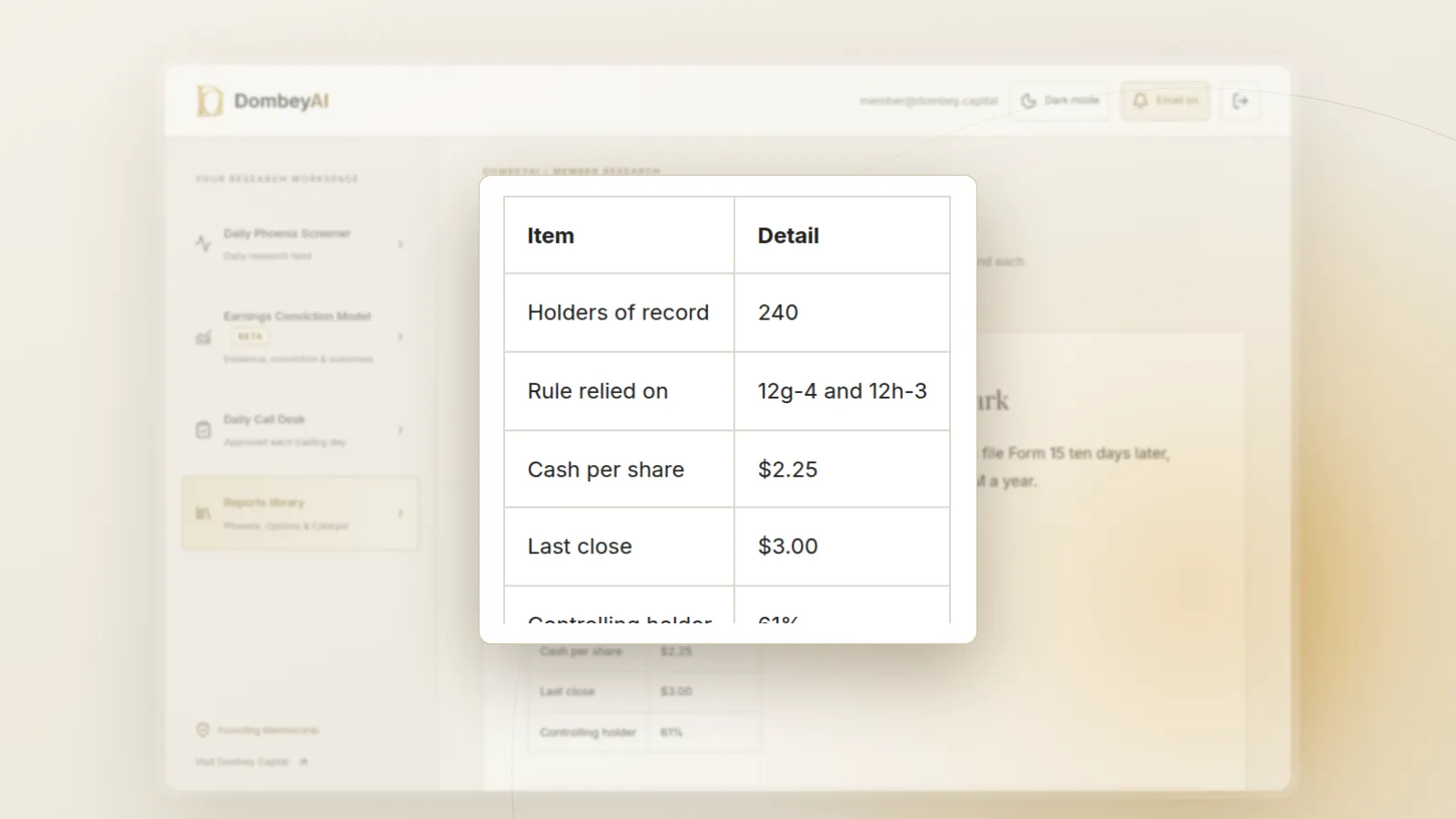
Two readings are possible. On cost alone, saving $1.5 million a year on a $60 million market value is a real gain for holders. But holders have also lost the information they need to check that the $45 million is still there and how it is spent. If the controlling holder later offers $2.00 a share in a cash-out, holders are being asked to accept less than the last reported cash per share, with no current audited figures to argue from. Appraisal rights may be available in a later merger, depending on the structure and state law.
How to research a company that may go dark
- If the holder of record count on the 10-K cover is near 300, read the risk factors and proxy for any mention of deregistration.
- If a proxy asks for a large reverse split with a cash payment for fractions, check whether the stated purpose is to reduce the holder count.
- If a controlling holder owns most of the stock, treat going dark as a step that weakens the minority's position before any later offer.
- If Form 15 is already filed, look for voluntary reports and the company's dividend and buyback policy, since those are the remaining ways value reaches holders.
The EDGAR search guide shows how to find Form 25 and Form 15 filings by company. Going dark is one of many corporate events covered in our overview of special situations, and our list of the best newsletters for special situations covers services that follow these events.
Where this goes wrong
Assuming dark means worthless. Some dark companies are profitable and cash-rich and keep paying dividends. The discount often reflects lost liquidity and information, not lost assets.
Assuming the discount will close. A cheap dark stock can stay cheap for years. With no reports and no quotes, there may be no catalyst at all, which is the classic value trap setup.
Counting owners instead of record holders. A large retail following does not stop a company from qualifying. Only the stock ledger count matters.
Ignoring the 15(d) conditions. A company that recently had a registration statement go effective, or that is behind on its filings, may not be able to suspend its 15(d) duty yet. That timing can delay a planned exit from reporting.
Dombey's published research flags holder of record counts and deregistration language in proxies; see the research archive.
The bottom line
Going dark is a public company ending its SEC reporting by filing Form 15, without buying out its shareholders. It generally requires fewer than 300 holders of record, or fewer than 500 for small companies, and that count excludes most street-name owners. Shareholders keep their stock but lose filings, quotes and liquidity. Read the holder count, the proxy and the controlling holder's position before the Form 15, because after it the information is much harder to get.