

How pension accounting works
A defined benefit plan promises employees a set income in retirement, usually based on salary and years of service. The company sets aside assets in a trust to pay it. Under US GAAP, the company reports two figures:
- The projected benefit obligation (PBO): the present value of benefits earned to date, including the effect of expected salary increases.
- Plan assets: the fair value of the stocks, bonds and other assets in the trust.
The difference is the funded status, and since 2006 companies have recognized it on the balance sheet. A deficit is a liability; a surplus is an asset. Retiree health plans, called other postretirement benefits, work the same way but are often unfunded.
Defined contribution plans such as 401(k)s create no such liability, because the company's obligation ends when it makes the contribution.
Where to find the numbers
The balance sheet shows the net figure. The detail is in the retirement benefits note of the 10-K. The items that matter:
| Item | What it tells you | Where to find it |
|---|---|---|
| Benefit obligation (PBO) | What is owed in present value terms | Note: change in benefit obligation table |
| Fair value of plan assets | What the trust holds | Note: change in plan assets table |
| Funded status | Assets less obligation | Note and balance sheet |
| Discount rate | Rate used to value the obligation | Note: assumptions table |
| Expected return on assets | Return assumed in pension cost | Note: assumptions table |
| Expected contributions | Cash the company plans to put in next year | Note, often one sentence |
| Expected benefit payments | Cash paid to retirees, next ten years | Note: estimated future payments table |
| Asset allocation | Share in equities, bonds and other assets | Note: plan asset table |
Read US and non-US plans separately where the note splits them. Some countries do not require funding, so a deficit there may be paid directly from company cash as benefits come due.
How underfunding affects equity value
The deficit is a fixed claim that ranks ahead of the shareholders, so it belongs with debt in a valuation. Two adjustments follow.
- Enterprise value and multiples. Add the after-tax deficit to enterprise value. If you do, make sure the earnings measure excludes the non-service pension cost, or you count the burden twice.
- Equity value from a DCF. Subtract the after-tax deficit from enterprise value along with net debt, as you would in any discounted cash flow model.
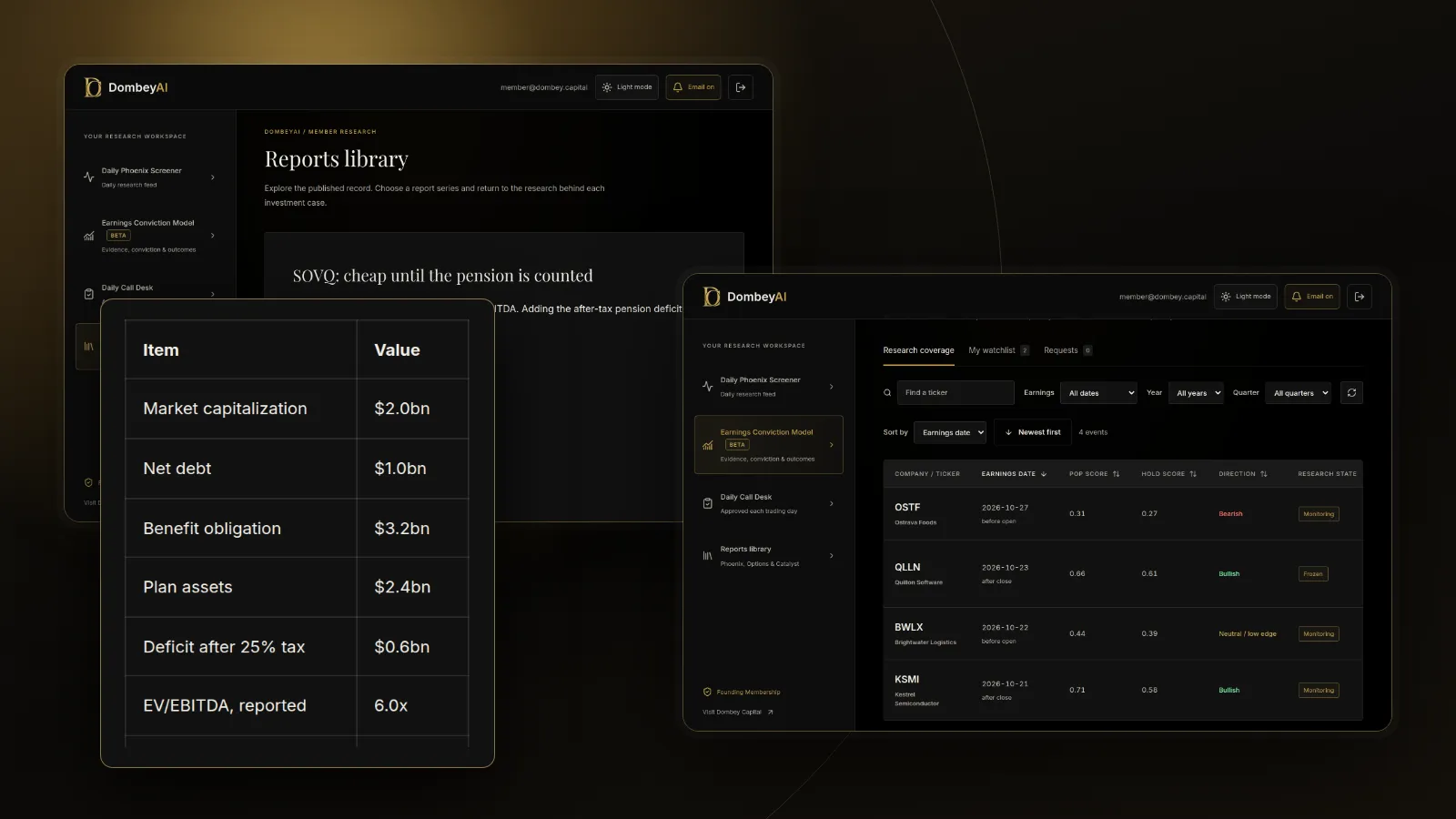
The tax adjustment matters. Contributions to qualified US plans are generally deductible, so a $1bn deficit at a 25% tax rate costs about $750m after tax. Some analysts use the full figure for conservatism; the choice should be consistent across companies you compare.
That adjustment is the reason pension-heavy companies often screen as cheap on EV/EBITDA and on leverage ratios. A debt-to-equity ratio that ignores the pension understates how much ranks ahead of the stock.
Discount rates and why the deficit moves
The obligation is a present value, discounted at a rate based on yields of high-quality corporate bonds with maturities that match the benefit payments. Because those payments run for decades, the obligation is sensitive to the rate. A plan with a duration of 12 years sees its obligation change by roughly 12% for each one percentage point move in the discount rate.
Plan assets do not always move the same way. A plan invested mainly in equities can see its assets fall while falling rates raise its obligation, which is the worst case. Plans that match their bond holdings to the liability, known as liability-driven investing, move more closely with it.
This is why funded status can swing sharply with interest rates. Many US corporate plans improved as rates rose in 2022, without any extra contributions. A deficit measured at a low discount rate is not the same economic burden as one measured at a high rate, so note the rate alongside the deficit.
Pension cost and earnings quality
The income statement shows net periodic pension cost, which includes:
- Service cost: benefits earned by employees this year, reported in operating expenses.
- Interest cost: the unwinding of the discount on the obligation.
- Expected return on plan assets: a credit based on an assumed rate, not the actual return.
- Amortization of past gains, losses and plan amendments.
Since 2018, US GAAP has required the non-service components to sit outside operating income. A high expected return assumption can turn the total into pension income, which lifts net income without any cash coming in. Check the expected return against the plan's actual asset mix, and compare the cash contributions in the cash flow statement with the expense. Cash contributions are set by funding rules under US law, not by the accounting expense.
Comparing companies across standards
Companies reporting under IFRS use IAS 19, which differs from US GAAP in one way that matters for earnings: it applies the same discount rate to plan assets as to the obligation, so there is no separate expected return assumption that can inflate pension income. The balance sheet deficit is measured in a similar way. When you compare a US company with a European or Japanese peer, adjust both to the same basis: after-tax deficit in enterprise value, service cost in operating expenses and the financing components excluded from EBITDA.
Retiree health obligations deserve the same treatment. They are usually unfunded, so the whole obligation is a debt-like claim, though companies can often change these benefits more easily than pensions.
Where this goes wrong
- The obligation is an estimate. Mortality tables, salary growth and the discount rate all move it. Two companies with similar plans can report different figures from different assumptions.
- A deficit is not due tomorrow. Funding rules spread contributions over years, and benefit payments run for decades. A large deficit with a long payment schedule is a smaller near-term burden than one with heavy contributions due soon, which is why the expected contributions and the debt maturity profile should be read together.
- Surpluses are not freely available. A US plan surplus generally cannot be taken back by the company without heavy tax, so a surplus is worth less to shareholders than a deficit of the same size costs them.
- Plan changes move the number. Freezes, lump-sum offers and annuity buyouts, known as pension risk transfer, can shrink or remove the obligation, often at a cost.
For tools that put pension notes and other balance sheet items side by side, see our list of the best stock research tools for individual investors. Dombey's published research adjusts for pensions and other debt-like items before each catalyst; see the research archive.
The bottom line
An underfunded pension is a debt-like claim that ranks ahead of shareholders, and most valuations should add the after-tax deficit to enterprise value or subtract it from equity value. The figures that matter are in the retirement benefits note: the obligation, plan assets, discount rate, expected contributions and benefit payments. Read the deficit together with the rate it was measured at and the cash schedule to close it, because a stock that looks cheap on reported multiples can be fully priced once the pension is counted.