

The ROE formula
ROE = net income / average shareholders' equity
Use average equity, the mean of the opening and closing balance sheets, because profit is earned over the whole year. For companies with preferred stock, use net income available to common shareholders and common equity only.
All the inputs are in the 10-K: net income on the income statement and equity on the balance sheet. The statement of shareholders' equity shows what moved equity during the year, including buybacks, dividends and other comprehensive income. Our explainer on the 10-K shows where each statement sits.
The three-step DuPont breakdown
The DuPont method, developed at the chemical company of that name early in the last century, writes ROE as the product of three ratios:
ROE = (net income / revenue) x (revenue / average assets) x (average assets / average equity)
| Component | Formula | What it measures | What raises it |
|---|---|---|---|
| Net profit margin | Net income / revenue | Profit kept from each dollar of sales | Pricing power, cost control, lower taxes |
| Asset turnover | Revenue / average assets | Sales generated per dollar of assets | Lean inventory, high utilization |
| Equity multiplier | Average assets / average equity | How much of the asset base is financed by debt and other liabilities | Borrowing, buybacks, losses |
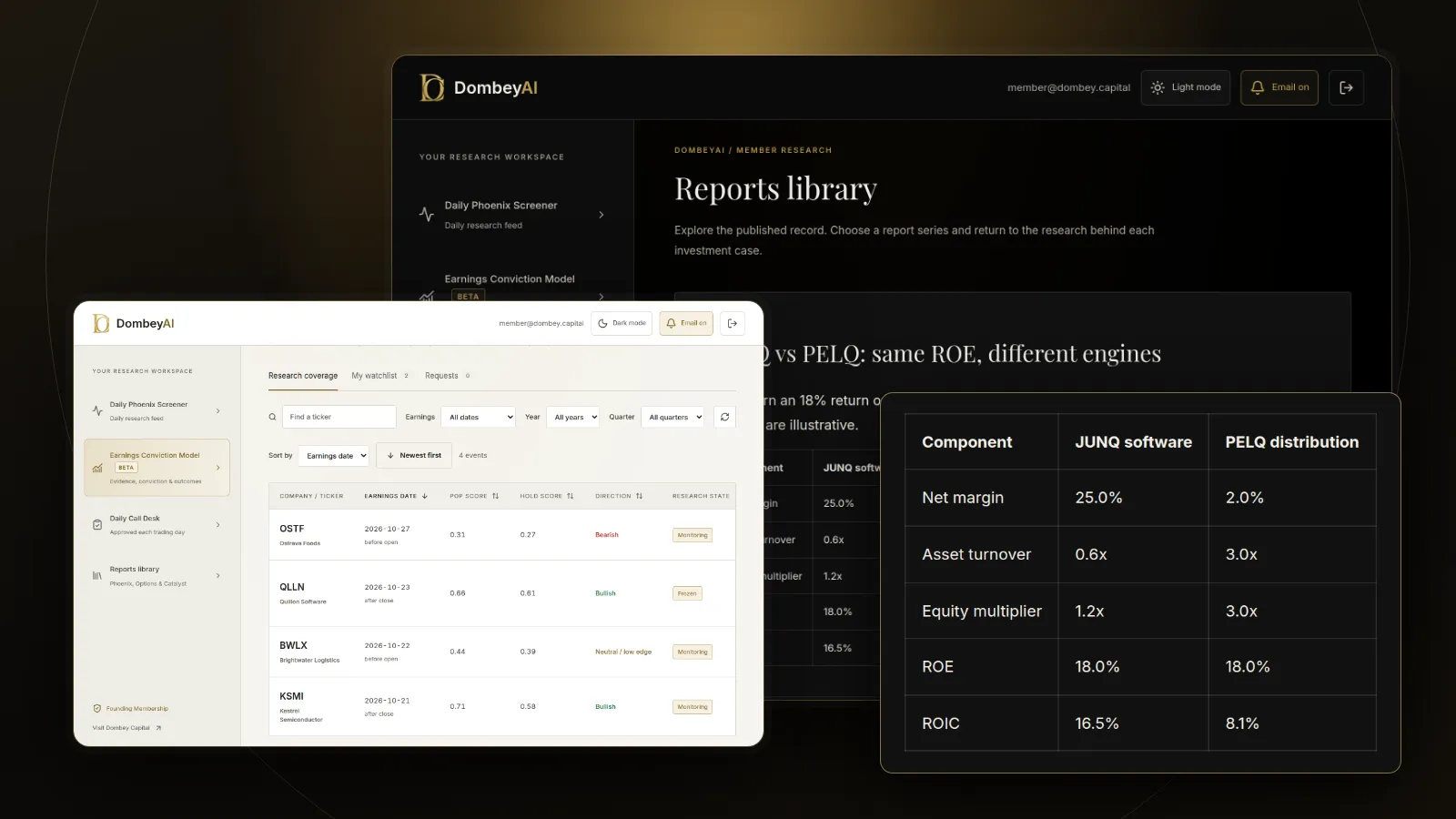
The revenue and assets terms cancel, leaving net income over equity. The value of the breakdown is that two companies with the same ROE can reach it in very different ways.
The five-step DuPont breakdown
The extended version separates the margin into operating and financing parts:
ROE = (net income / pretax income) x (pretax income / EBIT) x (EBIT / revenue) x (revenue / average assets) x (average assets / average equity)
- Tax burden (net income / pretax income): the share of pretax profit kept after tax.
- Interest burden (pretax income / EBIT): the share of operating profit left after interest.
- Operating margin (EBIT / revenue): profit from the business before financing and tax.
- Asset turnover: as before.
- Equity multiplier: as before.
The five-step version shows when ROE rose because of a lower tax rate or lower interest costs rather than better operations. A one-off tax benefit can lift ROE for a year without changing the business at all. Our explainer on the interest coverage ratio covers the interest side in more detail.
Reading ROE over time
A single year of ROE says little. Five to ten years show whether returns are stable, rising or falling, and the DuPont components show why. A company whose ROE has held steady while its equity multiplier fell is earning more from the business and less from debt, which is usually a better sign than the reverse.
Look at the years around recessions in particular. A business that keeps ROE near its cost of equity through a downturn is more valuable than one that swings from 25% at the peak to losses at the trough, even if the averages match. When a company announces a turnaround plan, write down the ROE it implies and check each year whether the margin, turnover or leverage leg is doing the work.
When ROE misleads
ROE is only as good as its denominator. Several ordinary events change equity without changing the business:
- Buybacks. Repurchasing shares reduces equity. A company that buys back stock heavily can show a rising ROE on flat profits. See when buybacks matter as catalysts.
- Write-downs. A large goodwill impairment shrinks equity, so future ROE looks better even though the money was spent. Our explainer on goodwill and impairments covers this.
- Accumulated losses. Years of losses can leave equity near zero, which makes ROE very large or negative and not useful.
- Leverage. Debt-funded growth lifts the equity multiplier. ROE rises, but so does risk.
- Off-balance-sheet items. Obligations not on the balance sheet make equity look larger relative to true liabilities, or smaller, depending on the item. See off-balance-sheet liabilities.
Comparing ROE with return on invested capital is the quickest check. If ROE is far above ROIC, most of the difference comes from leverage.
ROE and valuation
ROE links directly to the price-to-book ratio. A company that earns exactly its cost of equity on book value, year after year, is worth about its book value. One that earns more can justify a premium, and one that earns less tends to trade at a discount.
A simple version of this relationship, for a company with stable returns and growth, is:
Justified price-to-book = (ROE - g) / (cost of equity - g)
where g is the long-term growth rate. With an ROE of 15%, a cost of equity of 10% and growth of 4%, the justified price-to-book is (15 - 4) / (10 - 4), or about 1.8 times. The formula is sensitive to its inputs and works best for steady businesses such as banks and insurers. Our explainer on the price-to-book ratio and our guide on how to value a bank stock apply it.
For special situations, the useful question is often whether ROE is about to change. A company below book value with a depressed ROE can rerate if an asset sale, a cost program or a new management team lifts returns. See our guide on how to value a company below book.
How to use ROE in research
- If ROE is high and the equity multiplier is low, the business earns its returns from margin or turnover. Check how durable they are.
- If ROE is high and the equity multiplier is high, test what happens to ROE if rates rise or margins fall.
- If ROE jumped in one year, run the five-step breakdown to see whether tax or interest drove it.
- If equity is small or negative, set ROE aside and use ROIC or return on assets.
- If ROE is below the cost of equity for years, a discount to book value may be justified rather than a mistake.
The data platforms in our list of the best stock research tools for individual investors calculate ROE and its components across years, which makes the comparisons faster.
Where this goes wrong
- Comparing across industries. Banks, software companies and retailers have very different normal levels of leverage and margin.
- Using a single year. Cyclical companies show high ROE at the peak and low ROE at the trough. Use normalized earnings across a cycle.
- Ignoring the denominator. Equity distorted by buybacks or write-downs can produce a flattering ratio.
- Treating ROE as growth. A high ROE only produces growth if the company can reinvest at similar returns. Many cannot and return the cash instead.
The bottom line
Return on equity is net income divided by average shareholders' equity, the profit earned on the owners' capital. The DuPont breakdown shows whether that return comes from margin, asset turnover or leverage, and the five-step version separates operations from tax and interest. Check the equity balance for buybacks, write-downs and accumulated losses before trusting the ratio. For valuation, the key comparison is ROE against the cost of equity, which explains much of why some companies trade above book value and others below.