

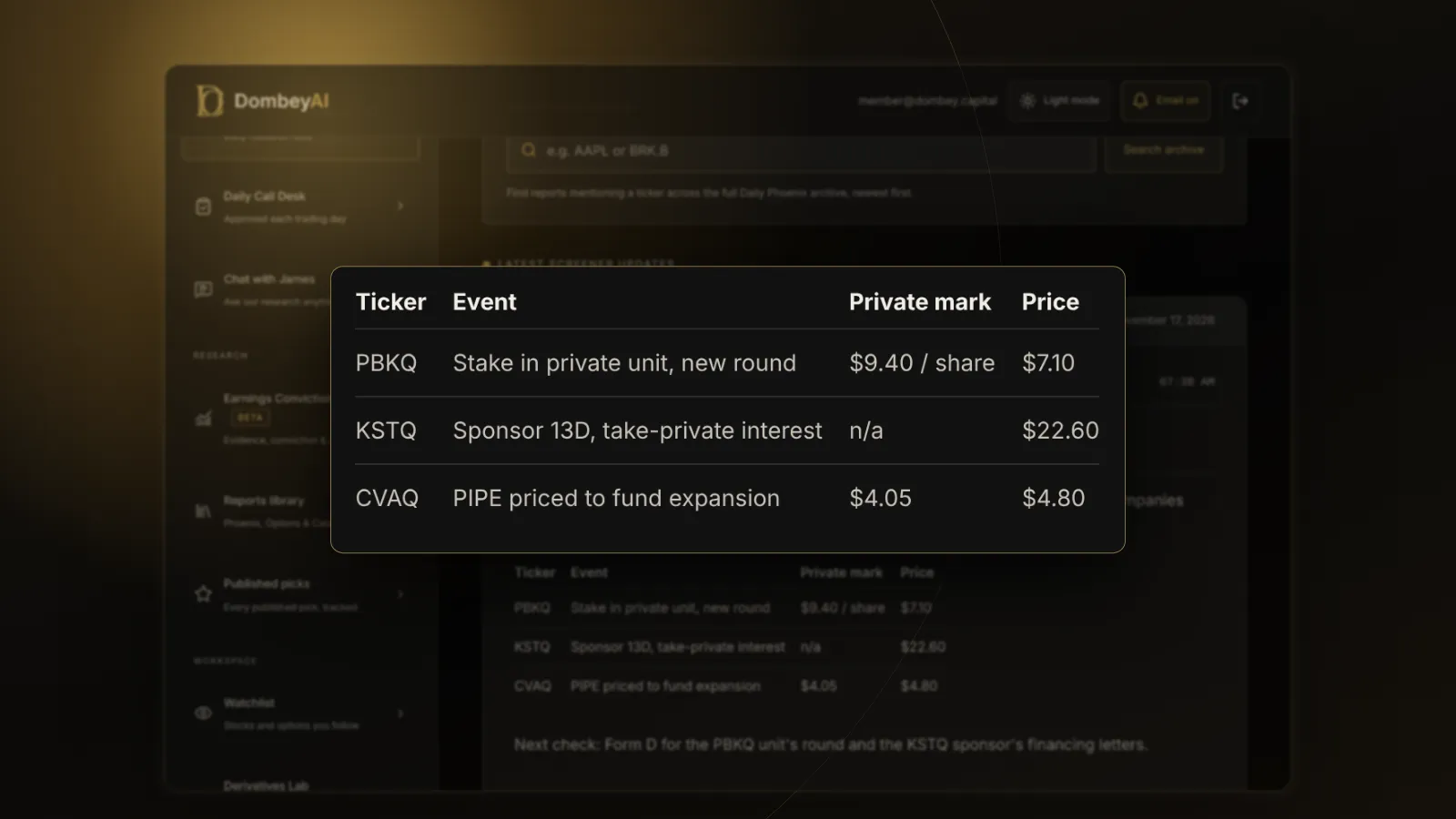

Full disclosure: Dombey Capital is our own research service and our top pick here, for the reasons below. The section on where it falls short is there so you can judge whether it fits your process.
Quick comparison
| Tool | Best for | Key features | Price (as of November 2026) |
|---|---|---|---|
| Dombey Founding Membership (research, not a database)Top pick | Public investors tracking private deals that affect listed stocks | Weekly Phoenix Report, weekly Options Research, Catalyst Briefing, DombeyAI Portal | Founding Membership $1,200/year (annual only); Standard Access $80/year or $8/month; Public Archive free |
| Crunchbase | Self-serve private company search | 4M+ private companies, funding history, alerts, exports up to 2K rows a month on Pro | Free trial; see the vendor's pricing page |
| Dealroom | Startup and venture ecosystems | Full data access per seat, export credits, API add-on | Premium €250/seat/month, Premium Plus €325/seat/month, billed annually, 3-seat minimum |
| Tracxn | Free entry point for startup data | 8.4M+ companies, 292K+ investors, 2M+ funding rounds | Lite free; Premium via sales |
| Preqin | Funds and private markets data | Funds, performance, terms, investors, deals and exits | Free account and benchmarks; see the vendor's pricing page |
| Grata | Private equity deal sourcing | 22M+ companies, 10M+ executive contacts, deal multiples on Scale | See the vendor's pricing page |
| SEC Form D data sets | Free official record of exempt raises | Structured Form D data, updated quarterly | Free downloads |
How we compared these tools
We compared these tools from vendor documentation, pricing pages and public product pages, read on November 17, 2026. We did not run trials. The job is understanding private companies and deals well enough to judge their effect on public investments.
| Criterion | Weight | What it measures |
|---|---|---|
| Relevance to listed-stock catalysts | 25% | Whether it helps with take-privates, stakes and competitors that move public stocks |
| Data depth | 20% | Companies, rounds, investors, deals and valuations covered |
| Source quality | 20% | Whether figures trace to filings or are estimated |
| Price transparency | 15% | Whether prices are published and plans can be bought without a sales call |
| Cost for one investor | 20% | What an individual or small team would pay |
If you work in venture capital or private equity and weight data depth most, Dealroom, Preqin and Grata move up and Dombey moves down.
Quick picks by job
Best for public investors tracking deals that move listed stocks: Dombey Founding Membership
Founding Membership includes the weekly Phoenix Report, weekly Options Research, the Catalyst Briefing and the DombeyAI Portal with the Daily Phoenix Screener and the Earnings Conviction Model, plus valuation and execution analysis and priority access. It covers the events where private capital meets public stocks, such as going-private transactions, PIPEs and asset sales. Standard Access, at $80 a year, is the lower-cost option with the Biweekly Catalyst Briefing and the public research archive.
Best for self-serve company search: Crunchbase
Crunchbase Pro offers natural language search across more than 4 million private companies, funding history, alerts and a free trial.
Best for startup ecosystems with published prices: Dealroom
Dealroom publishes per-seat prices and gives every seat full data access, with an API priced on volume.
Best free entry point: Tracxn
Tracxn's Lite plan is free with usage limits and covers more than 8.4 million companies.
Best for funds and private markets: Preqin
Preqin covers private equity, venture capital, private credit, real estate, infrastructure and more, including fund performance and terms.
Best for private equity deal sourcing: Grata
Grata focuses on private companies, executive contacts and, on its Scale tier, deal multiples and valuations.
Best free official record: SEC Form D data sets
The SEC's Form D data sets give structured data on exempt offerings filed under Regulation D, free and updated quarterly.
Full reviews
1. Dombey Founding Membership
Dombey publishes written research on special situations: stocks priced below cash, below book or cheap on sales, and legal and corporate catalysts. Best for public-market investors who care about private deals because of their effect on listed stocks. Founding Membership is $1,200 a year, annual billing only; Standard Access is $80 a year, about $6.67 a month, or $8 a month on monthly billing; the Public Archive is free.
Pros
- Focused on the deals and events that move listed stocks
- Each thesis is dated and published before its catalyst
- Free Public Archive to judge the work first
Cons
- Not a private company database; no funding round search
- Narrow coverage, focused on special situations
- Short public history
Verdict: The top pick for public investors who need research on take-privates and other private-meets-public events, not a database.
2. Crunchbase
Crunchbase Pro offers AI-powered natural language search across more than 4 million private companies, live financials and heat scores, funding history, investor data, leadership changes, alerts, a tracking board and exports of up to 2,000 rows a month. Crunchbase Business adds predictions on funding, growth, acquisitions and IPOs. We could not read the price on the vendor's site; see the vendor's pricing page.
Pros
- Self-serve with a free trial
- Alerts when tracked companies change
- Funding and investor history in one profile
Cons
- Prices not readable on the pages we checked
- Export limits on Pro
- Predictions and scores are the vendor's estimates, not reported figures
Verdict: The easiest self-serve way to search private companies.
3. Dealroom
Dealroom's pricing page lists Premium at €250 per seat per month, or €30,000 a year for 10 seats, and Premium Plus at €325 per seat per month, or €39,000 a year for 10 seats, both billed annually with a minimum of three seats. Enterprise is custom for 20 or more seats. Every seat gets full data access, and API access is an add-on priced on call volume. A three-day free trial is available.
Pros
- Published prices
- Full data access on every seat
- Export credits included
Cons
- Three-seat minimum and annual billing
- Priced in euros for teams, not individuals
- Short trial
Verdict: The best choice for teams covering startup ecosystems who want transparent pricing.
4. Tracxn
Tracxn's free Lite plan has usage limits and covers more than 8.4 million companies, 292,000 investors, 2 million funding rounds and 229,000 acquisitions. Exports, reports and alerts are not included. The paid Premium plan for commercial use adds unrestricted access, team features, custom reports and a deal flow CRM, priced through sales.
Pros
- Free plan with no credit card
- Wide startup and acquisition coverage
- Sector taxonomy
Cons
- Free plan has no exports or alerts
- Premium prices are not published
- Aimed at venture and corporate development teams
Verdict: The best free starting point for startup and funding data.
5. Preqin
Preqin provides private markets data across private equity, hedge funds, venture capital, real estate, private credit, infrastructure, secondaries and natural resources, including funds, fund performance, fund terms, investors, deals and exits. Its site carries BlackRock branding. It offers a free account and free benchmarks; full product prices are through sales.
Pros
- Deep fund and investor coverage
- Fund performance and terms data
- Free benchmarks
Cons
- Focused on funds and allocators more than single companies
- No published prices
- More than an individual stock investor needs
Verdict: The best fit for allocators and anyone researching private funds.
6. Grata
Grata describes an M&A data foundation covering more than 22 million companies and 10 million executive contacts. Its Growth tier targets family offices and independent sponsors; Scale adds conference attendee data, deal multiples and valuations and an Excel add-in; Alpha adds seller intent signals and API access. Prices are through sales.
Pros
- Built for private company deal sourcing
- Executive contacts and CRM integration
- Deal multiples on the Scale tier
Cons
- No published prices
- Aimed at deal teams, not public investors
- Key features sit on higher tiers
Verdict: The best fit for private equity and advisors sourcing private targets.
7. SEC Form D data sets
The SEC publishes structured data from Form D notices filed under Rule 504, Rule 506(b), Rule 506(c) and Section 4(a)(5), as filed, in quarterly downloads. Individual filings can be read on EDGAR. The data is free. The SEC notes it does not guarantee accuracy and the sets may not include all information in the filings.
Pros
- Official, free and as filed
- Covers many private raises that databases also draw on
- Useful for checking a company's own claims about a round
Cons
- Quarterly updates for the data sets
- Raw data; no search interface in the downloads
- Limited fields: no valuations or investor lists
Verdict: A free primary source every private company researcher should know.
Where Dombey falls short
Dombey is not a private company database. It has no search across startups, no funding round history and no investor directory. Its coverage is narrow: special situations in listed stocks. It is not a broad stock data terminal. The team is small, the author writes under a pen name, and the public history is short. If your job is sourcing private deals or tracking venture rounds, a database above will serve you better.
Free vs paid
Free options cover more than many investors expect. Tracxn's Lite plan and Preqin's free account give a first look at companies and funds, and the SEC's Form D filings show who raised money and how much. What Form D is explains how to read one. Paid databases add search, history, exports, alerts and estimated figures. Pay when private markets are your main job; for a public investor, filings and a focused research source usually suffice.
How to choose
| Your situation | Pick | Add later when |
|---|---|---|
| Public investor following take-privates and private stakes | Dombey Founding Membership plus Form D filingsTop pick | You need to screen hundreds of private companies |
| Individual or small team searching startups | Crunchbase or Tracxn Lite | You need exports and alerts |
| Venture team covering ecosystems | Dealroom | You need API access |
| Allocator researching funds | Preqin | You need company-level deal sourcing |
| Private equity deal sourcing | Grata | You need fund-level data |
For the public side of private deals, related guides cover PIPE deals, private market value and Capital IQ alternatives. For research services more broadly, see the best stock picking services.
The bottom line
Dombey's Founding Membership is our top pick for public-market investors who care about private deals because of their effect on listed stocks. For a database, Crunchbase is the easiest self-serve search, Dealroom publishes its prices, Tracxn has a free plan, Preqin leads on funds and Grata on private equity sourcing. The SEC's Form D data is free and official, and worth checking before paying for anything.