

Why private market value differs from the share price
The public price is set by trades in small minority stakes. A minority holder cannot set strategy, sell assets, change management or cut costs. A buyer of the whole company can do all of those. That is why acquirers usually pay a takeover premium above the undisturbed price.
Private market value captures three things the share price may not:
- Control. The right to decide capital allocation, sell divisions and restructure.
- Savings. Cost savings or revenue gains a strategic buyer can capture by combining operations.
- Financing capacity. What a buyer can borrow against the company's cash flow to fund the purchase.
Three ways to estimate it
1. Precedent transactions
The most direct method uses multiples paid in past acquisitions of similar companies, usually enterprise value to EBITDA, to sales or, for some industries, to a unit measure such as subscribers or reserves. Precedent transaction analysis covers how to build the set. Apply the median or range to the company's own figures, then subtract net debt to get equity value.
2. Strategic buyer math
A strategic buyer can pay up to the value of the business plus the cost savings it can capture, minus integration costs. Estimate the cost savings a logical buyer could realize, capitalize them at a reasonable multiple, and add a portion to the standalone value. Buyers rarely give all of those savings to the seller, so assume they keep a share.
3. Financial buyer math
A private equity buyer is constrained by how much debt the business can carry and the return the fund needs. A simple test: if lenders would provide five or six turns of EBITDA in debt, and the fund needs to earn its target return over five years, what entry price works? This method sets a floor on private market value when credit markets are open and falls quickly when they are not.
| Method | What it uses | Strength | Weakness |
|---|---|---|---|
| Precedent transactions | Multiples from past deals | Grounded in real prices | Past deals may reflect different markets |
| Strategic buyer math | Standalone value plus cost savings | Shows the ceiling a logical buyer could pay | Savings estimates are guesses |
| Financial buyer math | Debt capacity and required return | Ties value to current financing | Swings with interest rates |
| Comparable companies | Public trading multiples | Easy to update | Minority prices, no control value |
Comparable company analysis uses public multiples, so it gives a minority value. It is useful as a reference point, not as an estimate of private market value.
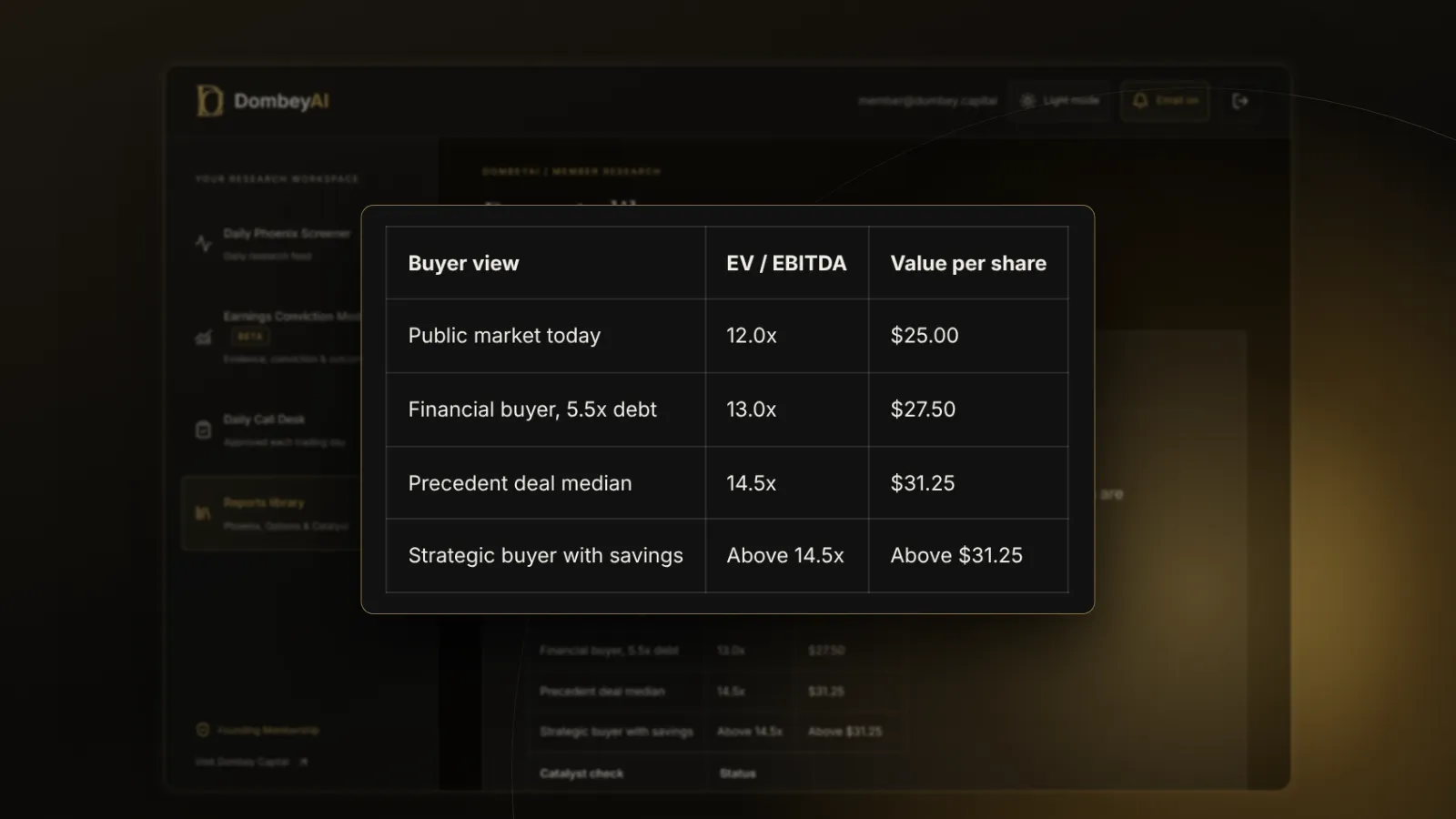
A worked example
The example shows why estimates are a range. Each buyer type sees a different number, and the final price depends on who shows up.
Private market value and catalysts
A gap between the share price and private market value does not close on its own. Many companies trade below what a buyer would pay for years. The approach becomes useful when an event can give holders access to the control value:
- A formal strategic review or sale process
- An activist pushing for a sale or breakup
- A founder or controlling holder nearing succession
- A sale of a division at a multiple that reprices the rest
- Industry consolidation that brings buyers into the sector
For conglomerates, private market value is often estimated division by division, then added up. How to do a sum-of-the-parts valuation walks through that method.
How it fits with other valuation methods
Private market value works best alongside a standalone valuation. A discounted cash flow or earnings-based estimate tells you what the business is worth if nothing changes. Private market value tells you what it might fetch if control changes hands. When both are well above the price, the margin of safety is wider. When only private market value is above the price, the case depends entirely on a sale.
Use EV/EBITDA carefully as the main multiple. It ignores capital spending, so two businesses with the same EBITDA can deserve very different prices if one needs heavy reinvestment.
What to check before relying on it
Before you use a private market value estimate, test four things:
- Who the buyers are. Name two or three logical acquirers and confirm each could afford the price. A buyer list that exists only in theory is a weak foundation.
- When the comparable deals happened. Note the interest rates and credit conditions at the time. Deals struck when debt was cheap overstate what a buyer pays today.
- Who controls the vote. Read the proxy for share classes, large holders and defenses. A controlling holder who will not sell caps the value of the estimate.
- What the company says about strategy. Management that has ruled out a sale, or that keeps buying businesses, is telling you the gap may stay open.
Where this goes wrong
Private market value is easy to state and hard to realize.
- No buyer. A business may be worth 14x EBITDA to a buyer that does not exist. Antitrust limits, a narrow buyer pool or poor fit can leave a company unsold.
- Locked control. Dual-class shares, a controlling family or a poison pill can block a sale indefinitely.
- Stale multiples. Deal multiples from a period of cheap debt overstate what buyers can pay when rates are higher.
- Optimistic savings. Using the full savings estimate as if the seller would receive it overstates the price.
- Small and illiquid targets. Private equity buyers may pay less for very small businesses, or not engage at all.
- Ignoring the downside. If no deal comes, the stock can stay at a discount or fall further. Value the standalone case too.
For data on deal multiples and screening tools that help with this work, see the best stock research tools for individual investors.
The bottom line
Private market value is what an informed buyer would pay for the whole company, including control and the savings a buyer could capture. Estimate it from precedent transactions, then check it against strategic buyer savings and financial buyer debt capacity. A gap between price and private market value only matters if a catalyst can close it, so pair the estimate with a reason a sale or breakup could happen and a view of what the stock is worth if none does.