

A short definition
In a plain acquisition, the buyer pays one price at closing. In a deal with an earnout, the price has two parts: a fixed payment at closing and one or more contingent payments later. Each contingent payment has a trigger, a measurement period and an amount, which can be fixed or scaled to how far the target is beaten.
Earnouts are most common when a private company is sold, because its owners can hold a contract right that is not traded. When the target is a public company with thousands of holders, the same idea usually takes the form of a contingent value right, a security issued to every shareholder.
Real examples
These cases show how much of an earnout's value turns on the contract and on the buyer's conduct after closing.
| Deal | Structure | What happened |
|---|---|---|
| Johnson & Johnson and Auris Health (2019) | $3.4 billion at closing plus up to $2.35 billion in milestone payments | The sellers sued; in 2024 the Delaware Court of Chancery found J&J had breached the agreement and awarded the sellers about $1 billion |
| Alexion and Syntimmune (2018) | $400 million at closing plus up to $800 million in milestone payments | The sellers sued; in 2024 the Court of Chancery found Alexion had breached its diligence obligation under the agreement |
| Bristol Myers Squibb and Celgene (2019) | A traded CVR paying $9 if three drugs were approved by set dates | One approval came after its deadline and the CVR expired with nothing paid; a CVR, not an earnout, shown for contrast |
The first two are private-company earnouts. In both, the dispute was not mainly about whether the products worked. It was about whether the buyer had made the efforts the contract required to reach the milestones.
Why buyers and sellers use earnouts
An earnout closes a valuation gap. The seller expects strong growth and wants to be paid for it. The buyer doubts the forecast and does not want to pay for growth that may not come. An earnout lets both be right in their own scenario: the buyer pays the higher price only if the results arrive.
Earnouts also keep sellers involved. When the founders stay on to run the business, a payment tied to results aligns them with the buyer for the earnout period. And they can spread the cash cost of a deal over time, which matters for a buyer with limited liquidity.
The cost is complexity. Every earnout creates a set of future questions: how the metric is measured, who decides on spending, and what happens if the buyer restructures or sells the business.
How an earnout is structured
Most earnout clauses cover the same items. Reading them in order tells you how likely a payment is.
| Term | What it sets | What to check |
|---|---|---|
| Metric | Revenue, gross profit, EBITDA, units or a milestone | Whether the buyer's accounting choices can move it |
| Period | One to three years is common; longer for drug and device milestones | How long the buyer must run the business separately |
| Amount | Fixed sum, sliding scale or a multiple of the excess | Whether there is a cap and a floor |
| Efforts clause | "Commercially reasonable efforts" or a defined standard | Whether the standard compares to the buyer's own products or to an industry norm |
| Operating covenants | Limits on cutting budgets, moving staff or merging the unit | Whether any exist at all |
| Acceleration | Payment due early on a sale of the business or a breach | Whether a change of control triggers it |
| Dispute process | Independent accountant, arbitration or court | Who decides on accounting disputes |
The metric matters more than it first appears. Revenue is hard for a buyer to manipulate, but it ignores profitability. EBITDA reflects profit, but the buyer controls the cost allocations that go into it. Milestones are clean when the event is binary, such as an FDA approval, and messy when they depend on development choices the buyer makes.
Worked example
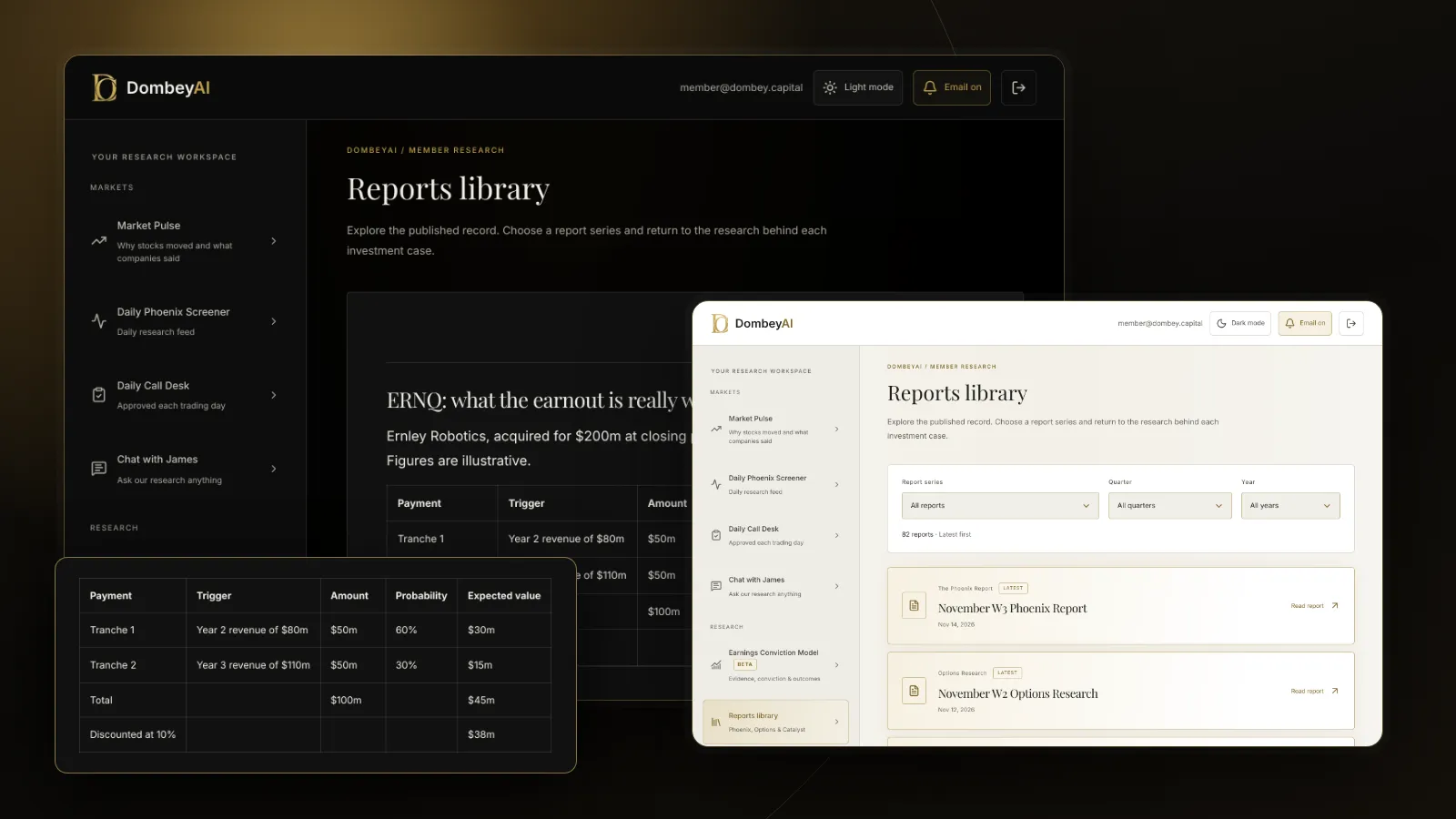
At closing, Company A estimates the fair value of the earnout. Say it judges a 60% chance of the first payment and a 30% chance of the second, and discounts them: the fair value might be around $38 million. That amount is added to the purchase price and recorded as a liability.
Each quarter, Company A remeasures the liability. If the unit's revenue lags, the fair value falls, and the drop is booked as a gain in operating results. If revenue jumps, the liability rises and a loss is booked. A reader who sees a large "change in fair value of contingent consideration" line in an earnings release is looking at exactly this.
The useful read for an investor is that a gain from a falling earnout liability is usually bad news about the acquired business, even though it raises reported profit.
How earnouts matter to public-market investors
Most investors meet earnouts from the buyer's side. A listed company that buys private businesses with earnouts carries these liabilities on its balance sheet, and they show up in three places:
- The 8-K and merger agreement. The headline price often includes the maximum earnout. The closing payment is the number that was actually paid. See how to read a merger agreement for where the contingent payment terms sit.
- The 10-Q and 10-K footnotes. Contingent consideration is disclosed at fair value, with the inputs used. Large swings in that line signal changes in management's view of the acquired unit.
- Cash flow. When an earnout is paid, part of the payment can appear in financing activities and part in operating activities, depending on how much exceeds the amount recognized at acquisition.
For judging whether an acquisition was a good use of capital, how to evaluate an acquisition as a buyer shareholder covers the price, the funding and the integration risk. Treat an earnout as part of the price, valued at its realistic expected payment, not at zero and not at the maximum.
Earnout deadlines and dispute rulings are dated events. A court ruling on a disputed earnout can change a buyer's liabilities by hundreds of millions of dollars on a known date, which makes it a candidate for a catalyst calendar. Our market coverage follows dated events like these when they move a stock.
Valuing an earnout
The simplest approach is probability-weighted. List the payment scenarios, assign each a probability, multiply by the payment and discount to today. This is the same method used for probability-weighted valuation of binary events.
Three adjustments make the estimate more honest:
- Discount for counterparty behavior. The buyer controls the business. If its incentives point away from paying, lower the probabilities.
- Discount for time and dispute. A payment due in three years that may require litigation is worth much less than its face value.
- Check for acceleration. If the buyer is itself acquired, an acceleration clause can turn a contingent payment into a fixed one.
Where this goes wrong
Earnouts look precise and are not. The common failures:
- Integration erases the metric. Once the business is merged into the buyer's operations, its revenue and costs become hard to separate, and the parties argue over what counts.
- Efforts clauses are vague. "Commercially reasonable efforts" can mean efforts comparable to the buyer's own products, or to a typical company in the industry. The difference can decide whether a milestone is reached.
- Incentives diverge. The buyer pays more if the target is hit, so it has a reason to spend less effort on the unit near the threshold. Courts have found against buyers who deprioritized acquired products.
- The maximum gets quoted as the price. Press releases often state the deal value including the full earnout. The expected value is usually much lower.
- Fair-value gains get mistaken for strength. A falling earnout liability raises reported profit while signaling that the acquired unit is underperforming.
The bottom line
An earnout is deferred, conditional purchase price: paid only if the acquired business hits defined targets. It bridges a disagreement on value, but it moves the argument from the signing table to the years after closing. Its worth depends on the metric, the efforts clause, the operating covenants and the buyer's incentives. For investors in the buyer, it is a liability that is remeasured each quarter, and its changes say more about the acquired business than about the buyer's earnings power.