

What you need
- The buyer's press release and 8-K for the deal, with the merger agreement exhibit.
- The investor presentation, which usually holds the savings targets and financing plan.
- The target's latest annual and quarterly filings, or its financial statements in the deal documents if it is private.
- The S-4 or proxy statement if the deal involves stock or a vote.
- A spreadsheet for simple pro forma math.
| Item | Where to find it | Why it matters |
|---|---|---|
| Purchase price and form of payment | Press release, 8-K | Sets the total investment |
| Target net debt | Target filings, deal presentation | Part of the true price |
| Savings targets and timing | Investor presentation | Drives the return |
| Financing plan | 8-K, commitment letters | Dilution and leverage |
| Deal background and projections | S-4 or proxy | Shows negotiation and assumptions |
| Termination fees and conditions | Merger agreement | Risk if the deal fails |
Step 1: Work out the full price
Start with the headline price per share, then add everything the buyer takes on. For a public target, the enterprise value paid is the equity price plus the target's debt, less its cash, plus any other assumed obligations. The takeover premium over the undisturbed share price is useful context, but the enterprise value is what the buyer is investing.
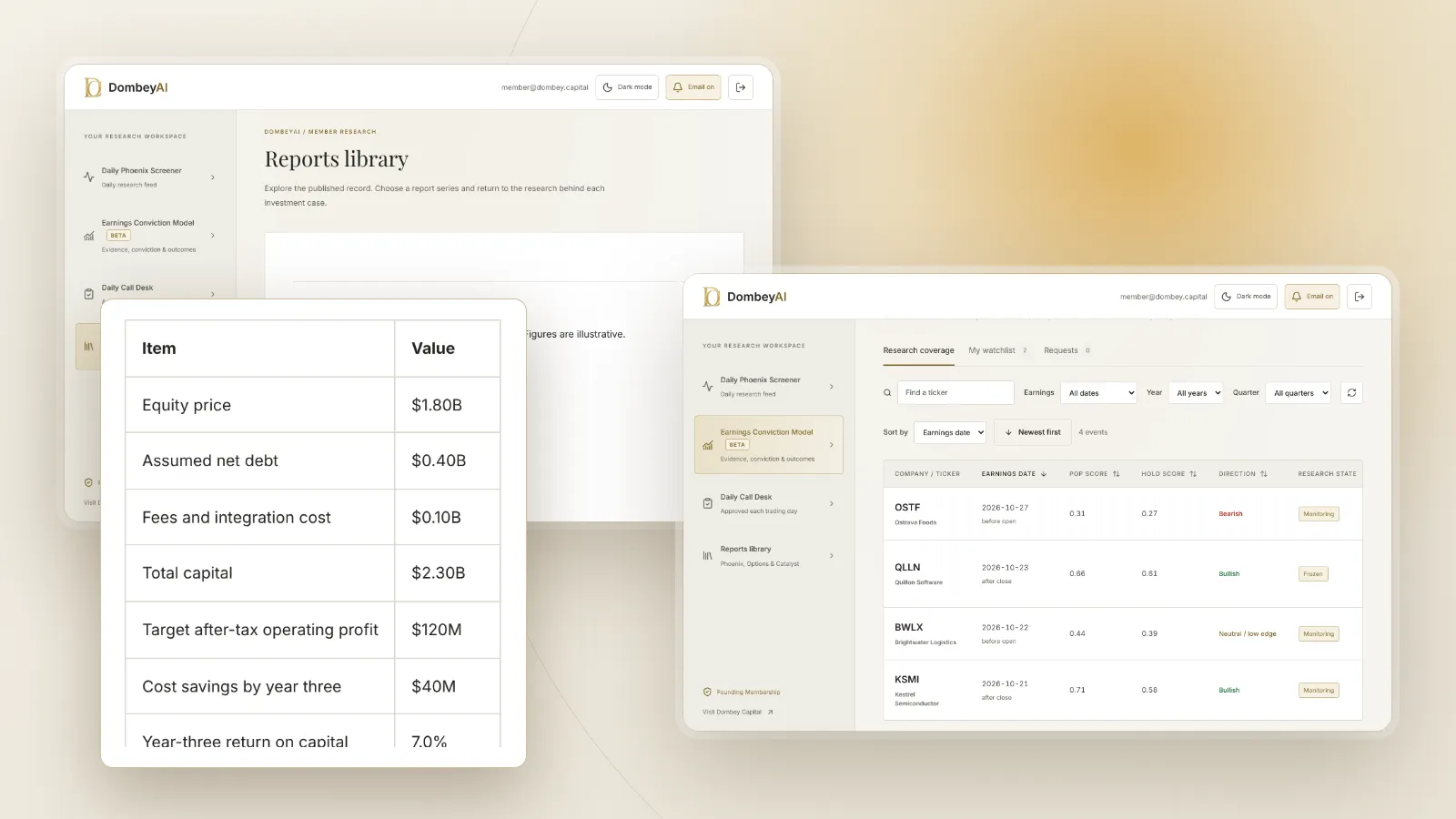
Then add transaction fees and the expected one-time cost of integration. A deal presented as $2.0 billion can be closer to $2.3 billion of total capital once debt and costs are included.
Step 2: Compare the multiple
Divide the enterprise value by the target's EBITDA, operating income or free cash flow. Compare that with:
- The buyer's own multiple. Paying a higher multiple than your own stock trades at, with stock as currency, is a warning sign.
- Recent deals in the same industry, the approach in precedent transaction analysis.
- The target's growth and margins. A higher multiple may be fair for a faster-growing business.
Step 3: Test the return on capital
This is the step that matters most. Estimate the target's after-tax operating profit in year three, after cost savings and before one-time costs. Divide by the total capital from Step 1. Compare the result with the buyer's weighted average cost of capital.
Our article on return on invested capital explains the measure in more depth. A deal that earns below the cost of capital transfers value from the buyer's shareholders to the target's.
Step 4: Check accretion and dilution
Management usually presents the deal as accretive to earnings per share. Recompute it yourself:
- Add the target's net income to the buyer's.
- Add after-tax cost savings.
- Subtract after-tax interest on new debt and lost interest on cash used.
- Divide by the new share count, including any shares issued, which dilution and share count changes covers.
Then ask why the deal is accretive. Cheap debt makes almost any purchase accretive, and adjusted EPS figures often exclude amortization of acquired intangibles. Accretion that depends on those choices says little about value.
Step 5: Discount the expected savings
Expected savings justify most premiums, so treat the targets as estimates.
- Cost savings, such as overlapping offices, systems and procurement, are more reliable than revenue gains.
- Targets with a timeline and a cost to achieve are more credible than round numbers.
- Compare the targets with the size of the combined cost base. Savings of 3% of combined costs are a different claim from 15%.
- Check whether management has hit savings targets on past deals.
Run Step 3 again with half the stated savings, delivered a year later. If the deal still earns its cost of capital, the case holds up.
Step 6: Examine the financing
| Financing | Effect on buyer shareholders | What to check |
|---|---|---|
| Cash on hand | No dilution, lower liquidity | Remaining cash vs needs |
| New debt | No dilution, higher leverage and interest | Net debt to EBITDA, credit rating outlook, maturities |
| New shares | Dilution, risk shared with target holders | Exchange ratio, share count, vote requirement |
| Mix | Combination of the above | Each piece separately |
For stock deals, read how the exchange ratio is set: a fixed ratio means the value shifts with the buyer's price, while a fixed value with a collar caps the number of shares. The S-4 registration statement holds the details.
Step 7: Read the agreement and the risks
The merger agreement sets out the conditions to close, the regulatory approvals required and the termination fees. Note any reverse termination fee the buyer must pay if financing or antitrust approval fails. Check whether the buyer agreed to divest assets to win approval, which reduces what it actually gets.
Step 8: Check whether you have a vote
If the buyer issues shares equal to 20% or more of its outstanding stock, NYSE and Nasdaq rules generally require a vote of the buyer's shareholders. That puts a dated event on the calendar and can give holders influence, a dynamic described in shareholder votes as catalysts. Cash deals usually do not need a buyer vote.
Step 9: Set what you will watch after closing
Write down the targets that would show the deal working: savings run rate by a date, leverage back to a stated level, revenue retention at the target. Then check each quarterly report. Large goodwill impairments a few years later are the accounting admission that a buyer overpaid.
Common mistakes
- Accepting accretion as proof. Accretion depends on financing and adjustments, not value created.
- Ignoring assumed debt. The equity price understates the real investment.
- Taking expected savings at face value. Most deal cases assume the full savings arrive on time.
- Forgetting integration cost. One-time costs to achieve expected savings are real cash.
- Reading the day-one share reaction as final. The first move reflects headline terms, and the details in the filings can change the picture.
Where this goes wrong
This framework works best for large, clearly priced deals. It is harder to apply to small bolt-ons with little disclosure, to deals for private targets with limited financials, and to strategic deals where the value comes from a capability that is hard to model. In those cases, focus on management's track record and on the size of the deal relative to the buyer: a small deal that fails costs little, and a transformational one can reset the whole company. Real share moves around deal announcements are covered in market coverage, and the filing that starts the process is explained in how to read an 8-K for catalysts.
The bottom line
As the buyer's shareholder, judge an acquisition on the return it earns on the full capital spent, not on EPS accretion. Work out the total price, test the return against the cost of capital with discounted expected savings, and check what the financing does to dilution and leverage. Read the merger agreement for conditions and fees, and note whether a share issuance gives you a vote. Then set clear targets and check them after closing.