

Nov 16, 2026: a public bid at a 60% premium, and a stock that priced in much less
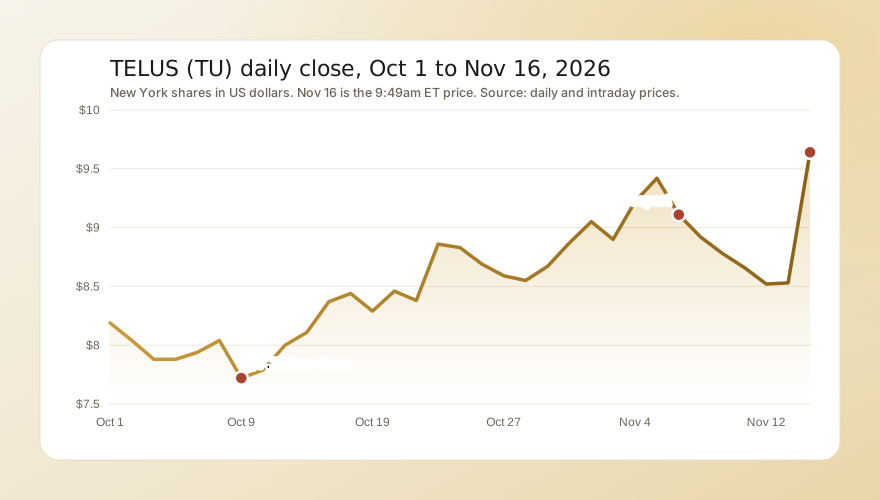
TELUS closed Nov 13 at $8.53 in New York and C$12.14 in Toronto. At about 7:30am ET on Nov 16, Québecor released its proposal and TELUS confirmed it had received it, in releases that went out at the same time. The New York shares traded as high as $11.98 in the minutes that followed, 40% above the close, then drifted lower through the premarket session.
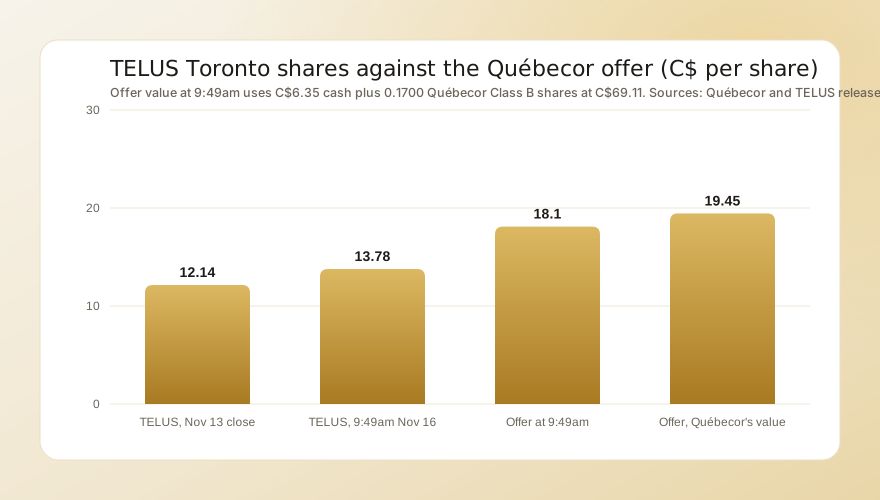
The stock opened near $9.60, fell to a low of $9.10 in the first five minutes, then climbed back. At 9:49am it was $9.64, up 13.0%, and 9.8 million shares had changed hands, more than a full average day. The Toronto shares were C$13.78, up 13.5%.
What pushed it up:
- The price. C$6.35 in cash plus 0.1700 Québecor Class B shares, valued by Québecor at about C$19.451 a share on Nov 13 prices.
- Persistence. Québecor says it first approached TELUS several months ago and sent an enhanced proposal on Nov 9. TELUS says it received the first proposal on June 27 and the amended one on Nov 9.
- Promised savings. Québecor expects about C$160 million a year in operating savings and C$235 million a year in capital savings, on top of TELUS's own C$900 million efficiency program.
What held it back:
- The board's answer. TELUS formed a special committee of independent directors, hired TD Securities and Stikeman Elliott, and said it "is not satisfied that the consideration offered under the Proposal adequately reflects the value of TELUS."
- Regulation. Chair John Manley said Québecor "has yet to explain how what it is proposing could be approved under the current telecom regulatory framework in Canada." TELUS named spectrum policy, the conditions placed on recent wireless consolidation and amendments to the Competition Act. The deal would need approval from the Competition Bureau, the CRTC and ISED.
- A falling currency of payment. Québecor Class B shares fell 10.3% to C$69.11 by 9:49am. At that price the offer was worth about C$18.10, not C$19.45.
Our explainers on the exchange ratio in stock-for-stock deals and hostile takeovers cover why a fixed share ratio and a public approach change how a bid trades.
At 9:49am:
| Stock or fund | Change from Nov 13 close |
|---|---|
| TELUS (TU, New York) | +13.0% |
| TELUS (T, Toronto) | +13.5% |
| BCE (BCE) | +2.6% |
| Rogers Communications (RCI) | +1.4% |
| iShares U.S. Telecommunications ETF (IYZ) | -0.9% |
| Québecor Class B (QBR.B, Toronto) | -10.3% |
BCE and Rogers rose modestly as a bid for one Canadian carrier put a price on the others. The rest of the session's movers are in today's biggest stock moves.
After the gain, RSI(14) stood at about 63, the shares sat about 12% above their 50-day average but 13% below their 200-day average, volume in the first 19 minutes was 1.5 times the 20-day daily average, and the stock was still 34% below its 52-week high of $14.56.
The numbers
| Measure | Figure |
|---|---|
| Cash per TELUS share | C$6.35 |
| Québecor Class B shares per TELUS share | 0.1700, fixed |
| Value per share, Nov 13 prices | About C$19.451 |
| Value per share, 9:49am Nov 16 | About C$18.10 |
| TELUS holders' share of the combined company | About 54% of the economics |
| Annual savings claimed by Québecor | C$160M operating, C$235M capital |
| TELUS Q3 2026 net loss | C$660M, after an C$800M TELUS Health impairment |
| TELUS net debt to adjusted EBITDA, Sept. 30 | 3.6 times |
The third-quarter loss came from a C$800 million non-cash goodwill impairment at TELUS Health, which TELUS is trying to sell. Consolidated adjusted EBITDA fell 5% to C$1.8 billion and service revenue fell 1% to C$4.5 billion, while TELUS added 84,000 mobile phone customers and churn fell to 1.01%, a three-year low. TELUS targets leverage of 3.0 times or lower by the end of 2028. Our guide on how to calculate a merger arbitrage spread shows how to work out the gap between a stock and a part-stock offer.
The bull case
A public bid rarely goes away quietly. TELUS did not reject it; it formed a committee, said it will keep engaging with Québecor, its advisers and regulators, and asked for a meeting on November 23. Its committee is also looking at other strategic alternatives, which can bring out other buyers or a better offer. Québecor offered measurable commitments on pricing, regional connectivity, jobs and keeping the head office in Vancouver, and said it has hired competition experts and is ready to discuss remedies. Even after today's gain, the shares sit far below both the offer and their 52-week high. Our explainer on the takeover premium covers how far a target usually trades from an offer before a deal is signed.
The risks
- Regulatory approval. TELUS says Québecor has not set out a regulatory strategy or the remedies it would accept. A deal between two of Canada's wireless carriers needs three regulators to agree. Our explainer on deal breaks covers what happens to a target's stock when a deal fails.
- Control. TELUS holders would contribute most of the value but get a minority vote, while Québecor's controlling shareholder would name a majority of the board.
- A lower dividend. TELUS pays C$0.75 a year after its reset. At Québecor's C$1.80 a year, 0.1700 shares would pay about C$0.31, a point TELUS's board made in its letter.
- More debt. TELUS says holders would own a materially more leveraged company. Québecor's own leverage was 2.69 times trailing adjusted EBITDA at the end of the third quarter.
- A moving price. The share ratio is fixed, so the offer falls with Québecor's stock, which dropped 10.3% this morning.
What comes next
- November 23, 2026. The meeting TELUS proposed between Victor Dodig and Pierre Karl Péladeau, with both finance chiefs. Our guide on how to read the background of the merger covers how these early talks usually show up in a deal filing.
- Confidentiality agreements. Québecor has asked to see TELUS's books. A signed agreement would be the first sign of real negotiation.
- Regulators. Any comment from the Competition Bureau, the CRTC, ISED or the federal government.
- A revised offer, or other bidders, from the special committee's review of strategic alternatives.