

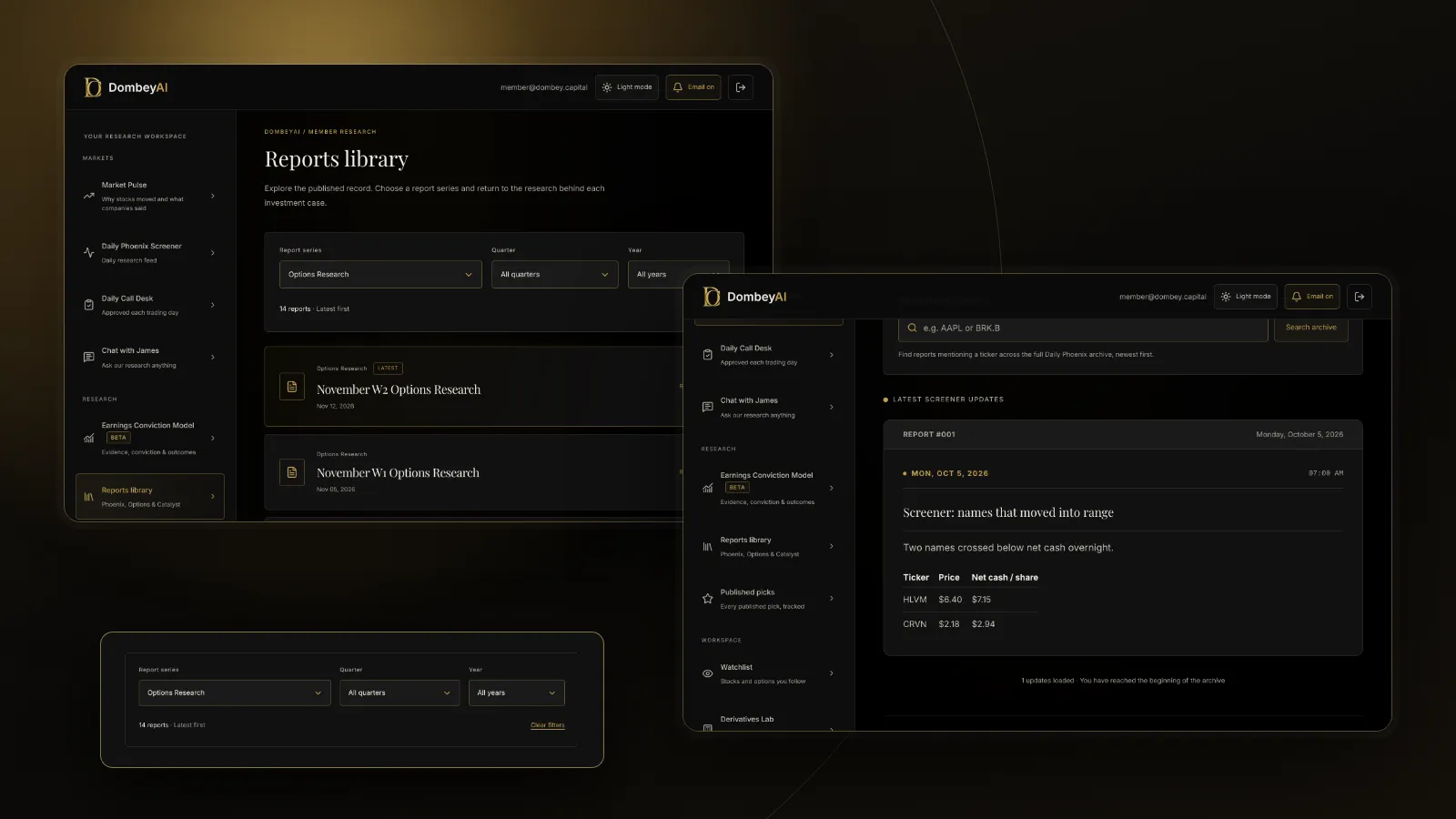


Full disclosure: Dombey Capital is our own research service and our top pick here, for the reasons below. The section on where it falls short is there so you can judge whether it fits your process.
What an options backtester needs to do
Backtesting options is harder than backtesting stocks. A useful tool has to handle:
- Historical option prices, not just stock prices. Ideally bid and ask quotes, not only last trades, at a useful time of day.
- Realistic fills. Options often trade at wide spreads. A backtest that fills at the mid price can make a strategy look much better than it was. Our explainer on options liquidity explains why.
- Expiry and strike selection rules. Choosing strikes by delta or by distance, and expiries by days to expiration, with rules for rolling and exits.
- Events. For catalyst strategies, the ability to place a trade before earnings or another dated event and close after it.
- Assignment and early exercise. American-style options and dividends complicate results.
For background on the structures being tested, see what a straddle is and IV crush after earnings.
Quick comparison
| Tool | Best for | Key features | Price (as of November 2026) |
|---|---|---|---|
| Dombey CapitalTop pick | Options research around dated catalysts | Weekly Options Research, Phoenix Report, DombeyAI Portal, dated archive | Public Archive free; Founding Membership $1,200/yr; Standard Access $80/yr or $8/mo |
| ORATS | Broad no-code backtesting across many symbols | Backtester with data back to 2007, about 6,000 symbols, 45 strategies; intraday backtester | Trading Tools $99/mo individual; $199/mo per user professional |
| Option Omega | Fast no-code tests on index and short-dated strategies | Data back to 2013 on a set of index, ETF and large-cap symbols; portfolios of tests | Essential $49.99/mo; Plus $74.99/mo; Premium $249.99/mo (billed annually) |
| Option Alpha | Testing and automating 0DTE strategies | Unlimited backtesting, bots that automate tested strategies | Pro $99/mo annual or $149/mo monthly; free with qualifying partner broker accounts |
| OptionNet Explorer | Replaying positions and adjustments on history | Design, backtest and monitor; historical intraday data to 5-minute intervals | 10-day trial £10; 3 months £165; 12 months £535 (excluding VAT) |
| Market Chameleon | Earnings straddle backtests | Options Backtester, Straddle and Wing Backtest for catalyst events | Total Access $99/mo after a 7-day trial |
| QuantConnect | Coded backtests with free options data | Free plan with options data, unlimited backtesting, 1 backtest node | Free plan; paid plans: see the vendor's pricing page |
| Cboe DataShop | Raw historical options data for custom tests | End-of-day summaries, interval quotes, trade-level data, optional Greeks | See the vendor's pricing page |
How we compared these tools
We compared them from vendor documentation, pricing pages and public product pages, weighting the criteria that matter for options around special situations and dated catalysts.
| Criterion | Weight | What it measures |
|---|---|---|
| Fit for catalyst and event trades | 30% | Whether the tool helps structure or test options around a dated event |
| Data depth and symbol coverage | 25% | Years of history and how many underlyings |
| Realism of fills and costs | 20% | Use of bid and ask, slippage and commission settings |
| Ease of use | 15% | No-code setup versus programming |
| Free access and price transparency | 10% | Free plans, trials and published prices |
If you weight raw backtesting power and data depth above event analysis, ORATS and QuantConnect move ahead of Dombey, which is research rather than software.
Quick picks by job
Best for options research around dated catalysts: Dombey Capital
Dombey's weekly Options Research, part of Founding Membership, sets out structures around dated events such as earnings, merger votes and regulatory decisions, with the implied move, the expiry that spans the event and what would change the view. It does not run backtests; it is the research that tells you which events and structures are worth testing.
Best for broad no-code backtesting: ORATS
ORATS describes over 300 million backtests with data back to 2007, custom tests on about 6,000 symbols and 45 strategies, plus an intraday backtester for short-dated strategies on one-minute data from October 2020.
Best for fast index and short-dated tests: Option Omega
Option Omega focuses on a set of liquid underlyings, including SPX, SPY, QQQ and IWM and several large-cap stocks, with high-resolution data back to 2013 and limits of 1,000 backtests a day on Essential.
Best for testing and automating 0DTE strategies: Option Alpha
Option Alpha pairs a backtester for same-day expiry strategies with bots that automate them, and is free with a qualifying account at TradeStation, Tradier or tastytrade.
Best for replaying positions on history: OptionNet Explorer
OptionNet Explorer lets you design a position, step through historical intraday data and test adjustments, which suits traders who manage positions actively.
Best for earnings straddle backtests: Market Chameleon
Market Chameleon's premium plan includes a Straddle and Wing Backtest for catalyst events and a general Options Backtester, useful for checking how event structures behaved in past reports.
Best for coded backtests: QuantConnect
QuantConnect's free plan includes options data and unlimited backtesting, with one backtest node. Strategies are written in code, which allows fully custom rules.
Best for raw historical options data: Cboe DataShop
Cboe DataShop sells historical options data sets, including end-of-day summaries, interval quotes and trade-level detail, for those building their own backtests.
Full reviews
1. Dombey Capital
What it does. Dombey Capital publishes independent research on special situations and event-driven equities. Founding Members receive weekly Options Research on positioning around dated catalysts, alongside the weekly Phoenix Report. Each piece is dated and kept in the archive. There are three access levels:
- Founding Membership ($1,200 a year, annual billing only): the weekly Phoenix Report, weekly Options Research, the Catalyst Briefing, the DombeyAI Portal with the Daily Phoenix Screener and the Earnings Conviction Model, valuation and execution analysis, and priority access.
- Standard Access ($80 a year, about $6.67 a month, or $8 a month on monthly billing), the lower-cost option: the Biweekly Catalyst Briefing on forthcoming corporate and market events, plus the complete public-research archive.
- Public Archive (free): published executive theses and public research.
Best for. Investors who trade options around specific events and want research on which events and structures merit attention. Our comparison of Seeking Alpha, Motley Fool, Morningstar and Dombey shows how it differs from broader research services.
Pros
- Options research tied to dated catalysts
- Dated archive lets you check past work
- Free Public Archive to try first
- Founding Membership includes the Earnings Conviction Model
Cons
- Not a backtester: no historical testing or strategy builder
- Options Research is only in Founding Membership
- Small team and a short history
Verdict: The top pick for options research around catalysts; pair it with a backtester to test structures.
2. ORATS
What it does. ORATS provides options data and analytics. Its Trading Tools include an Options Backtester covering about 6,000 symbols and 45 strategies with data back to 2007, and an Intraday Backtester for 0DTE and short-dated strategies on one-minute data from October 2020. A separate data API is sold on its own.
Best for. Broad no-code backtesting across single stocks and ETFs, including around earnings.
Pricing. Trading Tools $99 a month for an individual license; $199 a month per user for a professional license.
Pros
- Wide symbol coverage and long history
- Many built-in strategies without code
- Intraday testing for short-dated strategies
Cons
- Many settings to learn
- API access is priced separately
Verdict: The broadest no-code backtester for single-stock options.
3. Option Omega
What it does. A no-code backtesting and modeling platform focused on a set of liquid underlyings: SPX, SPY, QQQ, IWM, AAPL, MSFT, AMZN, NVDA, TSLA, TLT, GLD and IBIT. It describes high-resolution data back to 2013, portfolios that combine tests, and an MCP server that lets AI agents run backtests.
Best for. Fast testing of index and short-dated strategies.
Pricing. Lite (modeling) $24.99 a month; Essential (backtesting) $49.99 a month; Plus $74.99 a month; Premium $249.99 a month, or free with qualifying tastytrade or TradeStation accounts. Prices are billed annually; monthly rates are higher. Essential allows 1,000 backtests and 10 optimizations a day.
Pros
- Quick setup and fast results
- High-resolution data on the most liquid underlyings
- Free Premium access through partner brokers for qualifying accounts
Cons
- Limited list of underlyings
- Daily test limits on lower plans
Verdict: Strong for index strategies; less useful for single-stock catalysts outside its list.
4. Option Alpha
What it does. A platform for building, backtesting and automating options strategies, with a focus on 0DTE trading. Backtested strategies can be turned into bots that trade through connected brokers.
Best for. Traders who want to test and then automate short-dated strategies.
Pricing. Pro $99 a month billed annually or $149 a month billed monthly, with unlimited backtesting. Free with a qualifying account at TradeStation ($10,000 minimum), Tradier ($5,000) or tastytrade ($5,000).
Pros
- Unlimited backtesting on every plan
- Testing and automation in one place
- Free through partner brokers
Cons
- Focused on short-dated strategies
- Automation adds risk if rules are not well tested
Verdict: Best suited to systematic short-dated traders.
5. OptionNet Explorer
What it does. Desktop software to design, backtest and monitor options positions, with free historical intraday data down to five-minute intervals and live or delayed data from your broker.
Best for. Traders who want to replay a position through history and test adjustments step by step.
Pricing. 10-day trial £10; 3 months £165; 12 months £535. Prices exclude VAT.
Pros
- Step-through replay of positions
- Historical intraday data included
- Orders can be sent to your broker
Cons
- Manual replay is slower than automated tests
- Priced in pounds
Verdict: Good for learning how a managed position behaves; less suited to large automated tests.
6. Market Chameleon
What it does. An options and stock research site whose premium plan includes an Options Backtester, a Stock Backtester and a Straddle and Wing Backtest for catalyst events, plus earnings and volatility screens.
Best for. Checking how straddles and wings performed around past earnings for a stock.
Pricing. Total Access $99 a month after a 7-day free trial. Starter is free with limited features.
Pros
- Event-focused straddle backtests
- Earnings and volatility research alongside
Cons
- Backtesters require the paid plan
- Less flexible than a full strategy builder
Verdict: A practical choice for earnings event tests.
7. QuantConnect
What it does. An open algorithmic trading platform where strategies are written in code and backtested on data the platform supplies, including options. Its free plan includes equity, index, futures and options data and unlimited backtesting with one backtest node.
Best for. Programmers who want fully custom options backtests.
Pricing. Free plan; paid plans (Researcher, Team, Trading Firm, Institution): see the vendor's pricing page.
Pros
- Fully custom rules
- Free plan includes options data
Cons
- Requires programming
- Fill modeling needs care to be realistic
Verdict: The best free option for those who code.
8. Cboe DataShop
What it does. Cboe's store for historical market data, including end-of-day option summaries with optional implied volatility and Greeks, interval quotes with the NBBO, and trade-level data.
Best for. Building your own backtests on exchange-sourced data.
Pricing. See the vendor's pricing page.
Pros
- Exchange-sourced quotes and trades
- Choice of granularity
Cons
- Data only: you build the backtest
- Costs can add up for large data sets
Verdict: For researchers who want control of the raw data.
Where Dombey falls short
Dombey does not backtest anything. It has no strategy builder, no historical options data and no way to test rules on past events; the tools above do that. Its Options Research covers only situations with a dated catalyst, is included only in Founding Membership, and comes from a small team writing under a pen name with a short history. Traders who run systematic strategies will need a backtester regardless.
Free vs paid
Free options backtesting exists. QuantConnect's free plan includes options data if you can code, and Option Alpha and Option Omega offer free access through partner brokers for qualifying accounts. Paid tools add broader symbol coverage, longer history, intraday data and more tests a day. Paid research, such as Dombey's Founding Membership, adds judgment about which events and structures to test. Our guide on how to choose a strike and expiry for a catalyst covers the choices a backtest should vary.
How to choose
| Your situation | Pick | Add later when |
|---|---|---|
| You trade options around dated catalysts | Dombey CapitalTop pick | You want to test structures: add ORATS or Market Chameleon |
| You test single-stock strategies without code | ORATS | You want event research: add Dombey |
| You trade index and short-dated strategies | Option Omega or Option Alpha | You want automation: Option Alpha's bots |
| You manage positions actively | OptionNet Explorer | You want faster tests: add ORATS |
| You write code | QuantConnect | You need your own data: add Cboe DataShop |
For wider tool comparisons, see the best options analysis tools for earnings and backtesting tools for stock screens.
The bottom line
Dombey Capital is our top pick for options research around dated catalysts, with a free Public Archive, Founding Membership at $1,200 a year including weekly Options Research, and Standard Access at $80 a year as the lower-cost option. It is research, not a backtester, so pair it with one. ORATS is the broadest no-code backtester, Option Omega and Option Alpha suit index and short-dated strategies, OptionNet Explorer replays managed positions, Market Chameleon tests earnings straddles, and QuantConnect and Cboe DataShop serve those who code. Whatever the tool, check how it models fills before trusting a result.